My hand slipped…

…into my purse, and I got out the money to buy these little beauties.

Room – Emma Donoghue 
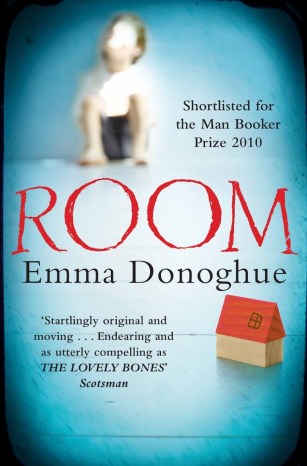
ROOM-IITo five-year-old Jack, Room is the entire world. It is where he was born and grew up; it’s where he lives with his Ma as they learn and read and eat and sleep and play. At night, his Ma shuts him safely in the wardrobe, where he is meant to be asleep when Old Nick visits.

Room is home to Jack, but to Ma, it is the prison where Old Nick has held her captive for seven years. Through determination, ingenuity, and fierce motherly love, Ma has created a life for Jack. But she knows it’s not enough…not for her or for him. She devises a bold escape plan, one that relies on her young son’s bravery and a lot of luck. What she does not realize is just how unprepared she is for the plan to actually work.

Told entirely in the language of the energetic, pragmatic five-year-old Jack, ROOM is a celebration of resilience and the limitless bond between parent and child, a brilliantly executed novel about what it means to journey from one world to another.


The Night Circus – Erin Morgenstern
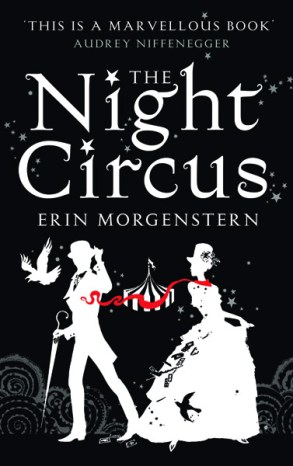
8bc91d5455e90ab1672faa19ecbe1c59The circus arrives without warning. No announcements precede it. It is simply there, when yesterday it was not. Within the black-and-white striped canvas tents is an utterly unique experience full of breathtaking amazements. It is called Le Cirque des Rêves, and it is only open at night.

But behind the scenes, a fierce competition is underway: a duel between two young magicians, Celia and Marco, who have been trained since childhood expressly for this purpose by their mercurial instructors. Unbeknownst to them both, this is a game in which only one can be left standing. Despite the high stakes, Celia and Marco soon tumble headfirst into love, setting off a domino effect of dangerous consequences, and leaving the lives of everyone, from the performers to the patrons, hanging in the balance.


We are all Completely Beside Ourselves – Karen Joy Fowler

cover

Meet the Cooke family: Mother and Dad, brother Lowell, sister Fern, and Rosemary, who begins her story in the middle. She has her reasons. “I was raised with a chimpanzee,” she explains. “I tell you Fern was a chimp and already you aren’t thinking of her as my sister. But until Fern’s expulsion … she was my twin, my funhouse mirror, my whirlwind other half and I loved her as a sister.” As a child, Rosemary never stopped talking. Then, something happened, and Rosemary wrapped herself in silence.

In We Are All Completely beside Ourselves, Karen Joy Fowler weaves her most accomplished work to date—a tale of loving but fallible people whose well-intentioned actions lead to heartbreaking consequences.


Elizabeth is Missing – Emma Healey

EIM-pb-jacket

Maud, an ageing grandmother, is slowly losing her memory—and her grip on everyday life. Yet she refuses to forget her best friend Elizabeth, whom she is convinced is missing and in terrible danger.

But no one will listen to Maud—not her frustrated daughter, Helen, not her caretakers, not the police, and especially not Elizabeth’s mercurial son, Peter. Armed with handwritten notes she leaves for herself and an overwhelming feeling that Elizabeth needs her help, Maud resolves to discover the truth and save her beloved friend.

This singular obsession forms a cornerstone of Maud’s rapidly dissolving present. But the clues she discovers seem only to lead her deeper into her past, to another unsolved disappearance: her sister, Sukey, who vanished shortly after World War II.

As vivid memories of a tragedy that occurred more fifty years ago come flooding back, Maud discovers new momentum in her search for her friend. Could the mystery of Sukey’s disappearance hold the key to finding Elizabeth?


How often do you treat yourself to a new book (or four)?

Governance: A handy handbook

Our first publication of 2015 is made all the more exciting by the fact that it has been desk edited by me! I am positively brimming with pride.

Introducing Commonwealth Governance Handbook 2014/15

GG cover 2011

Commonwealth Governance Handbook 2014/15 is the comprehensive guide to public sector reform and innovation in the Commonwealth.

The Commonwealth Secretariat, through its Governance and Natural Resources, Rule of Law and Political programmes, promotes effective, efficient and equitable public governance in member countries – a range of work that bridges the defining Commonwealth pillars of democracy, development and diversity.

Commonwealth Governance Handbook brings together Secretariat perspectives with those of partners in government; professions,
development agencies and the private sector. This edition covers:

  • Deepening democracy: electoral finance and e-voting technologies
  • Constitutional change, leadership and human resources
  • Open data, cyber security and governance of the internet
  • Human security: civic/ethnic considerations, cross-border issues and land tenure
  • Performance management in public services and contracting
  • Utilities, environmental risk and the ‘blue economy’
  • The Commonwealth Association for Public Administration and Management (CAPAM) Innovation Awards

The publication also contains 53 governance profiles of member countries as well as progress on the Millennium Development Goals and other indicators.

For more information or to purchase a copy of the publication please visit our website.

Private Pleasures – Hamdy el-Gazzar

“All I know is that when I whisper to dirt, my conversations are less than meaningful.” ― Maggie Stiefvater

4166013

I was drawn to Middle Eastern literature after reviewing A Thousand Splendid Suns by Khaled Hosseini. I enjoyed the book so much that I had to see what else there was on offer. Also, and this may seem a bit naïve on my part, I have really enjoyed other translated texts I have read, in particular French translations, and the work of Haruki Murakami – so I was interested to see how an Arabic translation would read.

I chose this book in particular because I was intrigued by the synopsis in the publisher’s catalogue:

Private Pleasures describes the three-day sex, drink, and drug binge of a thirty-something newsreader in the back streets and crumbling apartments of his native Giza, that pullulating mass of humanity that, like an ugly sister, sits opposite Cairo on the Nile’s west bank.

Sex, drink and drugs – it seemed like it could be interesting, so I requested a copy.

For me the book got off to a good start, you know I am a sucker for a rich description, and I was drawn into el-Gazzar’s initial portrayal of Giza square:

Behind us, Giza square is a raucous pullulating, raging inferno, filled to its farthest limits with lights, sounds, and shapes and crowded to overflowing with bodies, objects, and goods of every conceivable kind. The square is a giant, twisted oblong bathed in the evening lights shining from the buildings and tall towers scattered about the corners of its celebrated streets: Murad, University, el-Sanadeeli, Saad Zaghloul, Salah Salim.

This wasn’t the most beautiful description I’ve ever read, but it really appealed to me. This scene does not paint Giza Square in a particularly romantic of light, or spread the square out in front of the eyes of the reader to scrutinise in the smallest details, there is no description of the buildings themselves, or the eyes of the people encased within the square. Instead it is described in its entirety as a teeming cess pool of activity filled with bodies crawling over one another, likes rats in a ship’s hold.

Unfortunately, after my initial delight at the author’s descriptions, it all went downhill.

I first got the inclination I wasn’t going to like the book when al-Gazzar introduced Simone, the beautiful, fair-skinned street walker. Any liking I had had for the author’s description of Giza went out of the window with his crude analysis of Simone. Her breasts are, ‘round and large as pomegranates’, she is chewing a ‘large piece of bubble gum in her small mouth’ which she rolls around with her ‘red tongue, popping it like a child.’ – These description are nothing like as evoking as those previously used. They are almost childlike, and then, as if to prove my point, he rounds off his description by summing up her face as ‘innocent and attractive’ – one of the vaguest statements I have ever read.

The introduction of Simone seems like a good time to bring in the sexual aspect of the book, I say ‘aspect’ but really there is little in the book which is not sexualised to the highest degree possible. I don’t mind overly sexual books, but this one is nothing short of obscene and downright ludicrous. I was most perturbed by the protagonist’s sudden interruption of his friend in the midst of doing the dirty with the fair Simone:

Impetuous and crafty, I galloped towards them like a donkey in heat, grabbed her breasts hard with both hands, plastered myself against her from behind, and plunged it between her white buttocks.
I lifted her thighs from the floor and put her into a kneeling position so that she looked like a coddled white bitch quietly standing there, and then I spread her legs apart till her buttocks clenched and quivered.
With schooled professionalism, she raised her backside into the air and displayed her two red passages.’

I didn’t just dislike this description; it made me cringe to think that anyone would ever describe sex, however primitive, in this way.  The idea of someone raising their backside up with ‘schooled professionalism’ is completely perplexing, even more so is the fact that she displayed her ‘two red passages’ – I’ve never heard the female anatomy described in this way before, and I don’t think anyone should ever use it again.

Unfortunately, this was only the beginning of a too-long succession of sex scenes, perverted streams of consciousness, and other randomly sexualised scenarios. The most ridiculous of which is a lengthy tale about a young girl possessed by a demon who made her overly sexual in every way shape and form:

Her family lived in constant fear that her breasts would burst forth in the faces of the passersby, that she might on some occasion reach down to her drawers, rip them to pieces, and throw them in people’s faces.

Yes, her family lived in fear that ‘her breasts would burst forth in the faces of passersby’. I’ll leave that at that, I don’t feel as though I need to explain why I found this ridiculous and unnecessarily perverse. By all means be in fear of the fact that she may disgrace the family, but not that her breasts will ‘burst forth’, no one lives in fear of that.

I felt at one point close to the end, when the three day-drink and drug binge which gave birth to two hundred pages of perverted stream of consciousness and overly self-pitying reflection was over, that the protagonist may have been about to redeem himself. After his wife had spent three nights devotedly feeding him warm milk while he recovered from his self-inflicted wounds, I thought that perhaps he would see this as an opportunity to make things right with her, to start again, from fresh, but I was to be disappointed.  Instead, after eating the food his wife prepared for him he went out again to smoke and feel sorry for himself some more.

One the whole, I found the book to be, not only perverted and grotesque, but completely self-obsessed and self-pitying. The protagonist was one of the most unlikeable characters I have ever come across. I was so relieved to have finished the book, after committing far too much of my time to struggling through each and every page.

With this as my first experience of an Arabic translation I have to say that I do not think it works well in English at all. Perhaps it reads much better in its native language, but I found it to be difficult and ugly to read. There was no beauty used to the language; it was harsh, and awkward. The whole experience has put me off of the idea of reading Arabic literature, if not for good, then for a while at least. Perhaps I will try again with something a little less controversial, but for now I feel happy to be ending this chapter of my reading life.

I was sent a copy of Private Pleasures by the publisher in exchange for a review.

Spring has sprung – Byron’s pool

The last week or so has felt like a new beginning after a very long and dreary winter. The other morning I was overjoyed to wake up with the sun on my face and more or less leapt out of bed. A sunny day off is not to be wasted. So my beloved and I headed down to one of my favourite local walking spots – Byron’s pool.

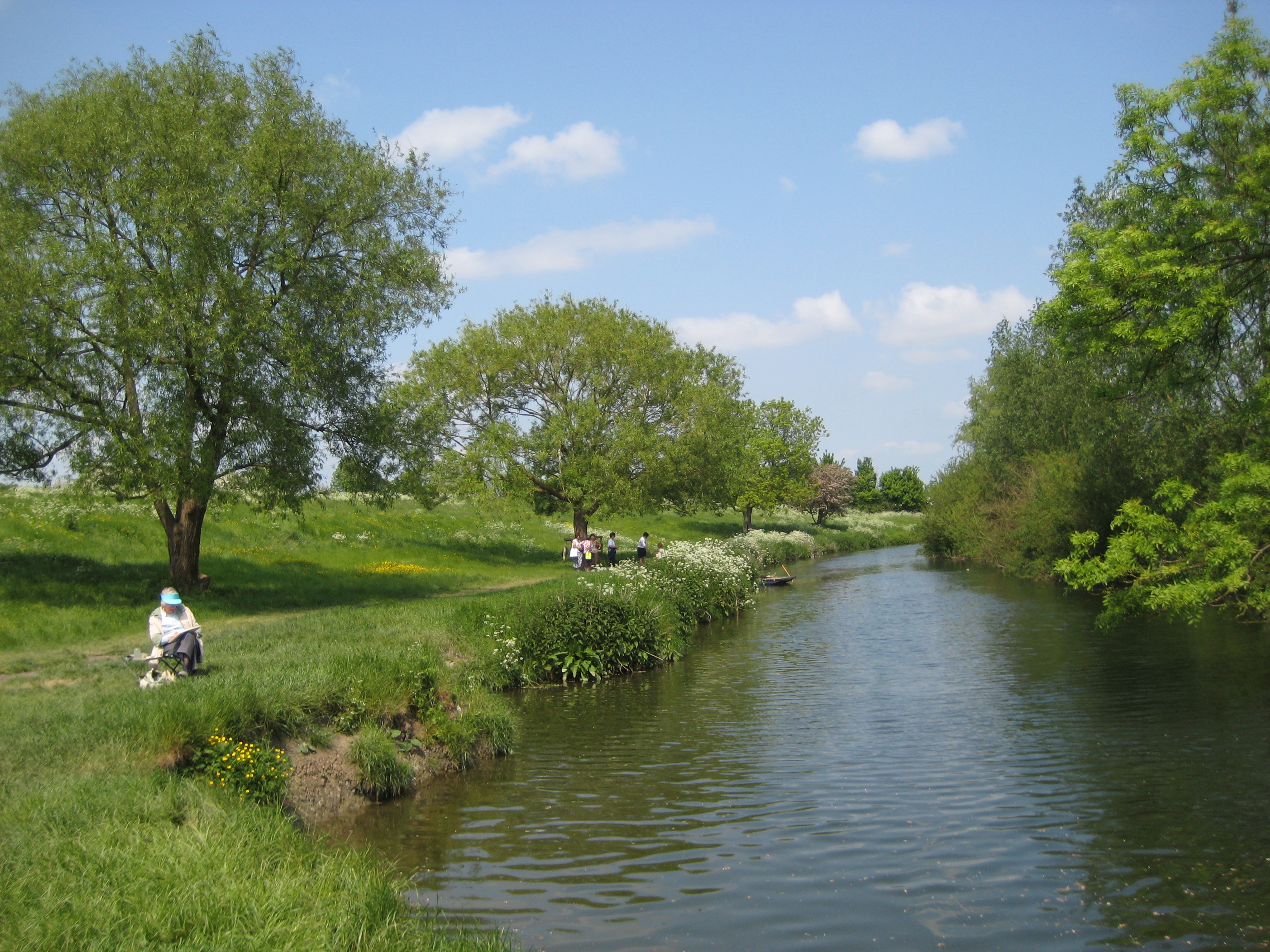
Byron’s Pool is a small nature reserve on the outskirts of Cambridge in the village of Grantchester, named after the poet Lord Byron, who it is said, would swim at the weir pool on warm summer’s days. It’s a picturesque location, and perfect for a leisurely walk along the River Cam.

If you have never been to Grantchester you could do worse than to plan a day trip, the village is a truly beautiful location.

Banks_of_the_Cam_at_Grantchester If you need more convincing, this should do the trick:

…………………. would I were
In Grantchester, in Grantchester! –
Some, it may be, can get in touch
With Nature there, Or Earth, or such.
And clever modern men have seen
A Faun a-peeping through the green,
And felt the Classics were not dead,
To glimpse a Naiad’s reedy head,
Or hear the Goat-foot piping low:…
But these are things I do not know.
I only know that you may lie
Day-long and watch the Cambridge sky,
And, flower-lulled in sleepy grass,
Hear the cool lapse of hours pass,
Until the centuries blend and blur
In Grantchester, in Grantchester ….

Rupert Brooke, The Old Vicarage, Grantchester, 1912

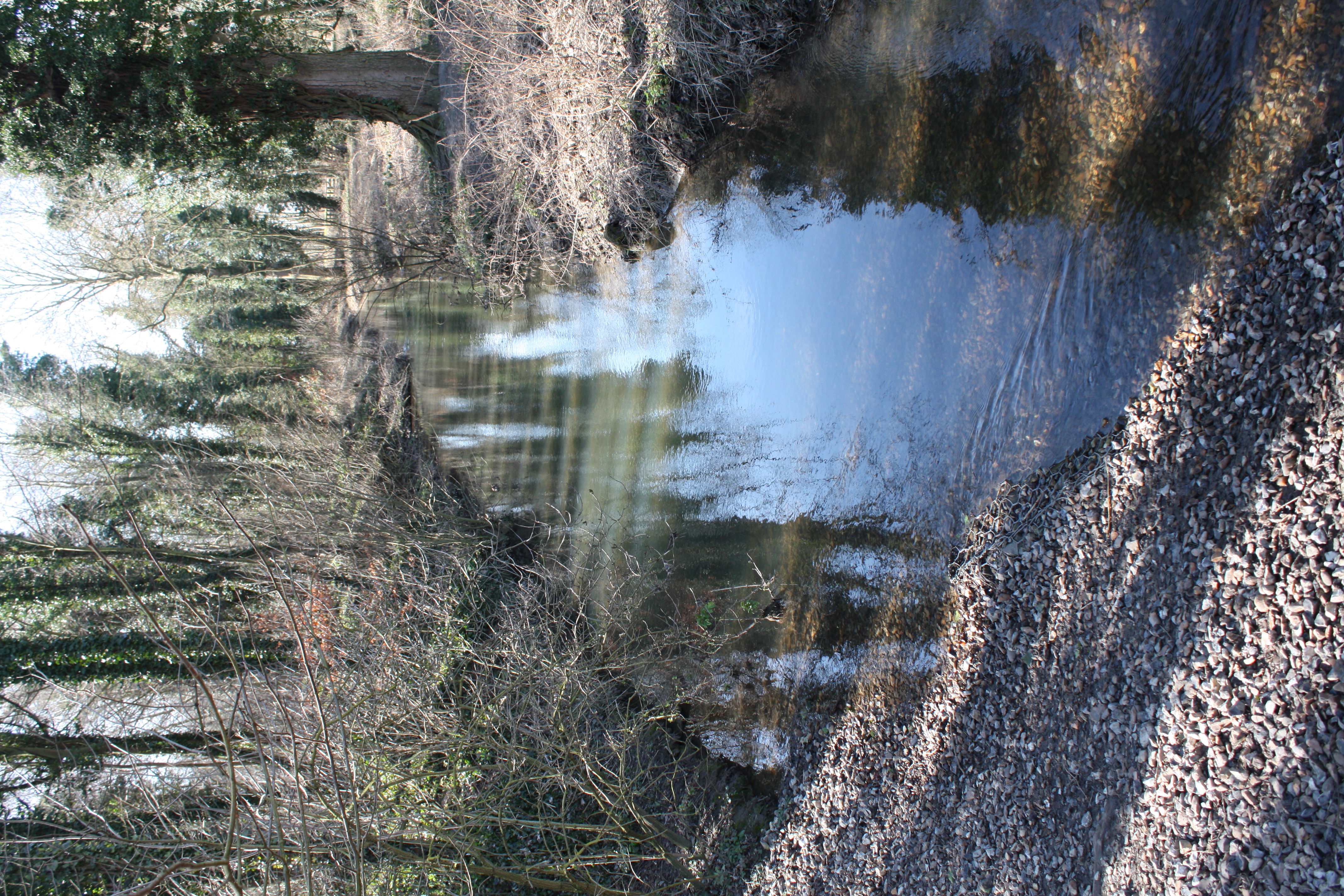
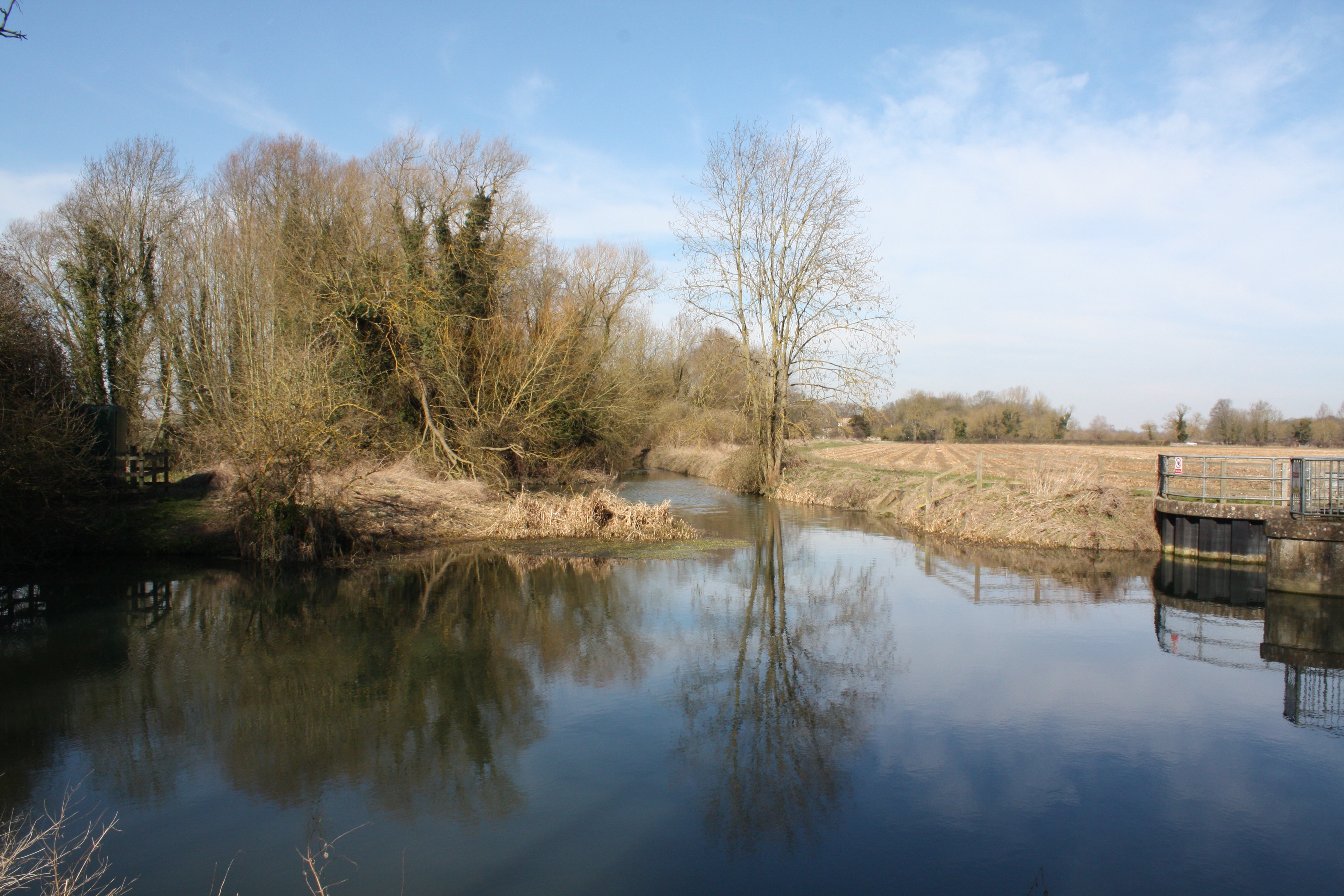
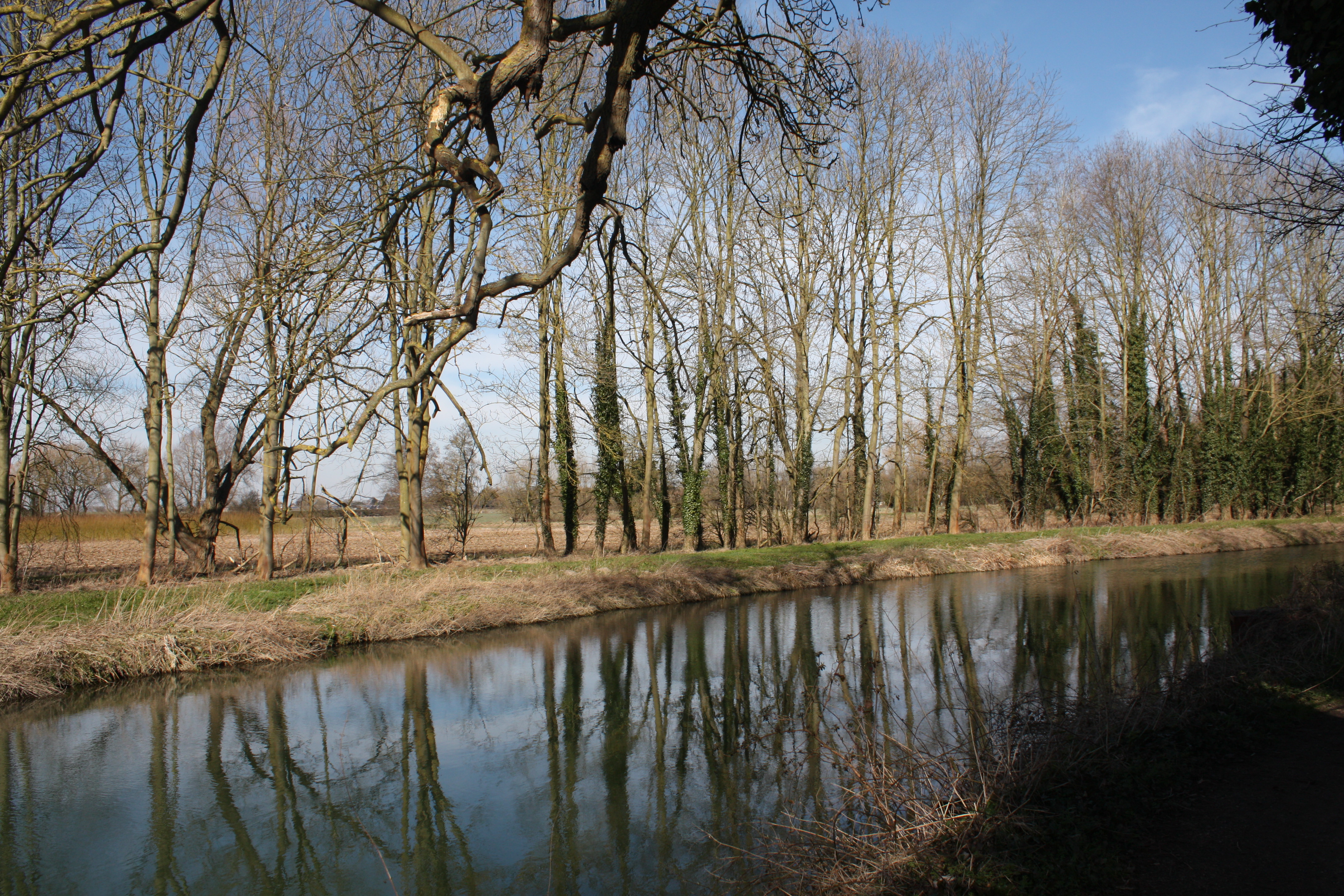
Byron’s pool itself is just outside of Grantchester. A public footpath through the reserve takes you in a loop alongside the River Cam, and around a small patch of quiet woodland. The river is calm and quiet, brimming with water lilies, with small shallow streams of crystal clear water and darting sticklebacks running through the woodland. The woods, though just beginning to bud in the early spring, comes to life in the summer with hundreds of sweet smelling wildflowers, daisies, willowherb, hogweed, ragwort, dovesfoot, meadowsweet, elder, ivy and cows parsley to name but a few.

IMG_0020

I think the main thing which draws me towards Byron’s Pool is the knowledge that Byron spent time there, and, if you listen to Brookes, perhaps still does:

Still in the dawnlit waters cool
His ghostly Lordship swims his pool,
And tries the strokes, essays the tricks,
Long learnt on Hellespont, or Styx.

I like to think that the playful spirit of Byron still roams the area.


George_Gordon_Byron,_6th_Baron_Byron_by_Richard_Westall_(2)Fun Byron fact – Lord Byron was a great lover of animals, and while he was a student at Trinity College installed a tame bear in his quarters. He was compelled to do so after becoming upset that the university forbade the keeping of dogs – they neglected to mention that bears were also forbidden. The college authorities had no had no legal basis to complain, although it is said that they tried to tell him that domesticated animals were not allowed, to which he replied: ‘I assure you that the bear is wild.’

I love the idea of wandering around with the spirits of poets past, and always feel compelled to slip beneath the water as to become even closer to the celestial body of Byron – Alas!IMG_0039

As always I had to settle for a quiet walk, pausing every now and then to try and capture the scene through the lens of my camera.

IMG_0036

IMG_0029

IMG_0035

IMG_0040

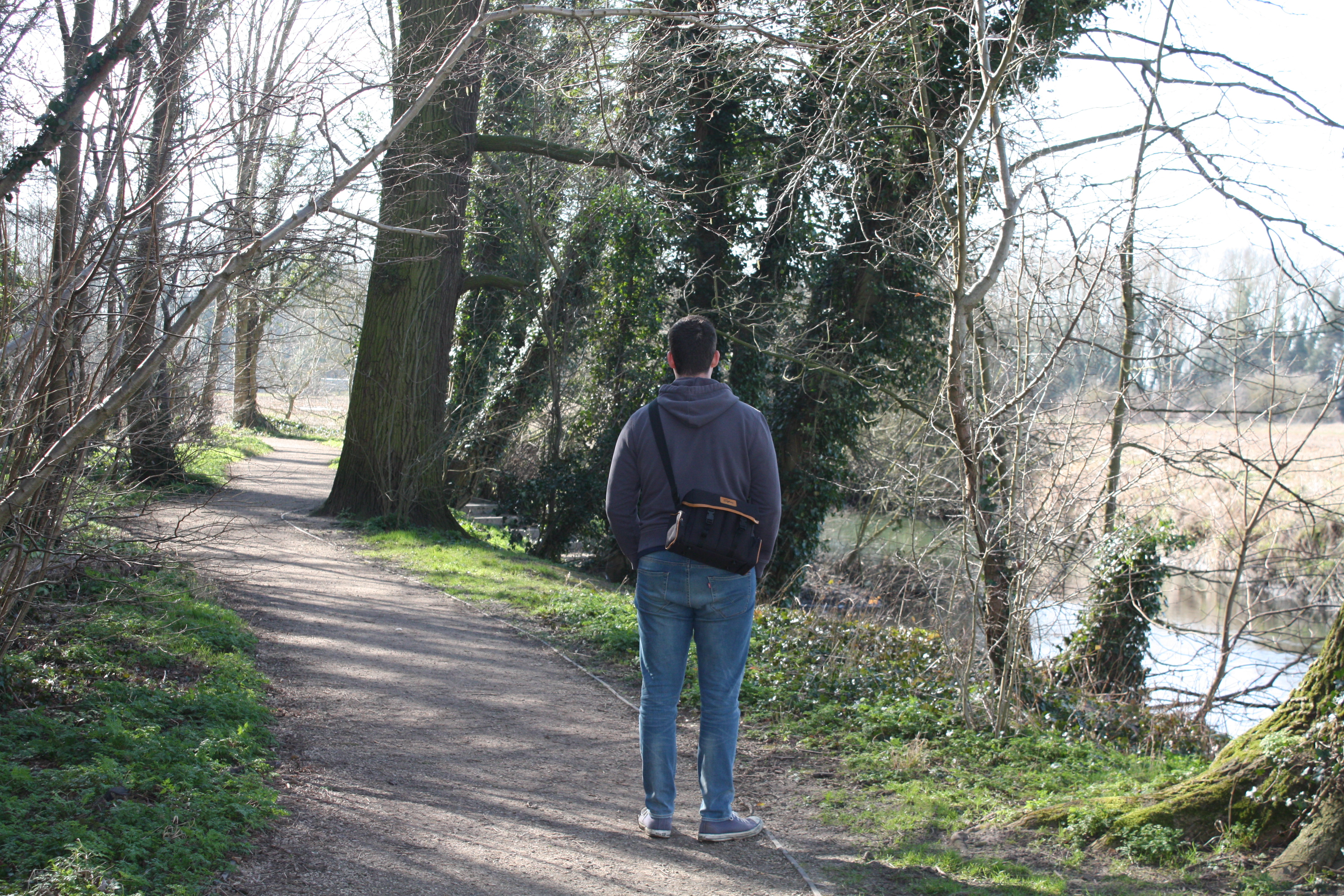
Walking with the boy on this warm spring day we spoke casually about the location and came upon a bit of difference of opinion. Sebastian thinks the location is ruined by its close proximity to the M11, and while I will concede that this doesn’t add to the experience it does not ruin it for me. I would be lying if I said I can’t hear the road, it is there, in the background, but the sounds of the river, the birds, and the breeze through the trees disguise this for me. Focus on the road and you will hear it, lose yourself in the location and it can pass you by.

IMG_0019

The Whitehall Mandarin – Edward Wilson

“A murderer is less loathsome to us than a spy. The murderer may have acted on a sudden mad impulse; he may be penitent and amend; but a spy is always a spy, night and day, in bed, at table, as he walks abroad; his vileness pervades every moment of his life” ― Honoré de Balzac

the-whitehall-mandarinCritically acclaimed author Edward Wilson returns with another seething spy thriller to add to his repertoire. A teeming broth of secrets, sex and scandals, the Whitehall mandarin is sure to be a hit with mystery fanatics and long standing Wilson fans.

Wilson specialises in spy fiction, with a strong focus on the Cold War, and there is no doubt he is a master of his subject. His novels blend seamlessly between fact and fiction, and The Whitehall Mandarin is no exception. The books alludes to a phenomenal amount of research on the part of the author where the smallest plot detail has been unquestioningly scrutinised and researched.  Through Wilson’s novels the reader travels back in time to rub shoulders with the upper classes, and witness firsthand the scandal which occurs behind closed doors.

Edward Wilson hones in on the year 1957, the Cold War is full swing, and British intelligence unit MI6 are investigating a soviet spy ring operating in London. They call upon secret agent William Catesby to keep a close eye on American cultural attaché Jeffers Cauldwell, who is accused of leaking somewhat compromising photograph of British officials to the Russians. The book begins with Catesby, his boss Henry Bone, and MI5 investigator Jim Skardon crammed onto the roof of a building overlooking St James’s Park, London, observing a secret liaison between Cauldwell and an employee of the British Admiralty. The Whitehall Mandarin follows Catesby on his hunt to uncover the truth in an intricately developed web of secrets, a journey which takes him from the scandals of 1960s London to the muggy jungles of Vietnam.


How strange, thought Catesby, that when you look through a telescopic sight and see another human being fixed in the cross-hairs you end up looking at yourself. It doesn’t matter whether it’s the lens reflection or imagination. You try to concentrate on your target but find your eye superimposed over their eyes. Those other eyes, so blissfully unaware of your unblinking predatory stare, are no longer evil. You feel your hate drop away and realise you can’t do it. It was Catesby’s most shameful secret from the war: he had never been able to pull the trigger. But he had learnt to since.


The Whitehall Mandarin is an intricate and multilayered book with a number of interweaving narratives; the plot is complex, and full of twists and turns. This is not the sort of book you can pick up and put down halfway through a chapter – not if you want to stand any chance of keeping up with the plot anyway – but requires considerable concentration on the part of the reader. Let your mind wander for even a second and you could well find yourself having to reread whole chapters.

Wilson portrays the British upper class as a literal hotbed of corruption and sexual scandal. Before reading the novel I will admit to being clueless as to the different between furries and plushies – in fact in all my innocence I’d never heard of either of these things – I’m now something of an expert on the topic. Did you know, for example, that ‘plushies’ are a rather difficult target for ‘honey-trap agents’? In fact, the scandalous things which the upper classes get up to provide the backdrop for the majority of the plot – this is somewhat epitomised by the photograph of a steamy reconstruction of Poussin’s The Triumph of Pan.

The very nature of spy novels makes them incredibly easy to ruin, so I am wary of sharing much more. But to give you a flavour – expect sex, high speed chases, intricate plot lines, and a beautiful English lady who is not quite what she seems.

The Whitehall Mandarin is a page-turning thriller which will leave you desiring more at the end of each chapter. If you are a fan of spy novels then this is undoubtedly the book for you. It is masterfully researched, stunningly written and, most importantly, utterly believable.

I was sent a free copy of The Whitehall Mandarin by the publisher in exchange for an honest review.

Charlotte’s Web named best children’s book of all time!

“A children’s story that can only be enjoyed by children is not a good children’s story in the slightest.” ― C. S. Lewis

I was over the moon today to learn that Charlotte’s Web by E. B. White had been voted the best children’s book of all time.

The 1952 tale, about a lovable pig named Wilbur who is saved from the slaughter thanks to his unlikely friendship with a resourceful spider named Charlotte, was named number one in a list of 151 books chosen by critics in a poll by BBC Culture.

917FQerThOL

The initial selection was whittled down to a list of the 21 top books in children’s literature, a diverse selection of books which provides a charming glimpse into children’s literature of the past two centuries.

1. Charlotte’s Web – E. B. White
2. The Lion, the Witch and the Wardrobe – C. S. Lewis
3. Where the Wild Things Are – Maurice Sendak
4. Alice’s Adventures in Wonderland – Lewis Carroll
5. Little Women – Louisa May Alcott
6. The Little Prince – Antoine de Saint-Exupery
7. Winnie-the-Pooh – A. A. Milne
8. Charlie and the Chocolate Factory – Roald Dahl
9. A Wizard of Earthsea – Ursula Le Guin
10. A Wrinkle in Time – Madeline L’Engle
11. The Little House on the Prairie – Laura Ingalls Wilder
12. The Wind in the Willows – Kenneth Grahame
13. From The Mixed Up Files of Mrs Basil E Frankweiler – E. L. Koenigsburg
14. The Phantom Tollbooth – Norton Juster
15. His Dark Materials trilogy – Philip Pullman
16. Matilda – Roald Dahl
17. Harriet the Spy – Louise Fitzhugh
18. Pippi Longstocking – Astrid Lindgren
19. The Secret Garden – Frances Hodgson Burnett
20. Goodnight Moon – Margaret Wise Brown and Pat Hancock
21. The Hobbit – J. R. R. Tolkien

There are many books on the list I would have happily seen voted number one, but I think the most deserving book won. The Lion the Witch and the Wardrobe, and Alice’s Adventures in Wonderland, and Little Women are all firm favourites of mine, but they are books I came to love later on in life, whereas Charlotte’s Web was one of the first books I read on my own.

maxresdefault

I loved Charlotte’s Web as a child, and I find it just as enjoyable now as I did twenty years ago. So I am over the moon at it’s number one spot. Books which tell a story from the point of view of animals have always been popular among children, and E. B. White took this classic theme and created something truly wonderful.

I’d love to know what your thoughts are on this. Did your favourite children’s book make in onto the list? Do you think something else is more deserving of the number one spot? Let me know! 

Payday splurge! Bookish treats to get me though April

“Anyone who lives within their means suffers from a lack of imagination.” ― Oscar Wilde

It’s the end of the month, which means it’s finally time to treat myself after a few penniless weeks. Check out my haul!

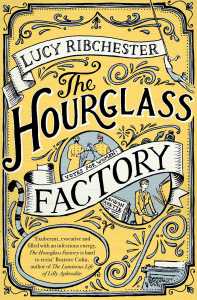
The Hourglass Factory – Lucy Ribchester

the-hourglass-factory-9781471139307_hr1912 and London is in turmoil…

The suffragette movement is reaching fever pitch but for broke Fleet Street tomboy Frankie George, just getting by in the cut-throat world of newspapers is hard enough. Sent to interview trapeze artist Ebony Diamond, Frankie finds herself fascinated by the tightly laced acrobat and follows her across London to a Mayfair corset shop that hides more than one dark secret.

Then Ebony Diamond mysteriously disappears in the middle of a performance, and Frankie is drawn into a world of tricks, society columnists, corset fetishists, suffragettes and circus freaks. How did Ebony vanish, who was she afraid of, and what goes on behind the doors of the mysterious Hourglass Factory?

From the newsrooms of Fleet Street to the drawing rooms of high society, the missing Ebony Diamond leads Frankie to the trail of a murderous villain with a plot more deadly than anyone could have imagined…

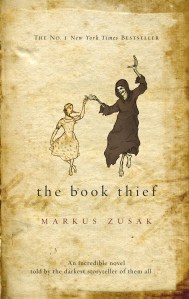
The Book Thief – Marcus Zusak

The-Book-Thief-cover1939. Nazi Germany. The country is holding its breath. Death has never been busier.

Liesel, a nine-year-old girl, is living with a foster family on Himmel Street. Her parents have been taken away to a concentration camp. Liesel steals books. This is her story and the story of the inhabitants of her street when the bombs begin to fall.

It’s a small story, about:
a girl
an accordionist
some fanatical Germans
a Jewish fist fighter
and quite a lot of thievery.

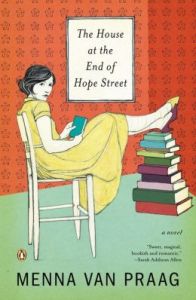
The House at the End of Hope Street – Menna Van Praag

9780143124948_p0_v1_s260x420When Alba Ashby, the youngest Ph.D. student at Cambridge University, suffers the Worst Event of Her Life, she finds herself at the door of 11 Hope Street. There, a beautiful older woman named Peggy invites Alba to stay on the house’s unusual conditions: she’ll have ninety-nine nights, and no more, to turn her life around.

Once inside, Alba discovers that 11 Hope Street is no ordinary house. Past residents include Virginia Woolf, Dorothy Parker, and Agatha Christie, who all stayed there at hopeless times in their lives and who still hang around – quite literally – in talking portraits on the walls. With their help Alba begins to piece her life back together and embarks on a journey that may save her life.

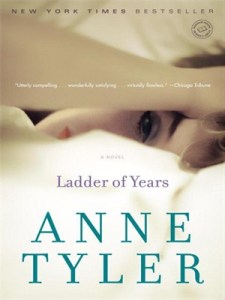
Ladder of Years – Anne Tyler

{D611CA94-A3E1-4F0E-AA1C-260F3312C980}Img400Forty-year-old Delia Grinstead is last seen strolling down the Delaware shore, wearing nothing more than a bathing suit and carrying a beach tote with five hundred dollars tucked inside.

To her husband and three almost-grown children, she has vanished without trace or reason. But for Delia, who feels like a tiny gnat buzzing around her family’s edges, “walking away from it all” is not a premeditated act, but an impulse that will lead her into a new, exciting, and unimagined life…

Did you treat yourself to any literary goodies this payday?

Children’s book review tour! The Griffin and Sabine Trilogy – Nick Bantock

‘All of us need to be in touch with a mysterious, tantalizing source of inspiration that teases our sense of wonder and goads us on to life’s next adventure.’  ― Rob Brezsny

Ok so these books aren’t technically children’s books; they’re very much written for adults. Instead, it’s the style of the books which is taken from traditional children’s literature – they are interactive, made up entirely of heavily illustrated postcards and private letters that you can remove from their envelopes.

I heard about this trilogy on an episode of the Books on the Nightstand podcast and knew straight away I needed to check them out. I’m always on the lookout for new things to read which are a little different; this one certainly piqued my interest.

Griffin and Sabine

610l1JvKFAL.Image._

Griffin Moss:
It’s good to get in touch with you at last.
Could I have one of your fish postcards?
I think you were right – the wine glass had more impact than the cup.
Sabine Strohem

So begins this extraordinary correspondence between Griffin Moss, a postcard illustrator living in London, and Sabine Strohem, a postage stamp illustrator from the fictional Sicmon Islands.

The book is without introduction, background to the conversation, or hint as to how these two people know one another. As a reader, you begin the book in exactly the same situation as Griffin, for he also knows nothing about Sabine.

The mysterious Sabine has been linked to Griffin for many years, with the power to see his artwork through his very eyes. He struggles to believe this fact, but what choice does he have? How else would she know that he darkened the sky in his most recent painting? This begs the questions is she real? Or merely a figment of Griffins grief addled mind?

Through their correspondence Griffin gets to know Sabine, and lays bare his soul for the entire world to see. The journey through their correspondence brings them closer together, though they are separated by thousands of miles of land and ocean.

The experience of reading this book was truly amazing. I was sceptical, mainly because I knew these books had been published in the 90s but that I had somehow never heard of them until now. But I was so far from being disappointed.

As the relationship between Griffin and Sabine unfurls you are able to delve into it on such a personal level. There is something so deeply intriguing and alluring about reading the story through private correspondence, as though you can enter the minds of both Griffin and Sabine. At no point are the characters actively described in terms of appearance and yet by the end of the book I had developed a clear image of both in my mind.

The illustrations are stunning. And so they should be, drawn supposedly by professional postcard and stamp illustrators. I felt as though I could spend hours studying the images, while the text itself could probably be read in just half an hour. At times the images of the postcards seem to illustrate the passion written in the short blurbs of text.

So – you’ve been making love to me ten thousand miles away – how tantalizing.

It’s all rather steamy, I can feel myself blushing – if I feel like this what kind of affect is it going to have on Griffin?!

Oh…IMG_20150315_130111281

Their relationship intensifies to the point that Griffin thinks himself insane, convinced that he has imagined himself a companion to sooth his troubled soul. He panics, terrified of what might happen, and attempts to break all ties with Sabine.

But she is not to be played with.

There are so many questions left unanswered. So much I want, no, need to know. Thank goodness I already have the rest of the trilogy.

Sabine’s Notebook

griffin-sabine-2_m

Faced with the terrifying prospect of coming face to face with his own imaginary creation Griffin has fled London. Meanwhile his muse sits quietly, patiently, awaiting his return, having taken up refuge in his empty flat.

The second book is told with the same beautiful postcard and intricately decorated envelopes that make up the correspondence between the two star crossed, and, possibly imaginary lovers – but with the added bonus of doubling up as Sabine’s notebook. The pages which surround Griffin’s letters and cards serve as extra space for Sabine to doodle, sketch, wonder and muse.IMG_20150315_130227339

Griffin travels all over, Dublin, Italy, Egypt, picking his way through crumbling ruins and ancient civilisations, drawing further into the abyss of the past, running further and further away but from what? All the while Sabine sits patiently in his flat in London, or else taking the occasional excursion to more rural England, waiting for his return.

Sabine serves as Griffin’s voice of reason – guiding him on his journey, puzzling through his problems in her intricate sketches, and ultimately, leading him home to her.

The second book flings up even more questions which will leave you itching to get your hands on this third.

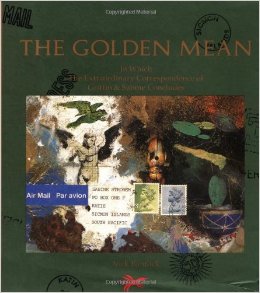
The Golden Mean

51Fdmd8yGdL._SX258_BO1,204,203,200_

Griffin is in back in London, and Sabine is back in the Sicmon Island – somehow they missed each other. But how? The final book in the trilogy sees Griffin and Sabine suffering silently against the unseen forces which keep them from one another.

‘It seems that each cannot exist in the presence of the other. Yet neither can continue without the presence of the other.’  

Sabine has returned to the Sicmon islands, she has washed her face in the sea and felt the sand between her toes, and yet she is unhappy. Her visions of Griffin’s artwork are fading, and a mysterious stranger is haunting her everywhere she goes.

The final part of the trilogy is told once again through postcards and letters, but this time the illustrations begin to take a darker form. Shadows emerge in the corners of the page, threatening to engulf that which lurks within the images. The fog leaks across the page, like that which creeps before the eyes of Griffin and Sabine, a physical representation of the dark forces at play.IMG_20150315_130321081

Desperate to be with one another Griffin and Sabine try one last time to make a connection.

Far from being a conclusion to the trilogy, The Golden Mean throws up just as many new questions as it answers old ones, and may leave the reader feeling many combinations of feelings – but I can guarantee this will not include disappointment.

From what I had heard about these books before I bought them, I expected them to be good, but not mind-blowing. I thought they would be novel – having books made out of postcards is such a quirky idea, but really, how far can a story be told in this way?

So, how do I feel now I’ve finished the books? Suitably humbled.

These books aren’t just good, they are really something special. Bantock’s artwork, imagination, and the intimacy and passion with which each letter is written combine to create a trilogy of books which really shine. The books are niche, clever and, above all, a truly epic read. I have been completely drawn in to Griffin and Sabine’s world.

I would recommend these books to crafty types, arty types, fans of children’s fiction, fans of fiction, fans of pictures books – in short, pretty much everyone, other than those who only read non-fiction.