“I’d rather you shot at tin cans in the back yard, but I know you’ll go after birds. Shoot all the bluejays you want, if you can hit ’em, but remember it’s a sin to kill a mockingbird.” – Atticus Finch
Penguin Random House have today launched a ten-day social media campaign to get people to (re)read To Kill a Mockingbird, ahead of the release of Harper Lee’s highly-anticipated second novel Go Set a Watchman.
The ten-day challenge, which will run from 21–31 May, is described as a ‘a read-along for readers old and new, (re)discovering and discussing the book together to a loose ten day plan.’
‘We’ll together be reading this brilliant piece of work by Harper Lee in preparation for Lee’s second book, Go Set a Watchman, out on the 14th July.’
You can keep up with what’s going on by following the Twitter, Facebook, Instagram and Tumblr sites that have been set up for Go Set a Watchman.
‘During this time we’ll be releasing lots of Mockingbird material, like family tree infographics, story guides and our favourite quotes,’ A Random House spokesperson has said. ‘We’ll also be making a call-out for everyone to share photos of their well-loved copies of To Kill a Mockingbird and hosting competitions to win copies of Go Set A Watchman to be sent out to lucky recipients as soon as the book is published in July.’
I don’t own a well-loved copy, although I did buy a copy of the new edition a couple of months back in anticipation of the release of Go Set a Watchman. I’m just so keen that I jumped ahead of the game!
Haven’t got a copy yet? Click here to solve that problem.
Go Set a Watchman, which sees Scout from To Kill a Mockingbird return to Maycomb as an adult, will be released on 14th July.
****GIVEAWAY****
In keeping with the spirit of the campaign I’ve decided to give you a chance to win a copy of the 50th anniversary edition of To Kill a Mockingbird. So if you want to take part in the challenge, but don’t have a copy of the book here’s your chance to get one. Just comment on this post by Sunday 24th May to be in with a chance of winning. The winner will be selected at random.
“Into the darkness they go, the wise and the lovely. ” ― Edna St. Vincent Millay
I first met George Jerjian last month at the London Book Fair. It was early evening, the time of day when notepads were slipped away and the drinks began to flow. Crates of beer and bottles of wine had appeared and ties were loosened with a satisfied sigh. We made our way around Olympia, stopping here and there to grab a glass and have a chat with this or that person whose books, or drinks, had caught our eye. It was over in the Armenian section that we ran into George who we got to know over a glass of fine Armenian brandy – The kind Winston Churchill favoured, or so I’m told.
Jerjian, who was born in Khartoum, Sudan, in 1955, has a rich family heritage that traces back to the former Ottoman Empire. When his paternal grandfather George Djerdjian left his hometown of Arabkir in Ottoman Turkey for the last time in 1907 he left behind a homeland which would never be the same again.
On 24 April 1915, Ottoman authorities rounded up, arrested and executed some 250 Armenian intellectuals and community leaders from Constantinople, marking the beginning of the Armenian genocide, the systematic extermination of Armenian subjects living within Ottoman Turkey at the hands the Ottoman Empire. In 1915 the Armenian Population of the Ottoman controlled region was reported to be approximately two million, by 1918 it is estimated that over one million had perished, with thousands more left homeless and without refuge, by 1923 virtually all of the Armenian population had disappeared.
The events of the genocide left Armenian areas of the empire completely devastated, assets were seized, property was demolished, and the historical monuments of the Armenian people were destroyed. Today, little remains of the Armenian society that once existed within the realms of the Ottoman Empire. Let us be thankful that when George Djerdjian left the Ottoman Turkey in 1907 he took a little piece of history with him.
Between 1900 and 1907 George Djerdjian took 240 photographs of his hometown of Arabkir and his college town of Erzeroum. For many years these photographs were stored in a grey steel box, dutifully following their owner, and his descendants, on their travels around the world. They travelled from Ottoman Turkey, to Egypt, Sudan, England and the United States. Now, a century after they first left Arabkir, they have finally emerged to see the light of day.
Jerjian explains how he came across the photos clearing out his elderly fathers flat; he found a ‘small treasure trove’ of artefacts and photographs. ‘In that box’ he says, ‘were close to about one hundred glass plates, photographs of Arabkir, my grandfather’s home town.’ The photographs were remarkable in that they were pre-genocide, taken of a time which has long been shrouded in mystery. It was fascinating, he said, to go into this world that has long since been extinguished.
Daylight after a Century is the story of a photographer who was able to capture life in eastern Anatolia in the early 1900s. George Djerdjian took everyday pictures, he captured people, schools, churches, nature, and life – social life, political life, economic life, the lives of the people of Arabkir. These unremarkable pictures have become remarkable, in that they show a time before: ‘Before the great war, before the genocide, before the lights were turned out on a civilisation.’
The photographs depict a life, a community and a place, that has long been lost.
In the film accompanying Jerjian’s book Hayk Demoyan, the Director of the Armenian Genocide Museum-Institute in Yerevan, speaks of the importance of the photos not just for the family of George Djerdjian, but for all Armenians. The images, he says, serve as ‘pieces of a puzzle’ which glimpse into the life of the Armenian people before the genocide.
The Armenians of Arabkir and Erzeroum had lived in the area for thousands of years; these pictures are not just a snapshot of life at the time, they are the some of the only remaining evidence of the last moments of an ancient civilisation which was about to become extinct.
These glass plates have traversed oceans and continents, countries and generations, and today after a century of darkness they have seen daylight.
It is extraordinary the distance the plates have travelled and the events they have lived through and emerged out the other side of, to tell the story, not just of George Djerdjian, but also the Armenian people of the Ottoman Empire. Daylight After a Century serves as a testament to a truly remarkable collection of pictures and a fantastic tribute to their photographer, who could never have known the significance his work would one day hold.
If you do only one thing today, please take the time to place your vote.
Wild horses couldn’t keep me away from the polling booths. I get such a thrill from exercising my duty as a British citizen, but I know there are a lot of people out there that are not planning on voting – please reconsider.
Not agreeing with any particular candidate is not an excuse not to vote. In a general election all votes are counted and recorded in constituencies across the UK, and this includes ballot papers where the voter has not voted for a candidate. Protest votes count – so have your say.
Remember that the right to vote is a privilege, and a privilege that was not always enjoyed by all. Don’t abuse it.
I’m aware this post is a little out of the ordinary, and so while I’m here let me introduce my newest literary gift to myself. It’s been a difficult week so far and I wanted a treat to cheer myself up. In the spirit of things I chose a book from The Guardian‘s top 10 books about the Suffragettes.
Falling Angels – Tracy Chevalier
One cold January morning, in the wake of Queen Victoria’s death, two young sets of eyes meet across the graves at Highgate Cemetery. One pair belongs to smartly dressed Lavinia Waterhouse, whose mother clings to the traditional values she sees slipping away; the other to Maude Coleman,
whose mother longs to escape the stifling grip of Victorian society. Thrust together by the girls’ friendship, these two very different families embark on a new century that promises electricity, emancipation and other changes that will shake the very foundations of their lives.
“We don’t see people as they are. We see people as we are.” ― Anaïs Nin
I’ve never read any Anne Tyler before, but I was lured into buying this book by a dramatisation I heard on Radio 4. Over the period of a week or two I’d often catch few minutes of the show and find myself wondering what had happened in the episodes I’d missed. The curiosity got the better of me and I treated myself to a second hand copy from Amazon.
In Ladder of Years Anne Tyler tells the tale of Cordelia ‘Delia’ Grinstead – a forty-year-old housewife and medical secretary, who, while on a seaside holiday with her family, walks off down the beach and doesn’t look back.
This all started on a Saturday morning in May, one of those warm spring days that smell like clean linen. Delia had gone to the supermarket to shop for the week’s meals. She was standing in the produce section, languidly choosing a bunch of celery. Grocery stores always made her reflective. Why was it, she was wondering, that celery was not called ‘corduroy plants’? That would be much more colourful. And garlic bulbs should be ‘money bags,’ because their shape reminded her of the sacks of gold coins.
Ladder of Years is a thoughtful book, one of those stories that will make you wonder at the significance in every small thing. If Delia had not been shopping in that particular store on that morning, or if she had spent a little less time musing over the celery, her life might have taken a very different route.
It is in the produce section that Delia meets Adrian Bly-Brice, the man, the catalyst, who would set her on the first un-Cordelia Grinstead journey of her life.
The question of why Delia decided to leave her family is a difficult one to answer. Mainly because she didn’t, decide to leave I mean. She never intended to leave her family, it just sort of happened. It is as though she was overwhelmed for a moment, fed up with being so predictable, and once she had started walking it was difficult for her to find her way back home.
Who is it that Tyler hopes the reader will feel compassion for? Is it Delia? Or with the family that she has left behind? I felt a strange mix of feelings for both parties; coming from a broken family myself I empathised with the family left behind in Baltimore, who had lost their mother completely without warning. She upped and left without the slightest hint, leaving all her belongings behind, these things are never painless or easy. It must have been horrendous for her children, no matter what their age. I also felt sad for Delia, who seemed so lost and confused, spending the first days of her absence crying herself to sleep. She didn’t even fully understand why she had left.
I feel as though Delia was going through some sort of midlife crisis. She is portrayed as silently struggling to deal with the recent death of her father, who had been the one constant figure in her life. When her children began to grow up, she had reverted to caring for him, and months on from his death she could not bear to clear out his bedroom. It remained stuck, in a sort of time trap. Then she began to doubt her reasons for getting married and second guess her husband’s feelings towards her. Feeling as though she had never been swept off of her feet, by a man like Adrian Bly-Brice, but then, as her twin nieces would say ‘well that’s life’. For this reason, I felt hopeful that Delia would find her way home.
While few physical events actually happen in the book, it is in the least bit boring, and the chapters do not drag. The journey is predominantly an emotional one, and as such no single event seems to stand out as that important. That said, the Delia Grinstead who emerges throughout the book is a very different woman to the one who puzzled over celery on the very first page.
Tyler’s impeccable writing style allows for this emotional journey to take shape. The whole world in which Delia inhabits is so clearly defined that it might be about to leap off the page. All thoughts are portrayed seamlessly, and with almost perfect attention to detail, through Delia’s eyes. Each time she meets a new person, is faced with a new situation, or does anything at all, it is as though you can see the cogs of her mind working. The faces of the people she meets unfolding before her, in such a way that everyone becomes incredibly rounded and 3-dimensional. I feel as though I could sit and sketch an image of every person in the book, from Delia herself, to the fleeting image of Rosemary Bly-Brice.
I feel as though I have spent a couple of days reading an incredibly articulate diary. Not too much happens in the grand scheme of things, but I was definitely drawn into Delia Grinstead’s world. This one was an easy book to get into, and an even easier book to finish. Eloquently written, but without a hint of snobbishness.
“The world is full of magic things, patiently waiting for our senses to grow sharper.” ― W. B. Yeats
‘The house has stood at the end of Hope Street for nearly two hundred years. It’s larger than all the others, with turrets and chimneys rising into the sky. The front garden grows wild, the long grasses scattered with cowslips, reaching toward the low-hanging leaves of the willow trees. At night the house looks like a Victorian orphanage housing a hundred despairing souls, but when the clouds part and it is lit by moonlight, the house appears to be enchanted. As if Rapunzel lives in the lower tower and a hundred Sleeping Beauties lie in the beds.’
This book is so incredibly sweet and gentle, definitely one for a lazy afternoon where you just want to curl up with a book and wile away the hours.
In The House at the End of Hope Street Van Praag vicariously lives out her dream of providing a safe refuge for women who have lost hope and need a place to recover and find their direction in life.
Alba Ashby, the youngest PhD student at Cambridge University has hit an enormous bump in her journey towards academic success. Alone and beside herself she begins to wander the streets of Cambridge, her mind constantly wandering back to ‘the worst event’ of her life. As she walks she attempts to shake away her memories and search for solace in the dark streets of the university city. One night something calls to her on the wind and she finds herself stood before a mysterious house on Hope Street, unconsciously ringing the doorbell. There the beautiful Peggy Abbot welcomes her with open arms and a steaming cup of hot chocolate. Alba is invited to remain at Hope Street for no more than 99 days: ‘long enough to help you turn your life around and short enough that you can’t put it off forever’. As well as having the luxury of no rent or bills, and a room of her own, Alba is promised that she will not have to work through her problems alone.
‘If you stay I can promise you this,’ Peggy says. ‘This house may not give you what you want, but it will give you what you need. And the event that brought you here, the thing that you think is the worst thing that’s ever happened? When you leave, you’ll realize it was the very best thing of all.’
Alba is an unusual girl, gifted with a second sight. She has the ability to see those who are no longer living as well as things that others cannot see – sounds, emotions, feelings and scents trail through the air before her very eyes. Birds sing in blue and weave ribbons through the sky, and the words of those she speaks with emerge before her eyes, written as if by an imaginary typewriter, revealing the speakers true colours. When she steps through the door of 11 Hope Street she is perhaps not as surprised as the reader by the magical world enclosed within, and not in the least bit startled by the ghost of girl sat smiling in the kitchen sink.
In The House at the End of Hope Street Van Praag introduces us to an enchanting, magical world. Over the years the house has been home to great women throughout history, black and white images of Sylvia Plath and Dorothy Parker come to life to offer words of wisdom and advice to Alba, the walls rattle and breathe and Alba’s room transforms, filling with book cases, and fluttering copies of hundred of novels. The house is alive, and drops hints and ideas into the minds of the residents, placing notes on their dressers, providing them with gifts to nurture their talents, and denying them those which they must seek elsewhere. Bookish Alba spends her first days curled up in the cocoon of her bedroom, losing herself in the books provided for her by the house, before slowly embarking on her own journey.
In her time at Hope Street Alba goes through even more heartbreak and devastation, as she loses the person closest to her and discovers the truth behind a long kept family secret. These events help guide her on the road towards self-fulfilment, as though every cloud really does have a silver lining. For the first time in her life she is able to make friends, rather than just acquaintances, and she discovers that people living right beneath her nose will soon come to mean the world to her.
There are twists in the story, some that I saw coming, and some that I didn’t, but all of which are delightful and sure go bring a smile to your face. Do not expect to find out exactly what Alba is running from right away, it takes some time, Van Praag teases the secret out deliciously, keeping you reading on long after you should have put the book down and started on supper.
As a Cambridge girl myself, I really enjoyed reading about the Cambridge Alba inhabits. I loved to imagine her slipping on the cobbles outside Trinity College, and running through the lanes, darting into a little bookshop to shelter from the rain, and delighted at her description of the Cambridge University Library as ‘her cathedral’.
Bookish types are sure to enjoy this book, and I would recommend it to anyone who enjoys gentle fantasy and magical realism. I would not say the book has changed my life and made it onto my favourites list, but I definitely enjoyed it, and was awarded with that warm feeling of satisfaction that comes from finishing a truly pleasant book.
A long weekend is the perfect excuse for a leisurely Saturday. Today we headed into town for a spot of lunch and a wander around market, and I just couldn’t resist slipping into the Oxfam bookshop on Sidney Street.
After treating myself to a few new books last week, I promised myself I wouldn’t buy anything. I reasoned that I would only go in for a look, just to be around the books for a bit and soak up that great used-book smell. After spending a few idle moments perusing the classic texts I stumbled upon the collectables – truth be told, I was looking for the children’s section, but it seems they’ve rearranged the place since my last visit.
Nestled in amongst some dusty hardbacks by authors whose names I’d never heard, and ancient cook books the likes of which might have graced my Grandfather’s kitchen shelves, I found a well-loved volume of children’s stories.
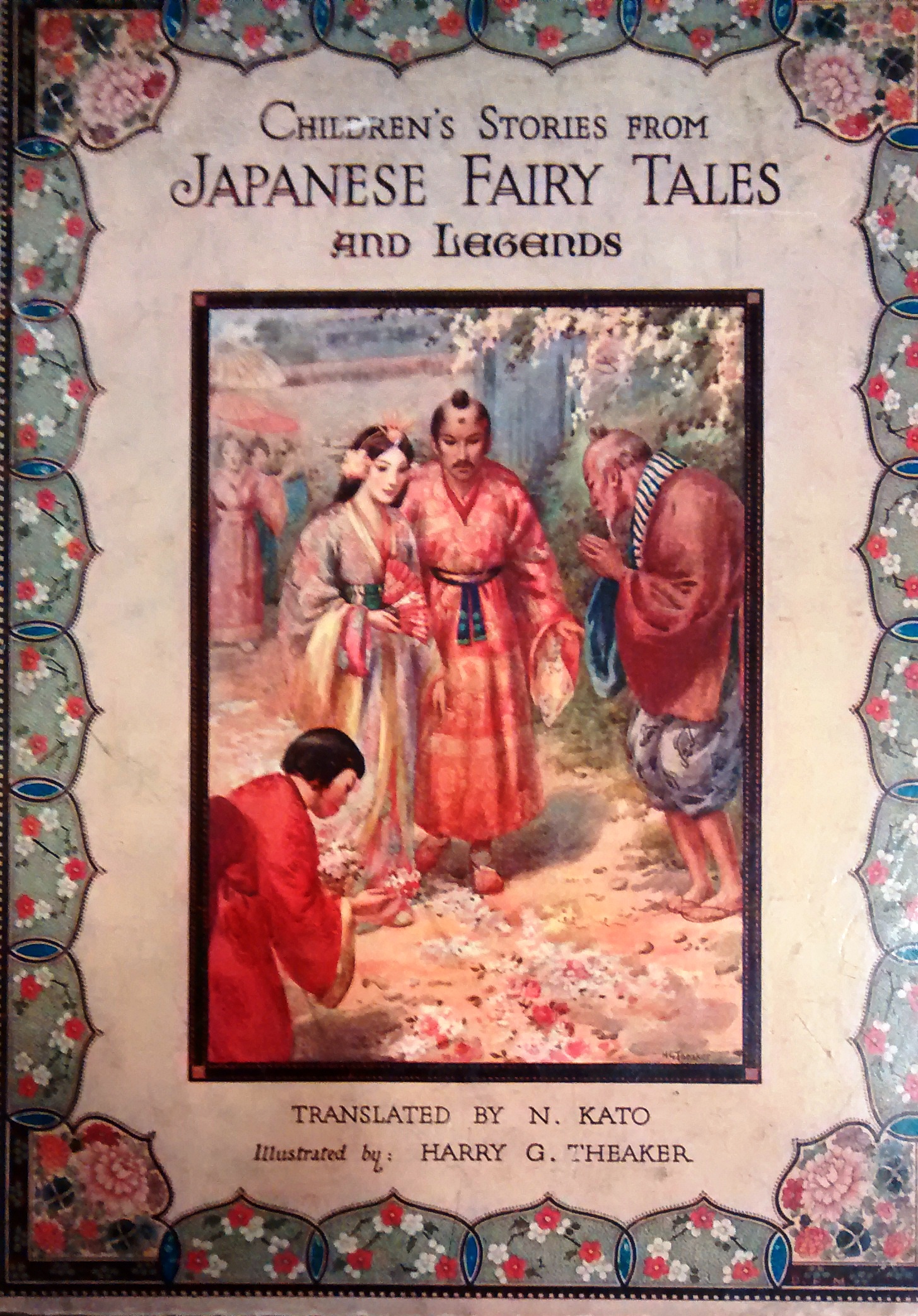
Children’s Stories From Japanese Fairy Tales and Legends
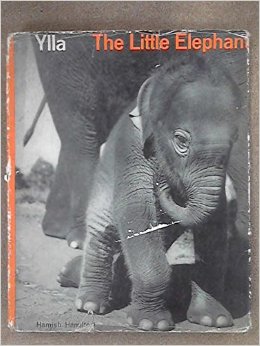
I love old children’s books. Our sitting room contains a bookshelf dedicated to children’s literature, where all the old fables and fairytales I was given as a child sit amongst Sebastian’s French Tin Tin comics and several tatty picture books by Hungarian photographer Ylla.
I knew I wanted to add this one to my collection before I had even taken it off the shelf. I’ve never read a Japanese fairy tale, and was interested to see how they would compare to my childhood favourites by Hans Christian Andersen. A quick glimpse inside the book let me know I was making the right choice.
I’ve never managed to pick up an old book with an inscription without buying it. There is something so beautiful about an inscription, as though it gives the book a story of its very own. Questions about the previous owner immediately started entering my mind. Were they a little boy, or a little girl? Why was Daddy gifting the book alone? Are they the only previous owner?
After trying, and failing, to strike up a conversation with the gentleman behind the till by informing him, somewhat excitedly, that there was an inscription in the book, I wandered home with my loot.
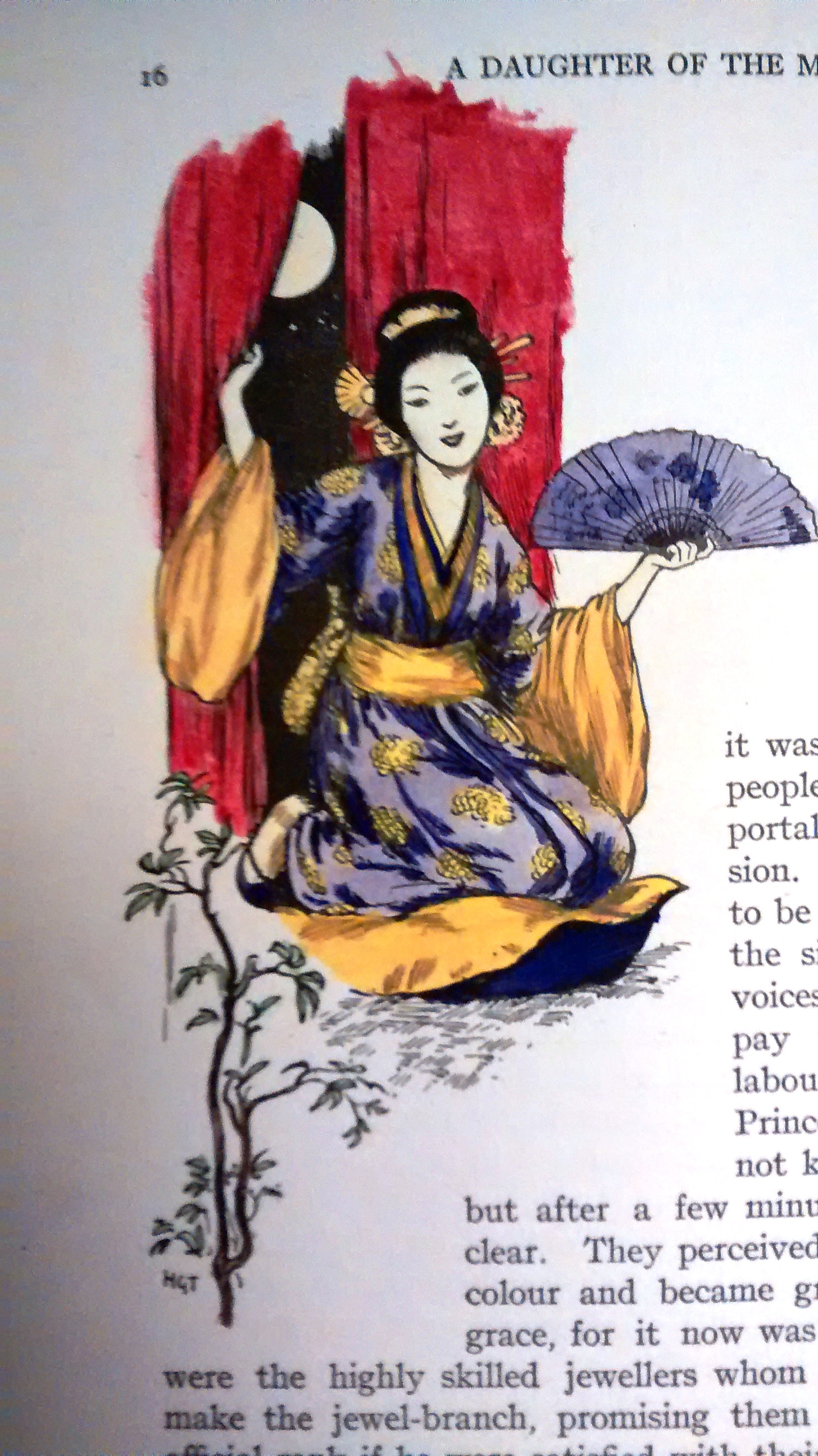
I spent the afternoon sat out sunshine getting to know my new friend, running my fingers lovingly over the pages to feel the indentations left by the old printing presses, and reading the first tale ‘The Daughter of the Moon’ – a charming story about a bamboo cutter who adopts a beautiful fairy.
As much as I liked the first tale, the thing that got me really excited about this book was the illustrations. There is the occasional printed colour plate often found in children’s books from the early 20th century, but there are also images included in the text that have been coloured in by hand.
Towards the front of the book the pictures have been filled in delicately, with something resembling watercolour paints (above left). I had a look at other editions of the books online, and the images were definitely in no more than black ink when the book was first published. They must have been coloured in by one of the previous owners – was it the child who first received the book from ‘Daddy’ in 1930?
As I got further into the book I noticed that the images were no longer coloured with paint, but instead with coloured pencils, and the signature scratch of a much younger child (above right).
Without knowing anything about the previous owners, I can’t know for sure who coloured the pictures in, but this makes it all the more exciting. This book has its own mystery; a secret story told only in marks left behind by the ghosts of the past. If the first owner of the book did contribute to the coloured in images, and I like to think that they did, I do hope ‘Daddy’ wasn’t too cross.
…into my purse, and I got out the money to buy these little beauties.
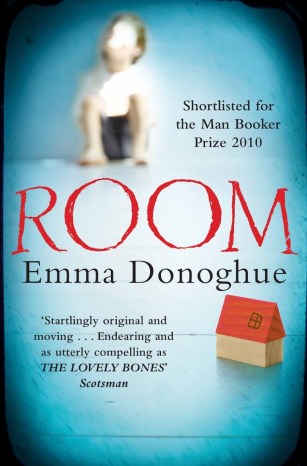
Room – Emma Donoghue
To five-year-old Jack, Room is the entire world. It is where he was born and grew up; it’s where he lives with his Ma as they learn and read and eat and sleep and play. At night, his Ma shuts him safely in the wardrobe, where he is meant to be asleep when Old Nick visits.
Room is home to Jack, but to Ma, it is the prison where Old Nick has held her captive for seven years. Through determination, ingenuity, and fierce motherly love, Ma has created a life for Jack. But she knows it’s not enough…not for her or for him. She devises a bold escape plan, one that relies on her young son’s bravery and a lot of luck. What she does not realize is just how unprepared she is for the plan to actually work.
Told entirely in the language of the energetic, pragmatic five-year-old Jack, ROOM is a celebration of resilience and the limitless bond between parent and child, a brilliantly executed novel about what it means to journey from one world to another.
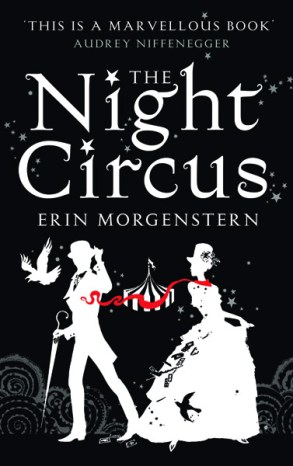
The Night Circus – Erin Morgenstern
The circus arrives without warning. No announcements precede it. It is simply there, when yesterday it was not. Within the black-and-white striped canvas tents is an utterly unique experience full of breathtaking amazements. It is called Le Cirque des Rêves, and it is only open at night.
But behind the scenes, a fierce competition is underway: a duel between two young magicians, Celia and Marco, who have been trained since childhood expressly for this purpose by their mercurial instructors. Unbeknownst to them both, this is a game in which only one can be left standing. Despite the high stakes, Celia and Marco soon tumble headfirst into love, setting off a domino effect of dangerous consequences, and leaving the lives of everyone, from the performers to the patrons, hanging in the balance.
We are all Completely Beside Ourselves – Karen Joy Fowler
Meet the Cooke family: Mother and Dad, brother Lowell, sister Fern, and Rosemary, who begins her story in the middle. She has her reasons. “I was raised with a chimpanzee,” she explains. “I tell you Fern was a chimp and already you aren’t thinking of her as my sister. But until Fern’s expulsion … she was my twin, my funhouse mirror, my whirlwind other half and I loved her as a sister.” As a child, Rosemary never stopped talking. Then, something happened, and Rosemary wrapped herself in silence.
In We Are All Completely beside Ourselves, Karen Joy Fowler weaves her most accomplished work to date—a tale of loving but fallible people whose well-intentioned actions lead to heartbreaking consequences.
Elizabeth is Missing – Emma Healey
Maud, an ageing grandmother, is slowly losing her memory—and her grip on everyday life. Yet she refuses to forget her best friend Elizabeth, whom she is convinced is missing and in terrible danger.
But no one will listen to Maud—not her frustrated daughter, Helen, not her caretakers, not the police, and especially not Elizabeth’s mercurial son, Peter. Armed with handwritten notes she leaves for herself and an overwhelming feeling that Elizabeth needs her help, Maud resolves to discover the truth and save her beloved friend.
This singular obsession forms a cornerstone of Maud’s rapidly dissolving present. But the clues she discovers seem only to lead her deeper into her past, to another unsolved disappearance: her sister, Sukey, who vanished shortly after World War II.
As vivid memories of a tragedy that occurred more fifty years ago come flooding back, Maud discovers new momentum in her search for her friend. Could the mystery of Sukey’s disappearance hold the key to finding Elizabeth?
How often do you treat yourself to a new book (or four)?
Commonwealth Governance Handbook 2014/15 is the comprehensive guide to public sector reform and innovation in the Commonwealth.
The Commonwealth Secretariat, through its Governance and Natural Resources, Rule of Law and Political programmes, promotes effective, efficient and equitable public governance in member countries – a range of work that bridges the defining Commonwealth pillars of democracy, development and diversity.
Commonwealth Governance Handbook brings together Secretariat perspectives with those of partners in government; professions,
development agencies and the private sector. This edition covers:
Deepening democracy: electoral finance and e-voting technologies
Constitutional change, leadership and human resources
Open data, cyber security and governance of the internet
Human security: civic/ethnic considerations, cross-border issues and land tenure
Performance management in public services and contracting
Utilities, environmental risk and the ‘blue economy’
The Commonwealth Association for Public Administration and Management (CAPAM) Innovation Awards
The publication also contains 53 governance profiles of member countries as well as progress on the Millennium Development Goals and other indicators.
For more information or to purchase a copy of the publication please visit our website.






 To five-year-old Jack, Room is the entire world. It is where he was born and grew up; it’s where he lives with his Ma as they learn and read and eat and sleep and play. At night, his Ma shuts him safely in the wardrobe, where he is meant to be asleep when Old Nick visits.
 The circus arrives without warning. No announcements precede it. It is simply there, when yesterday it was not. Within the black-and-white striped canvas tents is an utterly unique experience full of breathtaking amazements. It is called Le Cirque des Rêves, and it is only open at night.


 Jade the Obscure