Twisted Wing – Ruth Newman

“Nobody owns life, but anyone who can pick up a frying pan owns death.” ― William S. Burroughs

I was recommended this book by a gentleman I used to work with, he found out I liked to read horror fiction and said this one would give me a fright. Sadly he passed away the January before last, so this one’s for him. Thank you for the recommendation Michael, it saddens me to know I will never again read a book on your advice.

‘Jesus Christ,’ Denison heard Weathers say. He stood up, and as the paramedics and police officers and pathologists shifted position, he saw, between and beyond them, the boy that lay spreadeagled on the floor in a pool of blood, torn open, intestines dragged out and over the floorboards.

51kFwZLeM+L

Cambridge is known as a seat of academic excellence, home to one of the most prestigious universities in the world – but sometimes evil lurks in the most unexpected places.

Exams are over and the students of Cambridge University are celebrating, but for one college, the annual May ball takes a bloody turn when a female grandaunt is found brutally murdered in her chambers. Alongside her mutilated body are two further students, Nicholas Hardcastle, found holding the knife frantically stuffing the entrails of the victim back inside her body, and his girlfriend Olivia Corscadden, blood-soaked and completely catatonic. The  ‘Cambridge Butcher’ has struck again.

It is up to forensic psychiatrist Matthew Denison to attempt to draw the killer’s identity from the troubled mind of Olivia, one the most traumatised patients he has ever worked with. If anyone can hope to solve the mystery of the Cambridge Butcher it is Olivia, if only Denison can get her to remember.

She was a pretty girl, Denison thought, even with the black eye and the split lip. Not for the first time he wondered what had provoked this extreme response. Had she really witnessed the murder? Has she herself fought off the killer?
Was the identity of the Cambridge Butcher locked away in that broken mind?

Twisted Wing is as unputdownable as they come – I wasn’t particularly blown away by the calibre of the writing but the story-telling is second to none. Newman switches between the present and past tense, feeding the reader snippets of information about the Cambridge Butcher. While the novel begins in the present tense, the story itself begins four years in the past, when the Cambridge Butcher’s first victim is found.

The book seems to get off to a fairly average start, there are two people found at the scene of the crime, Olivia is sent for psychological analysis while Nick becomes the number one suspect. Having read murder mysteries before I thought it was pretty obvious neither of them would turn out to be the killer. It would be too simple, or so I thought. In reality, the book is far more complex and unexpected than I ever could have anticipated. It is more of a psychological thriller than a run of the mill murder mystery.

The murder case is an absolute mystery to the police, and it falls to Denison to work out the answers. The students of Ariel College seem to have formed into an impenetrable unified force; there is an ‘us and them’ mentality, and as such the police are struggling to crack the case. One thing is certain, the murders have been committed from within the walls of Ariel College – somewhere within the carefully guarded group is a dangerous psychopath. It has been four year since the first murder, and they are no closer to finding the killer. It is up to Denison to uncover the identity of the Cambridge Butcher, but he must first work out the true identity of Olivia.

I would love to tell you that I found the book scary, but the reality is that I didn’t – that said, I am a hard-boiled horror fan so it takes a lot to frighten me. The book is definitely unsettling, and there were times when I felt disturbed by what I was reading, but I personally didn’t get that much of a thrill from it – sorry Michael.

Even so, I consumed the book in a matter of days – only stopping to sleep and go to work. I would recommend you set aside a weekend to read it in its entirety, because you will want to keep reading at the end of each chapter.

If you’re a fan of murder mysteries and psychological thrillers I would definitely recommended giving Newman a look in – and if you don’t fall into one of these categories I think it’s fairly obvious this isn’t the book for you.


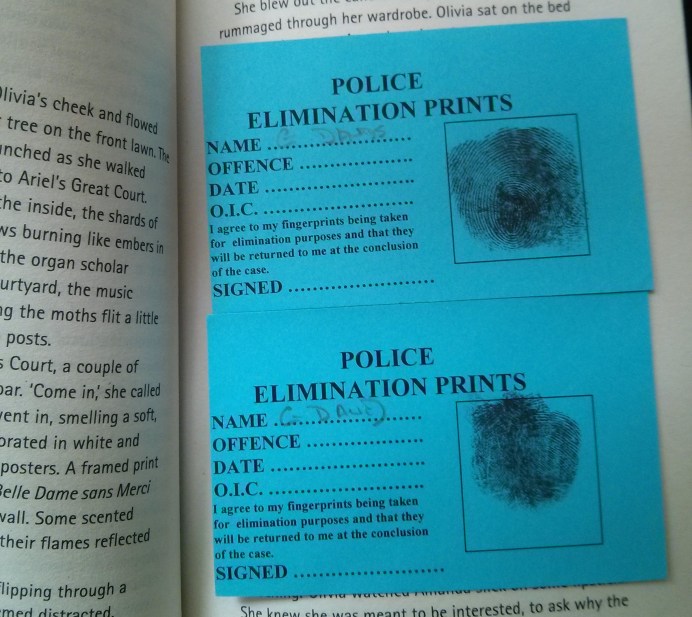
A slight caveat – I did get a little freaked out at one point when I was reading the book, but that was less thanks to Newman than it was to an unknown individual who decide to sell their second hand copy of Twisted Wing on Amazon. One night I was reading in bed when I felt something fall from between the pages of the book, I assumed it was my bookmark and thought nothing of it, until I went to put the book down and found these police elimination prints in my bed.
IMG_20150608_113506

Weird coincidence isn’t it? Why would these be inside a book? The creepiest thing is that they didn’t fall out until I was three-quarters of the way through; my bookmarks always fall out so why didn’t these? Perhaps the old owner put them in there as a bit of a practical joke, or maybe he was just using them as a bookmark (interesting choice). Either way it was unsettling – and slightly exhilarating finding them.

The Lost Art of Sinking by Naomi Booth – Book review and giveaway!

“The floor scooped me up where I stood, and I blinked as it hit me― M. Beth Bloom

sinking_sm

Have you ever played the Fainting Game?

The girls of class 2B have a new obsession – perhaps you know it as the Dying Game, or maybe Indian Headrush? The rules are all the same.

We had all agreed. We would secretly play the Fainting Game every day in assembly the following week. The winner would be the girl who passed out the most times. Or, in the case of a tie, whoever passed out in the most dramatic way. If anyone died, they scored an automatic win. If more than one person died, the winner was the girl who died in the coolest way.

When the decision-makers of class 2B decided it was time to play the Fainting Game, it was nothing more than that – a game. It was just silly ritual among adolescent girls, to annoy their teachers and try and get a bit of a buzz, something to quickly go through and leave behind.

They all grew out of it… or rather… they almost all grew out of it.

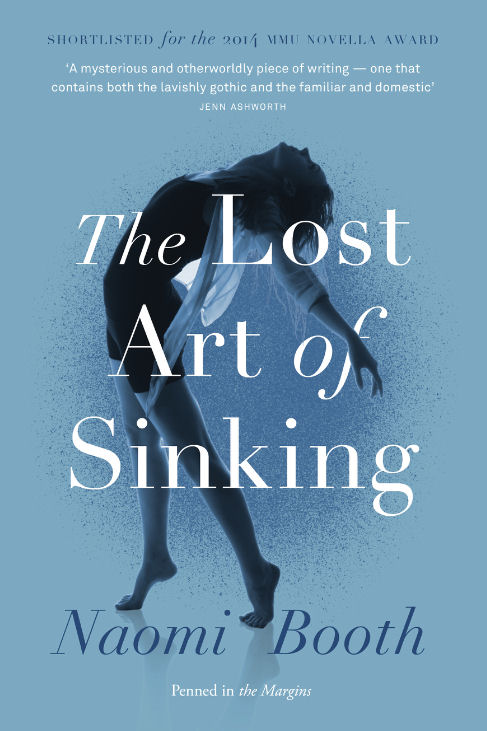
In her debut novel Naomi Booth explores the art of losing yourself, and the effects of taking obsession a little too far. The Lost Art of Sinking is a beautiful, yet unusual novella, as artfully striking as it is subtly unsettling. Prepare to be blown away, swept into the depths of obsession and addiction, a journey which begins, and ends in a mysterious room.

Esther cannot stop thinking about the game, a self-proclaimed ‘non-swooner’ she has never managed to successfully lose consciousness. She obsesses over what it would be like, the experience, to find out what she was missing. She wants to see the visions the girls in her class have boasted about. To see the strange and beautiful shapes, like ghosts, familiar, yet alien, which will your body to let go.

I thought it sounded like the most wonderful thing and I hoarded that possibility inside myself.

While all her friends move on, passing likes ghosts from her peripheral vision, Esther continues to experiment with different ways to pass out.

Her fascination is rooted in the memory of her late mother the beautiful retired dancer, who lived her final years locked away in her studio, like a butterfly with a broken wing. In her despair, Esther’s mother never stopped attempting the perfect swoon – curving, trembling, sinking and rising.

Utterly resolved to her fate Esther holds her breath, wills herself to fall and when that fails she snorts cleaning products. Later, unable to rid herself of her obsession she loses herself in the sights and sounds of London. Through the endless streets and houses she can feel her mother calling to her, saturating her body and mind, tilting her head, arching her back, begging her to let go.

Esther’s fascination with falling is so all encompassing that she neglects all other aspects of her life. She has no plan, drifting from one place to another, seeing where the wind takes her, always searching.  Her obsession blinds her, so much so that she misses a glaring secret hidden in her past – one which, if left untold, could be her undoing.

In Esther, Booth has created a strange and wonderful character. Her persona is mystifying yet utterly two-dimensional – defined only by her actions and her obsession. As a reader you are given access to her inner thoughts, but these centre only on her desire to sink away, to become one with her mother. Her relationships feel hollow; her fleeting encounters with men no more than another attempt to reach her goal. Each time she is with someone they are with her body only, her mind is somewhere else entirely.

While Esther herself is a bit of a mystery, those around her are artfully sketched. She outlines all those she encounters, pouring their descriptions onto the page, from an unpleasant-smelling gentleman on the tube, whose odour emanates from his body in ‘mustardy waves’ to the odd young man that is her father.

Through Esther’s obsession, Booth takes the reader on a beautiful and haunting journey – which is all at once unsettling, dark and strangely hilarious. The Lost Art of Sinking is exquisitely written, evoking, sensual and all encompassing – once I started to read I didn’t stop. I was blown away by the writing, absorbed by the ride and fascinated by Esther’s mind. This is definitely one for those of you looking for something fresh and new – Naomi Booth is not to be overlooked.

The Lost Art of Sinking will be released 1st June 2015 by Penned in the Margins.

I was given a free review copy of the book in exchange for an honest review.

****GIVEAWAY****

I have been given a copy of The Lost Art of Sinking by the publisher to give away to one lucky reader.

To be in with a chance of winning all you have to do is comment on this post. Be sure to enter your correct email address when posting so I can get in touch if you win. The giveaway will run until Friday 12th June – giving you plenty of time to enter.

Good luck!

The Guest Cat – Takashi Hiraide

“What greater gift than the love of a cat.” ― Charles Dickens
One shining, sunny afternoon, slipping through a crack in the open door, four bright white feet stepped softly onto the room’s insulated drain board, and with a well-honed curiosity rushing through her entire body, Chibi quietly surveyed its meagre interior.

Guest-Cat-2

A married couple in their mid-thirties live a solitary life in urban Tokyo, in a small rented guesthouse on the border of an estate owned by an elderly woman and her ageing husband. Both husband and wife work from home, freelance copy-editing, writing, and proofreading from their solitary desks – it has been a long time since either one has had very much to say to the other.

Late in the autumn of 1988 a small cat, tamed by a young boy who lives next door, invites itself into their humble kitchen and begins to explore its surroundings. The cat becomes a regular feature in the couple’s home, and brings warmth and love into their lives. As the cat comes and goes, seemingly set in her routine, the couple begin to talk about her, to anticipate her arrival and share stories about her. The arrival of the guest cat opens a door which had seemed closed forever.

In his New York Times Bestseller, Japanese poet Takashi Hiraide eloquently explores the remarkable bond between man and cat. When the guest cat enters the couple’s house, she brings with her a feeling of hope; suddenly life seems to hold more promise for the husband and wife, and their days are filled with a new kind of meaning.

It is not out of preference that I use the word fate – or should say, Fortuna – but as the young cat’s visits became more frequent, I came to feel that there were some things only this word could express.

I have been told that cats emit a certain type of pheromone which makes them more attractive to the people they are around. This, some say, is why so many people do not realise how much they love cats until they have one of their own. The husband, whose voice the novella is written in, describes himself and his wife as neither having a particular liking for cats. But this all changes when the guest cat first sets foot into their kitchen.

There’s a photographer who says cat lovers always believe their own cat is better looking than anyone else’s. According to her, they’ve all got blinders on. She also says that, though she too is a major cat lover, having noticed this fact means that she is now hated by all cat lovers, and so these days only takes pictures of scruffy-looking strays.

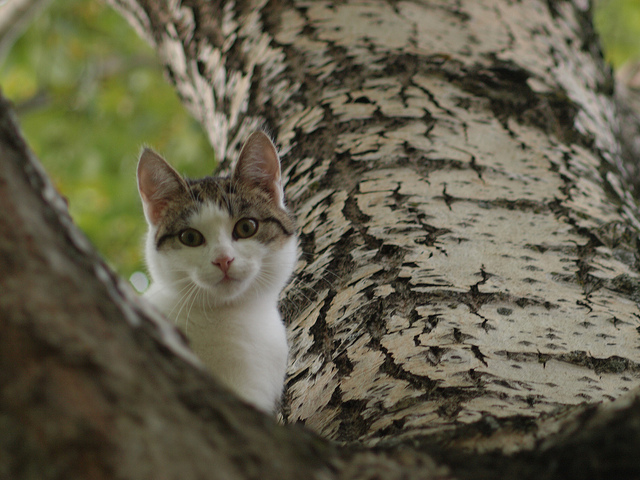
cat-in-a-tree

It is almost as though the cat fills the empty space between the man and his wife, a space perhaps reserved for a child. I imagine that the cat’s name, Chibi, which we are told means ‘little one’, alludes to her importance to the man and his wife. She is so much more than just a cat to the couple; she is a friend, a companion, something which gives their life meaning. With Chibi in their lives, the house, the garden, the zolkova tree and even the dark ‘lightening alley’ all have more light and colour. Everything brims with a new beauty created by the smallest of pleasures – watching the cat play with a ball, or hearing the gentle tinkling of her collar.

I was bought the guest cat by my father-in-law this past Christmas; he has clearly noticed that my two favourite things in life are books and cats. There was no doubt in my mind that I would enjoy the book –  my father-in-law is an excellent judge of reading material – but I didn’t anticipate just how much pleasure I would take from such a short piece of writing. The book is gentle, and beautiful, simply brimming with imagery and poetics. In just 140 pages Hiraide manages to speak volumes about the complexities of life and the existence of joy in the most unlikely places.

The writing has a stunning eloquence that fans of Japanese literature will admire. There is something I find so appealing about Japanese translations; the words seem to possess a unique flow, a beauty completely their own. The translated words stream effortlessly across the page, swirling into stunning imagery and deeply profound passages of thought, the result of which is a rare and wonderful treasure of a novella.

Needless to say, I would recommend this book. It is gentle and poetic, yet captivating enough to read in a single setting. This one is not just for cat lovers.

The Lovely Bones – Alice Sebold

“If you have a sister and she dies, do you stop saying you have one? Or are you always a sister, even when the other half of the equation is gone?” ― Jodi Picoult

the-lovely-bones-9781447275206I had wanted to read this book for so long. I would often find myself seeking it out in bookshops just after it was released, picking it up and stroking the cover, reading the blurb on the back for the umpteenth time

My name was Salmon, like the fish; first name, Susie. I was fourteen when I was murdered on December 6th, 1973. My murderer was a man from our neighbourhood. My mother liked his border flowers, and my father talked to him once about fertilizer.

But I never bought it.

I have obsessed over the idea of this book for the best part of a decade – a story told by the spirit of a murdered girl, however macabre it may sound, is right up my street. I am fascinated by anything to do with the paranormal and spirituality. I wanted to get to know Susie Salmon better; I wanted to read her story.

So when my good friend Kate over at The Little Crocodile bought me the book last month for my birthday I was over the moon!

The Lovely Bones is a haunting tale told by the spirit of murdered school girl Susie Salmon. Looking down from her heaven Susie observes her family and friends. She watches the devastation and destruction that her murder causes, rippling through her small town, and shaking the community to its very core. Susie watches her family as they struggle to comprehend life without her, leaving the porch light on well after they know she is no longer coming home. As time goes on, and Susie watches her siblings and friends grow older, she learns that she must let go of her anger to allow those left behind to heal.

This book is not for the faint hearted. I become much more emotionally invested in a book than I ever have in film or TV and this one really got to me. I’ve had unsettlingly emotional episodes with books in the past; I grieved for Sirius black after reading Harry Potter and the Order of the Phoenix and Anybody out there? by Marian Keyes threw me into the depths of despair for a good few weeks. This one was different though. Sebold’s writing gave me nightmares, and at some points I doubted whether I would actually be able to finish it.

That is not to say that I didn’t enjoy the book – I did. It was everything I hoped for, and a little more. The effect that this book had on me speaks of the power of Sebold’s words – I was upset by Susie’s death, horrified by the circumstances and devastated by the effect that this had on the family. But more than this, I was distressed by Susie’s position in all this, as an outsider looking in on the effect that her death had in her community. She was intercepted by her neighbour on the way home from school that cold winter’s day in 1973; she never made it home. Susie’s story is incredibly moving in that it details her spirit’s journey, still attempting to find her way home after so many years; she may be in heaven, but her true place will always be on Earth.

SEBOLD_ALICE_0316044938_1._V204759192_

Sebold has taken a story about a murdered school girl and completely turned it around, presenting an intricate analysis into grief and resolution. Fans of crime fiction may be put off to know that there is no secret as to who the killer is, you know him from the start, and if you begin the book hoping for a revelation in which Susie’s killer is brought to justice you will likely feel disappointed. But approach Sebold’s work with an open mind and you will be pleasantly surprised.

The Lovely Bones is beautifully written and hauntingly captivating and will leave you quietly contemplating Susie long after you have finished her story. It is difficult to say who I would recommend the book to – so I will simply say that if you feel intrigued by my review, then give it a go.

Has anyone else read this book? I’d love to hear from you to find out what you thought. Drop me a line or comment below.

The Writing on the Wall: Everyday Phrases from the King James Bible – Richard Noble

“The words. Why did they have to exist? Without them, there wouldn’t be any of this.” ― Markus Zusak

716TWoJNZ5L._SL1280_

Clichés, expressions, and idioms, they can be the apple of your eye, or a thorn in your flesh – but do you know where these seemingly meaningless phrases originate? If not, this is the perfect book to guide you off to the land of nod.

In The Writing on the Wall: Everyday Phrases from the King James Bible, Richard Noble provides a fascinating glimpse into the history of 65 phrases and expressions, now firmly ingrained in everyday speech, which have their roots in the King James Bible. While it may not be for everyone, this book will whet the appetites of anyone with an interest in language, theology, or Christian history.

For each book of the King James Bible, Noble isolates a single well-known phrase, presenting the reader with a brief explanation of the original context of the words, before tracing their usage throughout history to their relevance in language today. If you are interested in everyday English speech, and intrigued by the origins of phrases such as ‘the blind leading the blind’ or ‘by the skin of one’s teeth’ this book is sure to delight your curiosity.

Those unfamiliar with the King James Bible need not be put off, as Noble’s analysis assumes no familiarity with the scriptures on the part of the reader. This said, the more devote among you are sure to appreciate Noble’s summary of the composition of the Old Testament, the relevance of the  silent Intertestamental Period and the fascinating revelations of the New Testament.

Noble has created an ideal bookshelf addition for Christians, non -Christians, historians, linguists, wordsmiths, and those who are simply fascinated by phrases. The Writing on the Wall is the perfect book to expand your understanding of the English language – a truly inestimable treasure.

The Writing on the Wall is available to buy direct from the publisher, Sacristy PressI was given a free copy of the book in return for an honest review.

To Kill a Mockingbird ten-day (re)read challenge

“I’d rather you shot at tin cans in the back yard, but I know you’ll go after birds. Shoot all the bluejays you want, if you can hit ’em, but remember it’s a sin to kill a mockingbird.” – Atticus Finch

Penguin Random House have today launched a ten-day social media campaign to get people to (re)read To Kill a Mockingbird, ahead of the release of Harper Lee’s highly-anticipated second novel Go Set a Watchman.

9d530ff5ee3031af2d95b62e86f3fa61

The ten-day challenge, which will run from 21–31 May, is described as a ‘a read-along for readers old and new, (re)discovering and discussing the book together to a loose ten day plan.’

‘We’ll together be reading this brilliant piece of work by Harper Lee in preparation for Lee’s second book, Go Set a Watchman, out on the 14th July.’

You can keep up with what’s going on by following the Twitter, Facebook, Instagram and Tumblr sites that have been set up for Go Set a Watchman.

‘During this time we’ll be releasing lots of Mockingbird material, like family tree infographics, story guides and our favourite quotes,’ A Random House spokesperson has said. ‘We’ll also be making a call-out for everyone to share photos of their well-loved copies of To Kill a Mockingbird and hosting competitions to win copies of Go Set A Watchman to be sent out to lucky recipients as soon as the book is published in July.’

I don’t own a well-loved copy, although I did buy a copy of the new edition a couple of months back in anticipation of the release of Go Set a Watchman. I’m just so keen that I jumped ahead of the game!

Haven’t got a copy yet? Click here to solve that problem.

Go Set a Watchman, which sees Scout from To Kill a Mockingbird return to Maycomb as an adult, will be released on 14th July.

****GIVEAWAY****

In keeping with the spirit of the campaign I’ve decided to give you a chance to win a copy of the 50th anniversary edition of To Kill a Mockingbird. So if you want to take part in the challenge, but don’t have a copy of the book here’s your chance to get one. Just comment on this post by Sunday 24th May to be in with a chance of winning. The winner will be selected at random.

Good luck!

I’m having another … Wordless Wednesday

6a00e0099839558833019b02240d56970b
“You can never get a cup of tea large enough or a book long enough to suit me.” ― C. S. Lewis

Daylight After a Century – George Jerjian

“Into the darkness they go, the wise and the lovely. ” ― Edna St. Vincent Millay

744832 (1)I first met George Jerjian last month at the London Book Fair. It was early evening, the time of day when notepads were slipped away and the drinks began to flow. Crates of beer and bottles of wine had appeared and ties were loosened with a satisfied sigh. We made our way around Olympia, stopping here and there to grab a glass and have a chat with this or that person whose books, or drinks, had caught our eye. It was over in the Armenian section that we ran into George who we got to know over a glass of fine Armenian brandy – The kind Winston Churchill favoured, or so I’m told.

Jerjian, who was born in Khartoum, Sudan, in 1955, has a rich family heritage that traces back to the former Ottoman Empire. When his paternal grandfather George Djerdjian left his hometown of Arabkir in Ottoman Turkey for the last time in 1907 he left behind a homeland which would never be the same again.

On 24 April 1915, Ottoman authorities rounded up, arrested and executed some 250 Armenian intellectuals and community leaders from Constantinople, marking the beginning of the Armenian genocide, the systematic extermination of Armenian subjects living within Ottoman Turkey at the hands the Ottoman Empire. In 1915 the Armenian Population of the Ottoman controlled region was reported to be approximately two million, by 1918 it is estimated that over one million had perished, with thousands more left homeless and without refuge, by 1923 virtually all of the Armenian population had disappeared.

The events of the genocide left Armenian areas of the empire completely devastated, assets were seized, property was demolished, and the historical monuments of the Armenian people were destroyed. Today, little remains of the Armenian society that once existed within the realms of the Ottoman Empire. Let us be thankful that when George Djerdjian left the Ottoman Turkey in 1907 he took a little piece of history with him.

Between 1900 and 1907 George Djerdjian took 240 photographs of his hometown of Arabkir and his college town of Erzeroum. For many years these photographs were stored in a grey steel box, dutifully following their owner, and his descendants, on their travels around the world. They travelled from Ottoman Turkey, to Egypt, Sudan, England and the United States. Now, a century after they first left Arabkir, they have finally emerged to see the light of day.

Jerjian explains how he came across the photos clearing out his elderly fathers flat; he found a ‘small treasure trove’ of artefacts and photographs. ‘In that box’ he says, ‘were close to about one hundred glass plates, photographs of Arabkir, my grandfather’s home town.’ The photographs were remarkable in that they were pre-genocide, taken of a time which has long been shrouded in mystery. It was fascinating, he said, to go into this world that has long since been extinguished.

maxresdefault

Daylight after a Century is the story of a photographer who was able to capture life in eastern Anatolia in the early 1900s. George Djerdjian took everyday pictures, he captured people, schools, churches, nature, and life – social life, political life, economic life, the lives of the people of Arabkir. These unremarkable pictures have become remarkable, in that they show a time before: ‘Before the great war, before the genocide, before the lights were turned out on a civilisation.’

The photographs depict a life, a community and a place, that has long been lost.

In the film accompanying Jerjian’s book Hayk Demoyan, the Director of the Armenian Genocide Museum-Institute in Yerevan, speaks of the importance of the photos not just for the family of George Djerdjian, but for all Armenians. The images, he says, serve as ‘pieces of a puzzle’ which glimpse into the life of the Armenian people before the genocide.

509979956_640

The Armenians of Arabkir and Erzeroum had lived in the area for thousands of years; these pictures are not just a snapshot of life at the time, they are the some of the only remaining evidence of the last moments of an ancient civilisation which was about to become extinct.

These glass plates have traversed oceans and continents, countries and generations, and today after a century of darkness they have seen daylight.

It is extraordinary the distance the plates have travelled and the events they have lived through and emerged out the other side of, to tell the story, not just of George Djerdjian, but also the Armenian people of the Ottoman Empire. Daylight After a Century serves as a testament to a truly remarkable collection of pictures and a fantastic tribute to their photographer, who could never have known the significance his work would one day hold.

UK General Election 2015 – Make it count

If you do only one thing today, please take the time to place your vote.

Wild horses couldn’t keep me away from the polling booths. I get such a thrill from exercising my duty as a British citizen, but I know there are a lot of people out there that are not planning on voting – please reconsider.

Not agreeing with any particular candidate is not an excuse not to vote. In a general election all votes are counted and recorded in constituencies across the UK, and this includes ballot papers where the voter has not voted for a candidate. Protest votes count – so have your say.

Remember that the right to vote is a privilege, and a privilege that was not always enjoyed by all. Don’t abuse it.

suff

I’m aware this post is a little out of the ordinary, and so while I’m here let me introduce my newest literary gift to myself. It’s been a difficult week so far and I wanted a treat to cheer myself up. In the spirit of things I chose a book from The Guardian‘s top 10 books about the Suffragettes. 

Falling Angels – Tracy Chevalier

91QV+7AkEtLOne cold January morning, in the wake of Queen Victoria’s death, two young sets of eyes meet across the graves at Highgate Cemetery. One pair belongs to smartly dressed Lavinia Waterhouse, whose mother clings to the traditional values she sees slipping away; the other to Maude Coleman,

whose mother longs to escape the stifling grip of Victorian society. Thrust together by the girls’ friendship, these two very different families embark on a new century that promises electricity, emancipation and other changes that will shake the very foundations of their lives.


Happy voting!

Ladder of Years – Anne Tyler

“We don’t see people as they are. We see people as we are.” ― Anaïs Nin

9780449910573_p0_v1_s260x420

I’ve never read any Anne Tyler before, but I was lured into buying this book by a dramatisation I heard on Radio 4. Over the period of a week or two I’d often catch few minutes of the show and find myself wondering what had happened in the episodes I’d missed. The curiosity got the better of me and I treated myself to a second hand copy from Amazon.

In Ladder of Years Anne Tyler tells the tale of Cordelia ‘Delia’ Grinstead – a forty-year-old housewife and medical secretary, who, while on a seaside holiday with her family, walks off down the beach and doesn’t look back.

This all started on a Saturday morning in May, one of those warm spring days that smell like clean linen. Delia had gone to the supermarket to shop for the week’s meals. She was standing in the produce section, languidly choosing a bunch of celery. Grocery stores always made her reflective. Why was it, she was wondering, that celery was not called ‘corduroy plants’? That would be much more colourful. And garlic bulbs should be ‘money bags,’ because their shape reminded her of the sacks of gold coins.

Ladder of Years is a thoughtful book, one of those stories that will make you wonder at the significance in every small thing. If Delia had not been shopping in that particular store on that morning, or if she had spent a little less time musing over the celery, her life might have taken a very different route.

It is in the produce section that Delia meets Adrian Bly-Brice, the man, the catalyst, who would set her on the first un-Cordelia Grinstead journey of her life.

The question of why Delia decided to leave her family is a difficult one to answer. Mainly because she didn’t, decide to leave I mean. She never intended to leave her family, it just sort of happened. It is as though she was overwhelmed for a moment, fed up with being so predictable, and once she had started walking it was difficult for her to find her way back home.

Who is it that Tyler hopes the reader will feel compassion for? Is it Delia? Or with the family that she has left behind? I felt a strange mix of feelings for both parties; coming from a broken family myself I empathised with the family left behind in Baltimore, who had lost their mother completely without warning. She upped and left without the slightest hint, leaving all her belongings behind, these things are never painless or easy. It must have been horrendous for her children, no matter what their age. I also felt sad for Delia, who seemed so lost and confused, spending the first days of her absence crying herself to sleep. She didn’t even fully understand why she had left.

I feel as though Delia was going through some sort of midlife crisis. She is portrayed as silently struggling to deal with the recent death of her father, who had been the one constant figure in her life. When her children began to grow up, she had reverted to caring for him, and months on from his death she could not bear to clear out his bedroom. It remained stuck, in a sort of time trap. Then she began to doubt her reasons for getting married and second guess her husband’s feelings towards her. Feeling as though she had never been swept off of her feet, by a man like Adrian Bly-Brice, but then, as her twin nieces would say ‘well that’s life’. For this reason, I felt hopeful that Delia would find her way home.

While few physical events actually happen in the book, it is in the least bit boring, and the chapters do not drag. The journey is predominantly an emotional one, and as such no single event seems to stand out as that important. That said, the Delia Grinstead who emerges throughout the book is a very different woman to the one who puzzled over celery on the very first page.

Tyler’s impeccable writing style allows for this emotional journey to take shape. The whole world in which Delia inhabits is so clearly defined that it might be about to leap off the page. All thoughts are portrayed seamlessly, and with almost perfect attention to detail, through Delia’s eyes. Each time she meets a new person, is faced with a new situation, or does anything at all, it is as though you can see the cogs of her mind working. The faces of the people she meets unfolding before her, in such a way that everyone becomes incredibly rounded and 3-dimensional. I feel as though I could sit and sketch an image of every person in the book, from Delia herself, to the fleeting image of Rosemary Bly-Brice.

I feel as though I have spent a couple of days reading an incredibly articulate diary. Not too much happens in the grand scheme of things, but I was definitely drawn into Delia Grinstead’s world. This one was an easy book to get into, and an even easier book to finish. Eloquently written, but without a hint of snobbishness.