Short Works – Ross Tomkins

“Trees are poems the earth writes upon the sky, We fell them down and turn them into paper, That we may record our emptiness.” ― Kahlil Gibran

9780262162555However uninspiring the title, Short Works, may appear, this is much more than just a book of poems, translations and short stories. The work nestled within this simple cover, accumulated over five decades, is nothing short of a literary treasure trove. It makes me wonder whether there is perhaps something more to the title Short Works – is this just a literal description of the contents in its rawest form, or does it mean something else? The works are really not short at all. I would go so far as to say they are relatively ‘long’ works. While the reader could easily make short work of reading the book – I myself succeeded in a lazy afternoon – it is clear that the author took more than a little more time in writing the book. Perhaps I’m looking too much into this – but I like to think that the, perhaps somewhat dull, title has a deeper meaning, one which alludes to something of the comedian in the author’s personality.

The first half of this book is a collection of poems, past and present, which speak volumes as to the life of the author. Tomkins’ wonderfully melodramatic and fantastic younger years overflow with the essence of youth, while largely avoiding the embarrassment of childhood innocence. Later years fall into the metaphysical, the metaphorical, and the philosophical. The works clearly span not just decades, but continents, and more than one or two frames of mind, exhibiting a truly unique voice, at times jumbled and jarring, at others fantastically vivid, presenting creatures, settings, times and places that form and reform before your eyes, like images from the screen of Disney’s Fantasia.

The author’s words are at times beautiful:

Under an opal moon
Metallic scorpions scuttle

Toad winks, blinks, and gulps
Wings sticking tattered to damp lips.

At others morbid:

I remember hide and seek
And a dog dead under a bush,
Its pebble-teeth scattering the path,

But always, above all, vivid and resounding.

I was delighted by the section given over to ‘Poems from Poems’ – although I can’t be sure, exactly, what Tomkins means by this. I imagine this section is where translations and found poetry come into play*. I absolutely love constructing poetry from other poetry, it has a charm all of its own, and I like to think that the author shares and has explored this passion. A story does not need to have a meaning before it is written, sometimes, it is in the writing that a meaning is born. This section of the book goes to show just this.

The section of short stories is perhaps the most difficult to pass judgment on – with so much content, how can you give adequate coverage to everything? On the whole, Tomkins’ short stories are well-written – remarkably well-written in fact – concise, intricate, and beautifully flowing. The works really bring character and setting to life, with the imagery exhibited in the poetry brought to a whole new level, delivering a picture the reader can really see. The stories are so open to interpretation, leaving their mark and giving the reader something to think about long after they have turned the final page. The characters, each unique in their own way, have hidden secrets, desires and aspirations that the text can only allude to, a mystery which can only be imagined, a silent, niggling message which can never be fully understood. I love the power of the short story to make you think, fill out the characters and create your own story, within the verbal landscape of the author.

I was particularly taken by ‘The Sands of the Sea’ – although ‘Mr Lippstadt’s Holiday’ was certainly not without its charm – being drawn in firstly by the delicious descriptions of Ferdy’s newly found bookshop. I was delighted by the description of the books as living creatures, hopping from shelf to shelf, following Ferdy on his search, as though desperately excited at the prospect of purchase. The last book, however, is something more insidious, with the elusive work crawling through the bookcases before coming to rest, like some predator, to lie in wait, inconspicuously, silently, on a final dusty shelf.

“And what rough beast, its hour come round at last, Slouches towards Bethlehem to be born.”

Overall I found Short Works to be refreshing, thoughtful and surprisingly readable. While undoubtedly magnificently written, this book is not self-important or difficult for the sake of difficulty. The poems and short stories alike are sure to delight wordsmiths, and leave the reader with one or two things to think about.

* Explanatory note from the author: ‘What they are in fact are translations in the form of condensations where I hope I succeeded in cutting away fluff and padding to get at the raw heart of the poems – pushing towards the interplay of images and away from the explanatory.’

New year, new update!

Hi boys and girls!

I hope you all had an amazing Christmas and New Year with your loved ones.

I know, I know, I suck! I’ve been really rubbish the last month and haven’t posted a single update!

You see…

The run up to Christmas was insanely busy, what with 12-week reviews, gift shopping, chest infections, and preparing for a long-haul flight (which, it turns out, makes me rather anxious), and I very much needed to take a little time off – I do hope you will forgive my radio silence!

Excuses, excuses.

In other news, we’ve just come back from an amazing few weeks in Hong Kong!

In my time away I drank Champagne in the highest bar in the world, got purposely elbowed in the face by a Chinese woman, fell over – twice, saw a real life giant panda, and ate more strange things than I would care to admit (sea cucumber is definitely an acquired taste).

But you didn’t come here to read about my festive antics, did you?

You’ll be pleased to hear that in my absence I surmounted quite the pile of books to review, so I’m going to have a very busy start to the new year. It’s a good thing I am feeling so wonderfully refreshed 🙂

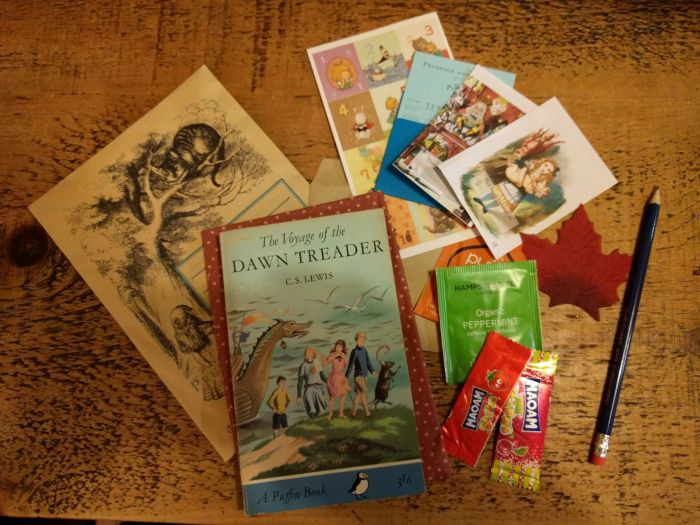
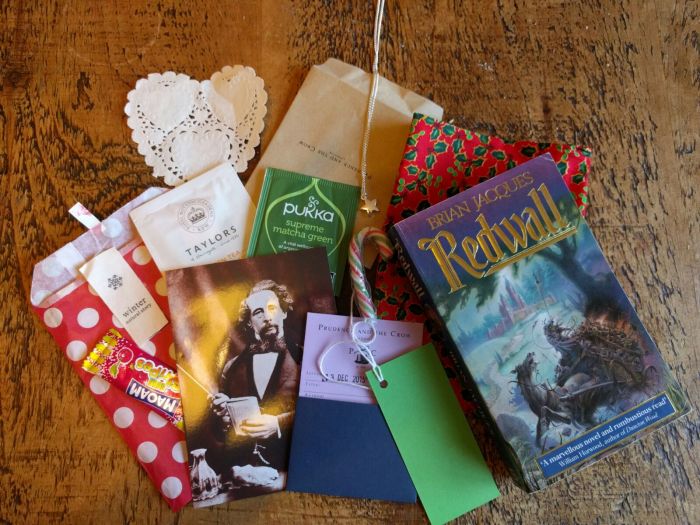
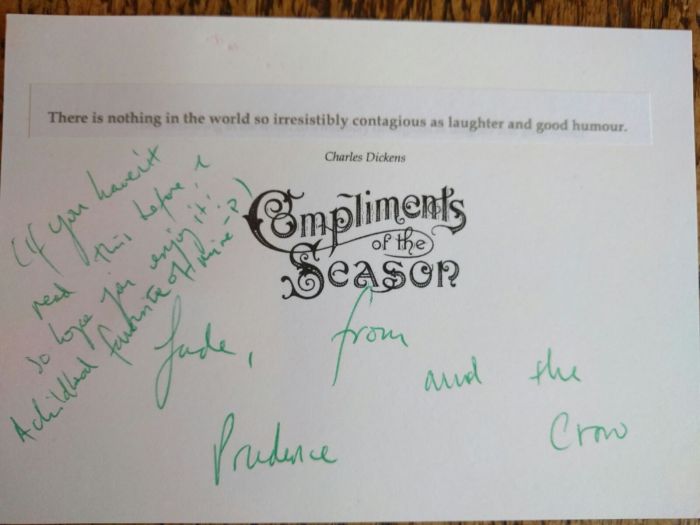
I also returned to some very welcome packages from my good friends Prudence and the Crow!

November’s box

IMG-20151120-WA0000

December’s box

IMG-20151227-WA0001

While I’m over the moon with both my books, I’ll be placing November’s choice on the bookshelf for now, purely because I reviewed all the Chronicles of Narnia not that long ago, but I can’t wait to get started on December’s choice:

Redwall – Brian Jacques

It is the start of the Summer of the Late Rose. Redwall Abbey, the peaceful home of a community of mice slumbers in the warmth of a summer afternoon. The mice are busy preparing for the great Jubilee Feast. 

Bust not for long. Cluny is coming! The evil one-eyed rat warlord is advancing with his battle-scarred mob. And Cluny wants Redwall. 

Needless to say, I am thrilled with the prospect of another vintage children’s book to sink my teeth into – especially as it comes with a personal recommendation from Prudence.

IMG-20151227-WA0000

Here’s wishing you all the Happiest of New Years 🙂

There will be many, many reviews to follow.

A Tale of Two Families – Dodie Smith

“But these backwaters of existence sometimes breed, in their sluggish depths, strange acuities of emotion” ― Edith Wharton

I’d never heard of this book, or the author, before I was asked to review it. In fact, I will confess to having thought it was a modern novel – as so many I am requested to review are. So I was surprised, but also not, having read the novel, to discover it was written in the 1970s. I was taken by the language and setting, and thought the portrayal of the time was done very well, but I also thought that is had a slightly modern feel to it. This has led me to conclude that Dodie Smith was somewhat ahead of her contemporaries in her writing style.

A Tale of Two Families – Dodie Smith

‘This is going to be a long five minutes’ walk,’ said June.

May thought this possible as there was still no sign of any house, but she continued to find things to praise: the overgrown hedges, the tall, still-dripping trees, the brilliant green of the grassy verges, the freshness of the air. And after several more bends in the lane they saw a white wooden gate standing open. Once through this they looked across a large, circular lawn surrounded by a gravel drive. And now at last they were face to face with the house.

‘Much too large,’ said June.

51QWhoqlqpL._SY344_BO1,204,203,200_May and June are devoted sisters, married to equally-devoted brothers, George and Robert, and even after more than two decades of marriage the four still thoroughly enjoy each other’s company. So when May and her highly-successful husband commit to a five-year lease on a huge, decaying manor house out in the country it seems only natural that they should persuade June and Robert to accept, rent free, a cottage within the grounds.

The two families leave London and, once joined by two not-quite-stereotypical grandparents, and blessed by regular visits from their respective children, begin to thoroughly enjoy their new experiences. Any initial qualms about leaving the city are lost in blissful hours spent wandering through the lilac groves, listening to the birdsong of the resident nightingale, absorbing the country air and indulging in May’s excellent cooking. The only thing that could possibly distress this perfect equilibrium is the compulsory visit of dreaded Aunt Mildred aka ‘Mildew’. Eccentric, annoying and thoroughly too young for her age, Mildred delights in secret dramas, regardless of their truth, or the harm that they may cause.

First and foremost I was absolutely delighted at Dodie Smith’s portrayal of country living. There are few things I love more than day-dreaming of a blissful, quiet life somewhere remote, with only the smell of flowers, birdsong, and the thought of bare-footed, early morning strolls through dew-soaked grass to trouble me. Even though Smith’s portrayal comes through the eyes of a somewhat dysfunctional family unit it still felt to me like a kind of absolute heaven, although perhaps a less than traditional view of heaven . I was so taken by the setting, from the second May and June arrived at the manor house, on a day in which the house and ground were engulfed by a stereotypical English downpour. The rain could not put me off, there was a magic in the dripping of the tree-lined driveway, and the impression of the foreboding, unloved Dower house, standing cold and resolute against the elements, and when the washed-out introduction gave way to pure, unadulterated spring bliss I was smitten. The whole book is brimming with lilac groves, quaint woodlands, blossoms, sundials and mounds and mounds of asparagus and strawberries – I loved every single second of it.

This is a book where characters are really central to the plot, I know characters are important in any story, but here it is the development of the characters that drive the story forward. Smith clearly had a talent for creating quirky, yet believable characters. Each and every character that passes through the estate has some kind of secret, inner passion or frustration. From the sensual Corinna, who is well and truly tired of waiting for saintly Hugh to make a move on her, to the quietly frustrated Robert, who, try as he might, cannot get his next novel on paper. Mildred inspires the release of these frustrations, allowing characters true desires to take form, while undoubtedly an expertly crafter character in her own right, her primary role is to serve as a catalyst for development in others.

In this way the story is very much in the moment, and in the experience, of two families shared existence. The day-to-day happenings in the Dower house are all at once endearing, humorous, envy-inducing, and on the whole utterly ridiculous. Think about it, could you really imagine your parents moving in with your aunt and uncle? Or yourself moving in with your sister/brother and their significant other? Regardless of how close knit a family you come from the situation is really rather odd. The book reads like an extended summer holiday – beautiful in its own way but very much temporary. I get the impression that, in the end, both families might actually quite like to return home.

All in all I thoroughly enjoyed reading A Tale of Two Families, and would be interested to look up Smith’s other works in the future. I found the book to be a perfect, relaxing afternoon read – it left me feeling pleasantly fulfilled, and without the emotional torture than comes from a horrific book hangover. That said, if you like a bit more substance to your books, there is definitely potential to delve a little further into the hidden meanings behind characters’ actions. On the whole, would recommend, whether as a casual afternoon read or a more in depth book club selection.

I received a free copy of A Tale of Two Families from Hesperus Press in exchange for an honest review.

The Mouse and His Child – Russell Hoban

“A clockwork heart can’t replace the real thing.” ― Dru Pagliassotti

I received this book in my August Prudence and the Crow box, the book selection was a fantastic bit of luck, as I’d been really craving classic children’s literature – between you and me I’m becoming more and more convinced that Prudence and the Crow are able to read my mind. From the a quick look at the front cover and the name alone – I know, I know, never judge a book by its cover, right? – I was expecting story about a mouse that fell in love with a windup mouseling. I’m sure you get the idea, something similar to Pinocchio, but English – so, perhaps with afternoons spent playing in dolls’ houses pretending to drink tea. I could not have been more mistaken, but, far from being disappointed, I absolutely loved it.

The Mouse and His Child – Russell Hoban

“Where are we?” the mouse child asked his father. His voice was tiny in the stillness of the night.
“I don’t know” the father replied.
What are we, Papa?”
“I don’t know. We must wait and see.” 

the-mouse-and-his-childOn a cold winter’s evening a tin father and son emerge from a box to stand on display in a toy shop window. Outside the cold wind blows and tramp passes by, momentarily taken by the sight of the toys. Brand new, and confused, the mouse and his child struggle to comprehend what it means to be windup toys and the thought of the life that lays before them makes the poor child cry.

It is not long before they are swept away, bought by a family, destined for a life spent dancing beneath the Christmas tree – the life of a windup. It is a simple life, spent quietly fulfilling their duties; until they break the ancient clock-work rules and must face the consequences.

Discarded in the snow the mouse and his child begin a wholly different journey than the one written for them. They are rescued, repaired by a tramp, and chased by a terrible force that would see all windup toys turned to slaves. Through all that they endure the mouse and the child wish for only one thing, a place to call their own – a magnificent house, a mother, and a sister.

I wish I could say that I had read this book as a child. This is definitely a tale that will take on an entirely different meaning, and gain resonance as a person grows older. I spoke about the book with a colleague when I had just started reading it, and he said that he loved it as a child, but upon revisiting it as an adult realised, quite simply ‘wow, this is really deep stuff’. I could try and say it more eloquently, but that is the bare bones of it. The Mouse and his Child is an incredible tale of quest and determination for children, and when viewed with an adult’s mind it is absolutely brimming with philosophical thoughts, lessons, analogies, and big, gaping questions about life.

“All roads, whether long or short, are hard,” said Frog. “Come, you have begun your journey, and all else necessarily follows from that act. Be of good cheer. The sun is bright. The sky is blue. The world lies before you.” 

The humanity of Hoban’s characters is truly incredible. The authors has taken windup toys and elevated them to the next level. Each toy, however minor their role in the tale, has its own unique drive and personality: the once-proud elephant, now plushless, and with the missing ear and eye patch; the tin seal, long separated from her colourful ball; the sweet child, forever asking questions, always looking, and understanding; and even the donkey – the poor, poor, donkey – who once dared to complain. These creatures may be made of clockwork, but they are no less human than you and I. They are exhausted, frightened, frustrated, despondent, sentimental, joyous, hopeful, and forever working towards their goals. Life throws its hurdles, and each one is tackled, even if it does take a short lifetime. Can you imagine what it would be like to spends years at the bottom on a pond? Through all this, they grow stronger, never losing sight of their aims, growing, learning and interacting with all whom cross their path. Just one more step, they will get there in the end.

The mouse and his child, who had learned so much and had prevailed against such overwhelming odds, never could be persuaded to teach a success course… The whole secret of the thing, they insisted, was simply and at all costs to move steadily ahead, and that, they said, could not be taught. 

The Mouse and his Child is a truly phenomenal children’s book, which has just as much, if not more, to offer to adult readers. I feel really thankful to have discovered this book, and look forward, truthfully, to a time when I can share it with the children in my life.

Millroy the Magician – Paul Theroux

“We do not need magic to transform our world. We carry all of the power we need inside ourselves already.” ― J.K. Rowling

My fiancé (oh yes!) recently finished reading this book and passed it on to me, insisting I read it my first possible opportunity. It didn’t take me quite as long to finish, he seemed to take months and months over it, but I can definitely understand why it might take someone a while to get through. The book is, shall I say, a little bit tricky. This is not a book you would want to attempt in a single sitting; it’s definitely one to take your time over.

Milroy the Magician – Paul Theroux

Our cheering drowned the music, but Milroy did not seem to hear it. He looked dignified, holding the flapping eagle, and he turned to me, and stared as he had before, and leaned over to where I sat in the second row.

Popping my thumb out of my mouth made the sound of a cork being yanked from a bottle.

Even through the cheering crowds his voice was distinct, as he said, ‘I want to eat you.’

So I stayed for his second show.

51WXvY4gl2LJilly Farina was nervous the day she attended the Barnstable County Fair. It was a hot, sticky Saturday in July and she was all by herself. Her Dada was black-out-drunk, so she went on alone, sitting at the back of the bus, quietly sucking her thumb, and thinking about what the fair had in store for her.

She had seen Millroy the Magician once before, he was famous for making an elephant disappear, and had once turned a girl from the audience into a glass of milk and drank her. Jeekers! But when Jilly stepped into the wickerwork coffin during a performance she had no idea that he would transform her life into something magical, and a touch bizarre.

You see, Millroy was no ordinary magician. A magical, eccentric, vegetarian, health fanatic, Millroy was set on changing the eating habits of the whole of America – Millroy could sense the future, and he knew that Jilly had a big role to play.

I was supposed to meet my father at the Barnstaple County Fair, and in a way I did, though he was not Dada.

Paul Theroux presents Jilly as a girl who is very young for her years. The world which emerges through Jilly’s eyes is that inhabited by a scared, lonely child. As a reader you enter the body of Jilly, and stand, absent mindedly sucking your thumb and stroking your ear, while dreamily drinking in the world around you. As a reader, you grow to know Jilly intimately, to understand her innocence and naivety.

It is really no wonder that Millroy chose her.

Jilly’s relationship with Millroy is an odd combination of love and fear, sometimes one, sometimes both, and often shifting quickly from one to the other. The relationship is, on the whole, slightly awkward. While it is obvious that Jilly dotes on Millroy they remain entirely separate beings, always together, but forever apart. It is obvious that she fears him, or at least she fears his magic, but at the same time loves him, as a father or perhaps something more?

Even odder is Millroy’s relationship with Jilly. If Jilly dotes on Millroy, then Millroy obsesses over Jilly. Linked to this is Millroy’s own obsession with food – he is determined to inform the American public of the evils of the American food industry, but more than this, he is obsessed with feeding Jilly.

Food is an underlying and overlying theme. The whole book is brimming with pottage, homemade bread, green tea, broiled fish and herbage. Try reading the book without in some way succumbing to the desire to be regular – I’m sure it can’t be done. I developed such an appetite for leaves! Millroy is forever chewing, munching or gulping some delectable healthy snack, while preaching the importance of a clean, fresh, healthy, regular lifestyle. At the same time, Millroy obsesses over the dark side of food, the insidious nature of the American food industry, the sweating, drooling, gasping, jiggling American population, stuffed full of fat, chemicals, meat and sugar.

If the American food industry is insidious, what is even more insidious is Millroy’s interest in Jilly. Why is he so obsessed with her? Why does he want to be responsible for ‘everything’ that goes inside of her? And why does he fall to pieces at the idea of losing her? It is almost as though he is in some way dependent on Jilly, not just emotionally, but physically, as though he is feeding off of her.

This is one of the oddest books I have ever read. It left me with so many questions, which I’m not sure have clear cut answers: Who is Millroy? What is the root of his magic? Does the magic pass on? Does it destroy the bearer? So many questions, and so many potential answers.

Millroy the Magician is a strange book – but one that I very much enjoyed reading. It is absorbing, without much action, and tense, without real drama. Each passage speaks volumes, without relaying much in the way of actual events. I feel as though the story is more of a journey in itself than an adventure – sure, Millroy travels across America and achieves amazing things, but in the end has much changed? Are Millroy and Jilly much different? Or have they merely switched roles?

On the whole, would recommend.

And yes, he did propose ❤

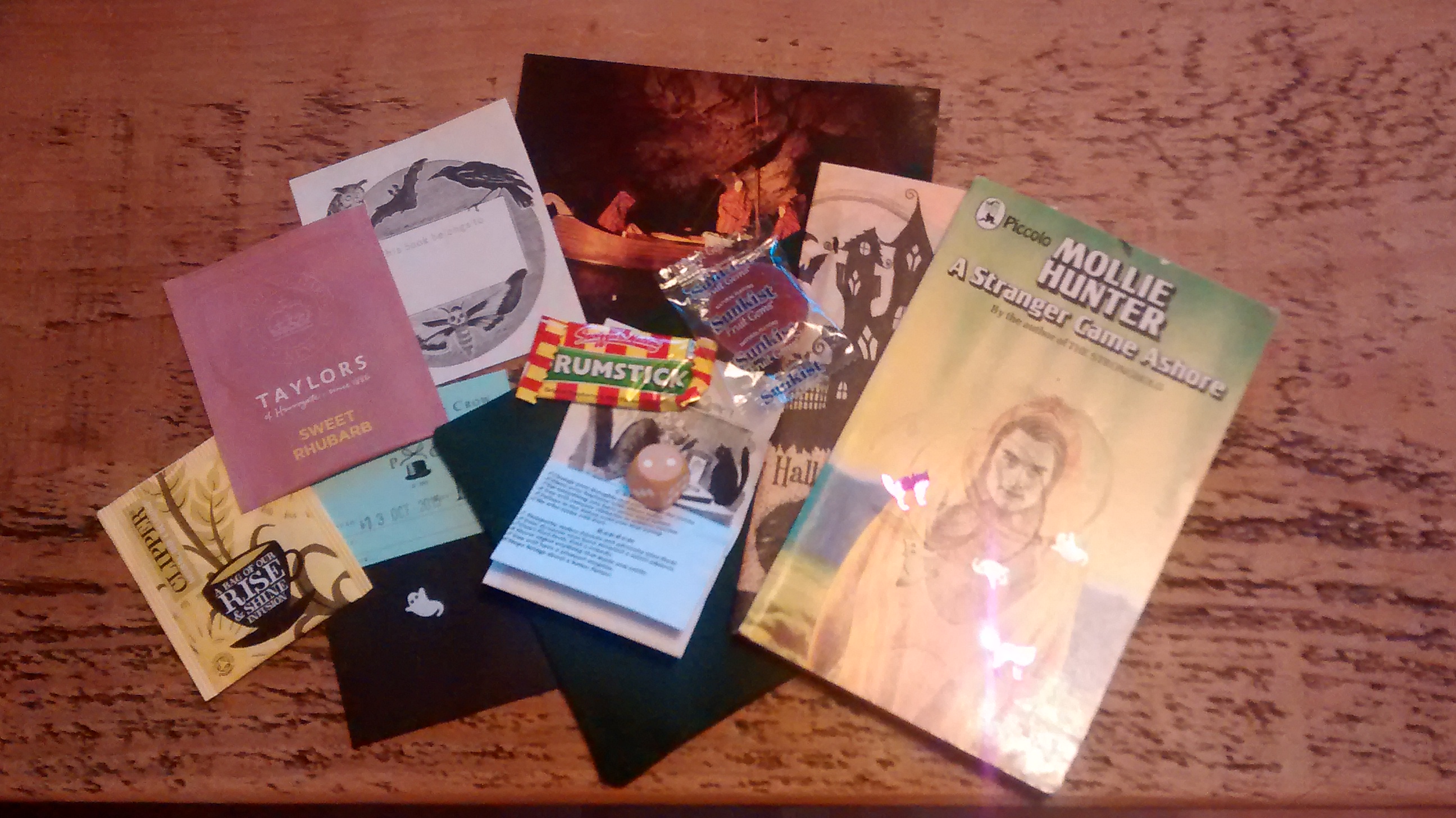
Monday motivation

There is no better way to start the week than with a special delivery from Prudence and the Crow.

Added bonus – it’s Halloween themed! Amazing!

IMG_20151014_180808659

The Hard Word Box – Sarah Hesketh

“She almost thought she’d said the words aloud, but she hadn’t. They remained trapped in her head, but not because they were barricaded by plaques and tangles. She just couldn’t say them aloud” ― Lisa Genova

The Hard Word Box – Sarah Hesketh

thwb_smI found this book on the Penned in the Margins Facebook page and was automatically drawn to it. A poetry book based on someone’s experience of time spent in a dementia care home is something I have not come across before, and I felt as though the book had the potential to be something truly amazing.

I realised that what was most important, was not that Maureen used to like jazz, or that Bill had once been a butcher, but that Jack tells great jokes, Phyllis likes helping others to the table – that’s who these people are now. They are still living their live, and these lives are what need to be represented.

‘What would happen if you placed contemporary artists in dementia care settings and asked them to create responses?’ – this is exactly what Sarah Hesketh strove to find out, and The Hard Word Box is the result.

The individual pieces within The Hard Word Box are a combination of poems, interviews, short stories and anecdotes. The poems are made up of words and phrases included on care plans and posters, as well as those words spoken to Hesketh by the residents of the care home. One particular piece contains every word a certain resident said to Hesketh during her time in the home. The piece, ‘Elizabeth’, is incredibly poignant, spanning several pages, with the words few and far between, casual phrases in a sea of silence.

Of the three interviews Hesketh published, it is the one with Marlene, the sister of a dementia sufferer, which I found to be the most moving. She speaks at length about the stigma of dementia – which is of course, something that those with developed dementia cannot do themselves – as well as the seven years she spent caring for her brother as his mental state declined. Marlene spoke of how isolated she became once her friends began to draw away because they could not cope with her brother, and this, she says, is something she will never learn to forget. People fear dementia, and they are embarrassed by it, but this only makes it worse for those for whom dementia is a reality. Getting old is terrifying, not just for those who grow old, but also for the people left behind.

Reading The Hard Word Box was an incredibly emotional journey for me. I was reminded of the time my own grandmother spent in a dementia home, before she eventualllost her battle with old age. She was once the most motherly of creatures, always there to make a cup of tea and offer a warm blanket on a cold day. Once in the care home she was a very different lady, she no longer spoke much, and liked to fuss around in the sitting area, rearranging magazines, dusting shelves and continually wiping the care assistants’ names off the white board.

I could draw so many parallels to the stories and poems, not just from my grandmothers own situation, but those of the people I grew to know in Nanna’s care home. Elizabeth, who didn’t like cats, and just wanted Blanchy (her daughter, who never visited) to put that ‘thing’ outside; Grace, who, at 103 years old had spent her entire life in care; and a group of ladies whose names escape me, who, every afternoon, could be found sat in the television room, happily singing along to the radio. I could see so much of these times in Hesketh’s work, the high-backed chairs, sterile bathrooms and regimental bedrooms somehow at odds to the colourful array of personalities nestled within the care home.

Through The Hard Word Box, Hesketh has given a voice to some of the most outspoken members of society. The individual stories and poems are so sad to read, but it is beautiful to see the words as these people have said them. For me, Hesketh’s work is ground-breaking not in what it says, but in how it says it.

I’ve never read a book before which touched me in the quite the same way as The Hard Word Box did. Elizabeth is Missing, with its presentation of dementia, came close, but I felt safe in the knowledge that the book was fiction – written to make you think, but ultimately, to entertain. The reality of The Hard Word Box is something which really struck a chord with me – these people and their stories, lives and words are real. Hesketh made me feel a terrifying array of emotions: I felt cold, lonely, frightened and – ultimately – ashamed. Dementia is such a difficult subject, one that a lot of people simply do not know how to deal with. I will be the first to admit that I find it difficult, but I am learning. The words need saying, but they are, indeed, hard words to say.

Kafka on the Shore – Haruki Murakami

“People think dreams aren’t real just because they aren’t made of matter, of particles. Dreams are real. But they are made of viewpoints, of images, of memories and puns and lost hopes.”
― Neil Gaiman

Kafka on the Shore – Haruki Murakami

Some time ago, after reading After Dark, I said I wanted to explore more of Haruki Murakami’s work, well I finally got around to it, and I’m very happy I did.

Earlier this year I read Norwegian Wood as a book club selection (review to come, our club has yet to meet due to a few members taking their sweet time to read the book!) and I loved it. I loved it almost as much as The Elegance of the Hedgehog, and you know how much I love that book! I don’t know what it is about certain translations (that they are beautiful maybe?) but I just can’t get enough of them. I was so taken by Norwegian Wood that I began to think that Murakami might actually be one of my favourite authors, but I couldn’t make such a decision based on two books, to find out for sure I needed to read more.

So, I set myself the task of actively reading more Murakami (to begin with I decided I’d read one book a month, but what with all my other commitments that is starting to seem like wishful thinking) and first on the list was Kafka on the Shore. Now, Norwegian Wood is said to be somewhat of an anomaly in Murakami’s portfolio, but Kafka on the Shore is quintessentially Murakami-esque – so I thought this could be the decision maker.

Where Norwegian Wood is a unique take on a classic tale of love, Kafka on the Shore is weird, wonderful and unashamedly unique!

It’s as if when you’re in the forest, you become a seamless part of it. When you’re in the rain, you’re a part of the rain. When you’re in the morning, you’re a seamless part of the morning. When you’re with me, you become a part of me.

kotsIn Kafka on the Shore storylines combine to trace the extraordinary journeys of two seemingly unrelated characters. Kafka Tamura runs away from home on the eve of his fifteenth birthday, haunted by the words of his father’s dark prophecy. Ever since the mysterious departure of his mother and elder sister Kafka’s life has been full of questions. Now his aim is simple, to travel to a far off place and live in the corner of a library. The journey, it seems, may hold the answers.

Elsewhere in Nakano ward, the dim-witted but amiable Nakata tracks lost cats and enjoys the simple things in life, like eels, and pickled vegetables with rice. But this is all set to change with the arrival of a tall man in a top hat and boots, whose interest in the neighbourhood cats is far from innocent. With his simple life turned upside down Nakata is forced to leave Nakano ward, and embarks on journey unlike anything he has ever experienced before, or his simple mind can even comprehend.

As Nakata and Kafka’s stories unwind and intertwine the remarkable interlaces with the ordinary and the world takes on a wholly unusual shape – fish and leeches fall from the sky, and cats converse with people, while WWII soldiers live, unageing, in the depths of unnavigable forest, and living ghosts lurk in the perimeters of consciousness.

Kafka on the Shore is a classic tale of quest and enlightenment, with a wholly unusual twist, which goes beyond the boundaries of classic literature. Murakami’s characters embark on a journey of stunning proportions, a voyage of self-discovery through inexperience. Neither Kafka nor Nakata know what it is they are looking for, but the answer is out there, and the journey introduces them to many strange and wonderful characters, with whom brief encounters prove to be life-affirming.

Anyone who falls in love is searching for missing pieces of themselves. So anyone who’s in love gets sad when they think of their lover. It’s like stepping back inside a room you have fond memories of, one you haven’t seen in a long time. It’s just a natural feeling. You’re not the person who discovered that feeling, so don’t go trying to patent it, okay?

Kafka on the Shore is strange – there is no getting around it. Weird and wonderful things occur and the reasons behind these occurrences are not immediately, if at all, clear. Each chapter harbours events which, however deep and profound an impact they may have, lack any logical explanation. Try and apply a logical filter to Murakami’s and you will no doubt find yourself disappointed and frustrated.

I found it useful, in having read Kafka on the Shore to try and get some insight into  Murakami’s own thoughts on his writing. Murakami has explained his writing process as similar to dreaming, rather than delving into the fantastical: “Writing a novel lets me intentionally dream while I’m still awake. I can continue yesterday’s dream today, something you can’t normally do in everyday life. It’s also a way of descending deep into my own consciousness. So while I see it as dreamlike, it’s not fantasy. For me the dreamlike is very real.”

Kafka on the Shore, then, can be seen as the amalgamation of two different worlds, the combination of the conscious and the unconscious. Think of the book as you would a dream, and suddenly things become much clearer. I was reminded, in reading this, of the talk I went to by Nigerian author Ben Okri last summer in which he spoke of exploring a new way of thinking in his writing, to show that text does not have to follow strict criteria. The world that you create, he said, can be sequential and logical, or circular and dancing. Kafka on the Shore falls firmly into the latter category.

Despite everything, it’s not a difficult book to read. The obscure and the philosophical, which may at times feel somewhat overwhelming, for me were lightened by Murakami’s abstract humour. Here I could give examples of the pimp dressed like Colonel Sanders, or Nakata’s continued reference to going for a ‘dump’ – but for me, the most hilarious part of the book, was Oshima’s fantastic shutting down of two women who refer to him as a ‘typical sexist, patriarchal male’.

My verdict – I liked it. But nowhere near as much as Norwegian Wood. I definitely need to read some more before I make a decision on just how much of a Murakami fangirl I am. The book won’t be for everyone – fans of the logical and sequential and those of you unsettled by violence against animals should steer clear of this one – but I’m certainly not done with my Murakami journey just yet.

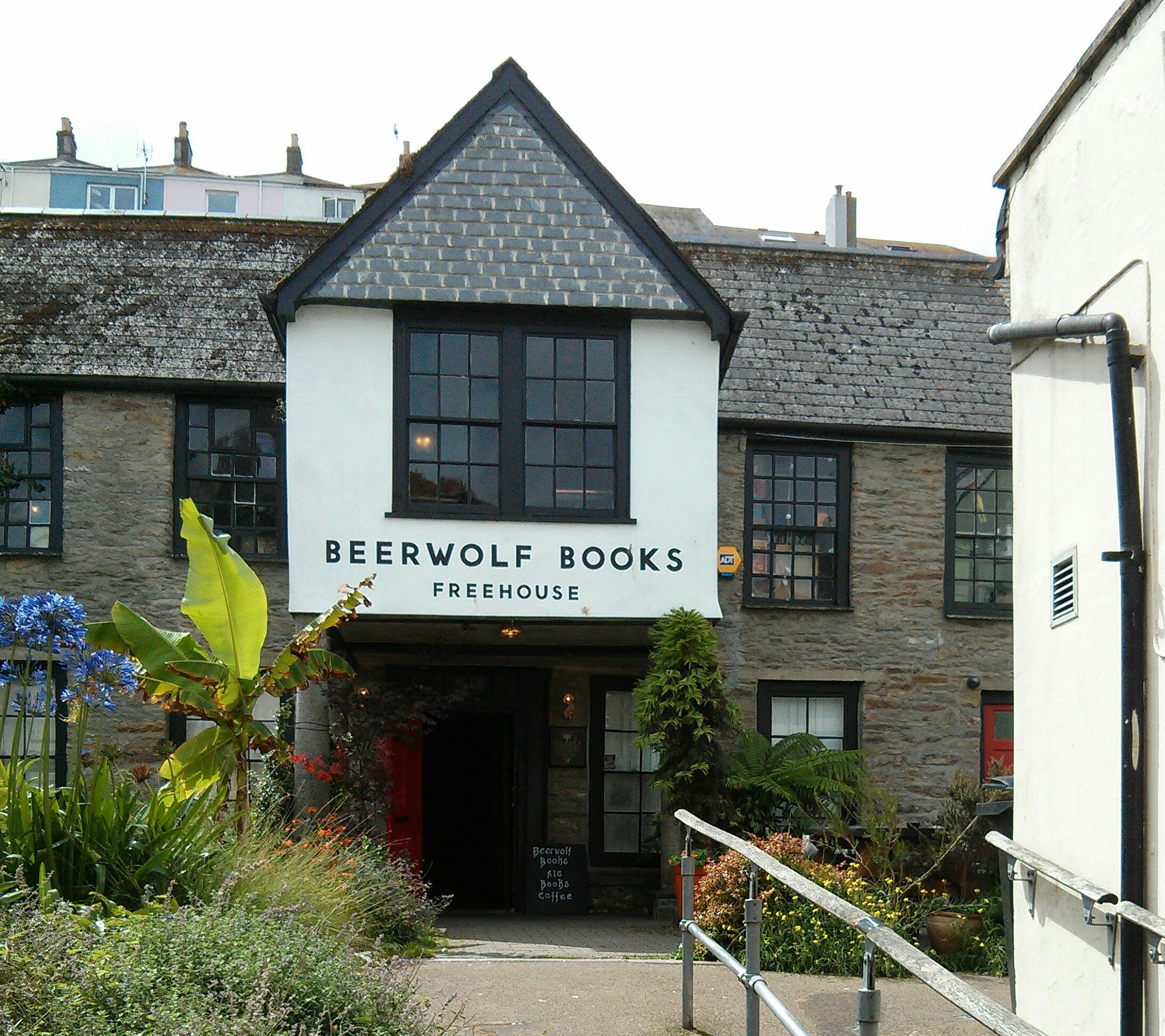
Beerwolf Books, Falmouth

I’ve just returned from a brief visit with friends down in Cornwall and am feeling wonderfully refreshed and recouped. There’s nothing quite like a stay in the country to help clear your mind and recharge your batteries.

During our stay we spent a couple of days in Falmouth checking out the many vintage boutiques and used-book shops, while stopping for an occasional ‘snifter’ in one of the local watering-holes. One such stop found us in a cosy little public house nestled down an alley behind the bustling main street. Now, each of the pubs we visited in Falmouth had its own special charm but this one was by far my favourite.

IMG_20150814_134721

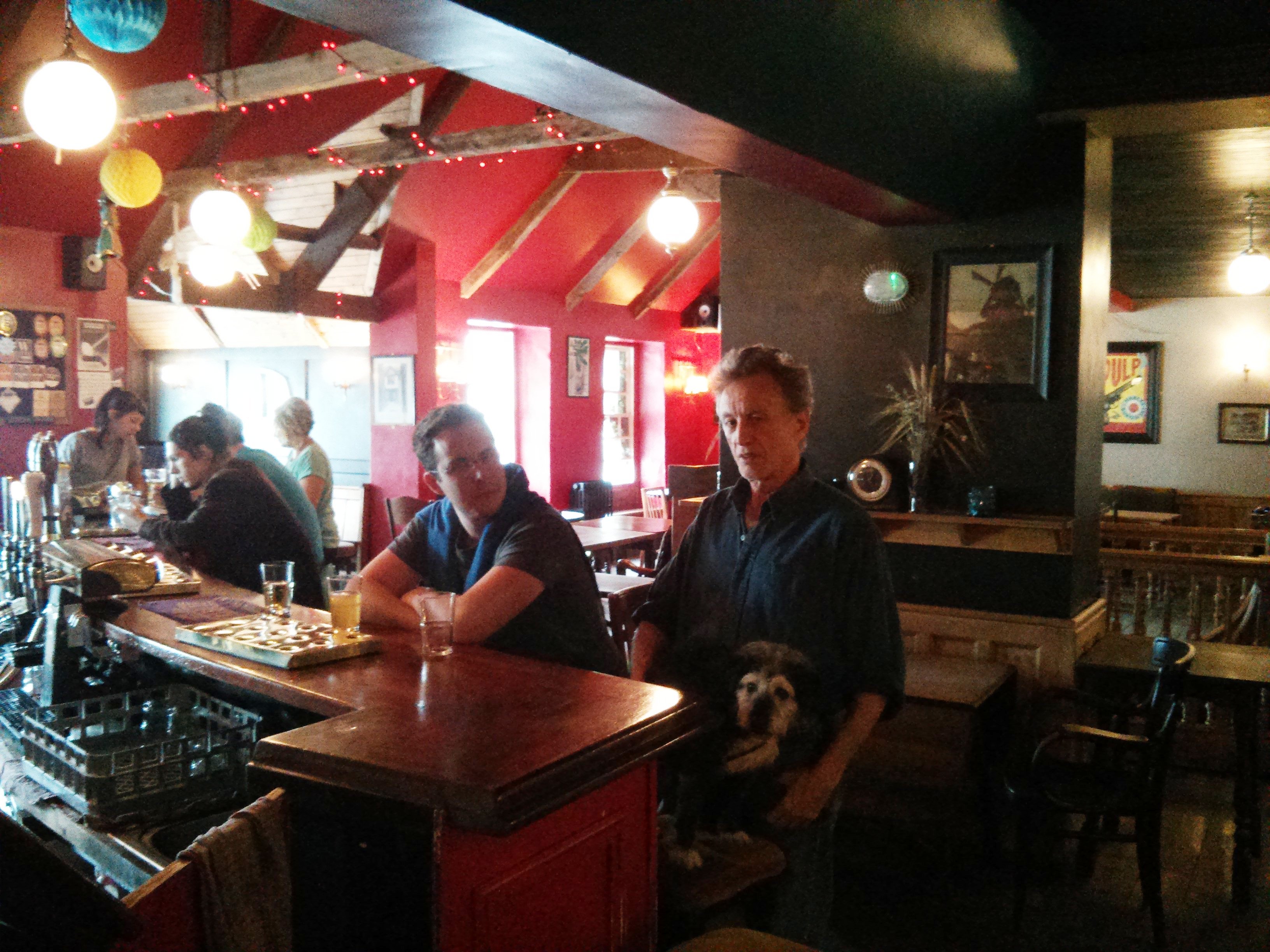
Beerwolf Books is not like any old boozer – it is a bookshop and public house combined, and consequently one of the most amazing places I have ever visited. Every pub should be like this one. I know a lot of pubs these days have bookshelves in them, but I’m not talking about a Wetherspoons with a dusty collection of random texts that no one has ever so much as glanced at – Beerwolf Books is just as much a bookshop with beer as it is a pub with books.

IMG_20150814_140940IMG_20150814_141009

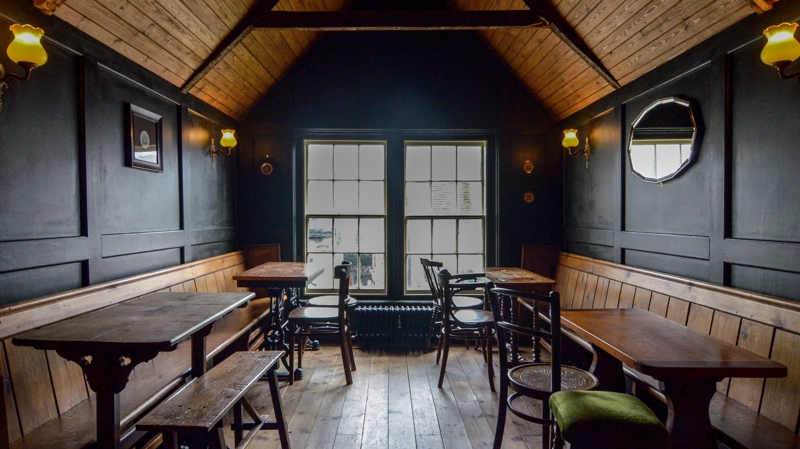
Upon entering the building, a steep central staircase brings you to a small room with shelves crammed full of books, which are available to buy from the bar, or simply to read during your stay. While there is a definite nautical/Cornish theme to a lot of the books there are also contemporary texts, classic literature and a great selection of children’s books and graphic novels. Spend a little time perusing the shelves and you are bound to find something to tickle your fancy.

IMG_20150814_141034IMG_20150814_141138

Outside of the book shop, the cosy bar provides the perfect atmosphere to unwind with your choice of tipple and literature. If you are feeling less than boozy you can curl up with a cup of tea, but the bookshop/coffee-shop combo has been done many a time before, and it seems a shame not to take advantage of the array of ales and ciders on tap.

IMG_20150814_140654beerwolf01

Obviously I couldn’t walk away empty handed. I’m not sure how I could I possibly justify NOT buying a book from a place like this. I was drawn, as is often the case, towards the children’s section and spent a while leafing through the local gems that were on offer before settling on this stunning hardback.

WaltzeswithGiants_Jacket

The Book Thief – Markus Zusak

“In our hatred, we are like bees who must pay with their lives for the use of their stingers” ― Friedrich Reck-Malleczewen

“I hate the Führer,” she said. “I hate him.”

And Hans Hubermann?

What did he do?

What did he say?

Did he bend down and embrace his foster daughter, as he wanted to? Did he tell her that he was sorry for what was happening to her, to her mother, for what had happened to her brother?

Not exactly.

He clenched his eyes. Then opened them. He slapped Liesel Meminger squarely in the face.

“Don’t ever say that!” His voice was quiet, but sharp.

71h2sjik5al-_sl1380_This book just launched itself directly onto my list of favourite books of all time!

The Book Thief is narrated by Death – this is what first drew me towards it. The front cover depicts a young girl skipping hand in hand with the Grim Reaper – how could I not want to read this?

Despite my excitement I was less than enthused by the way the book began. The whole prologue had vaguely unnatural feel to it. I found it really difficult to get into and I worried that the whole book would continue in the same jarring, start-and-stop style. I knew I wouldn’t be able to force my way through the 500+ pages of text if Zusak didn’t grasp my attention soon.

Thankfully, my worries were in vain.

It was as though someone turned on a light, and I suddenly went from being vaguely uncomfortable to completely in my element. The rest of the book is written in a similar style, but whereas the prologue felt awkward and unnatural, the proceeding chapters click perfectly into place.

The book thief’s story begins in 1939 in Nazi Germany. Liesel Meminger is taken to Himmel Street in Molching, to the home of her new foster parents, Hans and Rosa Hubermann. Her communist parents have been taken away to concentration camps, and her young brother did not survive the journey to their new home.  On her first night in Himmel Street as she lies in her new room, the bed reserved for her brother lying empty next to her, she is plagued by nightmares of her brother’s death, and awakes screaming in a cold sweat. Her foster father, ‘Papa’, comforts her, reading to her from The Gravedigger’s Handbook – Liesel’s first stolen text.

As political tensions in Germany increase, Hans is called upon to fulfil a promise he made years before, forcing him to harbour a deadly secret, and placing the family constant danger. Despite their fears, relationships in the family grow stronger and each night Hans continues to read with Liezel. As her book collection grows, Liesel recognises the power of the written word and slowly begins to write her own story.

Zusak’s style, while perhaps slightly jarring at first, is wonderfully unique. The story is separated into small chapters, each focusing on a very specific point in time, with death drawing out the relevance of each occurrence to the wider story. The text is broken up with pictures, handwritten notes, and regular snippets of background information in amongst the main tale: brief statistics, information on Stalingrad, small observances, and even a pamphlet made from the painted-over pages of Hitler’s Mein Kampf, are all slipped into the flow of the text.

tumblr_mhxkst85nD1rnqtdko1_500

The presence of Death as a narrator is interesting, and works really well given the context of the book. Throughout the novel the shadow of loss hangs heavy over Nazi Germany and Death himself is a constant feature on every street corner. As a narrator, Death foretells of which characters are due to meet their demise. Zusak allows you to fall in love with characters you know are going to die. And no, this doesn’t ruin the ending, it adds to the overall tension which builds up over the course of the book. It is as though you are placed in the midst of the inhabitants of Himmel Street, knowing that war will claim some of those that you love. Waiting to find out when Death will strike is the real struggle.

The Book Thief is unique amongst WWII fiction as it tells the tale of war-torn Germany from a Nazi-child’s perspective. Liesel Meminger is a wonderfully-developed and complex character who is just beginning to form her own understanding of the world. She understands the importance of doing as she is told out in the street, of Heil Hitler-ing the lady in the sweet shop and attending Hitler Youth in a neatly pressed uniform. But inside, she conceals her own personal judgements and aspirations, harbouring thoughts that must not be spoken outside the walls of 33 Himmel Street.

The Book Thief is marketed as a book for young adults, but I struggle to see how anyone, whatever their age, could fail to enjoy it. If you are interested in WWII fiction, or, like me, in historical fiction in general, then this really is a must read.