Hot off the press — Governance for Development 2014-15

Our third publication of 2014 is back from the printers and ready for the launch at the UN Public Service Forum in Seoul next week.

G4D

Introducing Governance for Development 2014-15 

Specially published for the UN Public Service Forum 2014, Governance for Development 2014-15 features:

• Winners of the UN Public Service Awards 2014 – the most prestigious international recognition of public service professionalism and excellence
• Independent thought leadership pieces and case studies
• A unique reference section with information on each of the 193 UN member states

For information on the publication, or to purchase a copy check out our website.

“I like books whose virtue is all drawn together in a page or two. I like sentences that don’t budge though armies cross them.” ― Virginia Woolf

Obscure poetry round two – Final sentence poetry.

I was recommended this method of constructing poetry by a friend of a friend, and I instantly loved it! The idea is to choose a book, and construct a poem by taking the final sentence from each chapter, starting at the back and working forwards

I took a while browsing through the books at home and in the office before I chose two to use that I liked the look of, and then used a long train journey to London to construct my poetry. The main issue I encountered was with overly long sentences, I took each of these as they came, cutting some of them down, or running them across two lines, depending on what I thought sounded better.

The following are the end result:


1134855Flying Fox in a Freedom Tree – Albert Wendt

Forgive dear reader please confession
Of Humble man who is man got religion.
All is well in Lava,
So spake the Flying-Fox.
She visits her husband’s grave at Magiagi every Saturday afternoon,
We crucified him.
It is only a saint they are burying,
The only one you’ve got down is only a pampered nag.
If mine father mother brother and captain see me now;
He held up his hand proudly.
Mauga stood crowned by the last rays of the setting sun.


Billy Liar – Keith WaterhouseImage

I began the slow walk home,
I did not have the courage to turn around and look at my mother.
I put out the light.
The idea of ever seeing Stamp again,
Filled me with horror.
I beckoned to Liz.
I did not stop running until I was clear of Clogiron Lane,
And whistled all the way down the Arcade,
Getting the Ambrosian repeater gun into position.
And even while I was burying the calenders the feeling was still with me.
Why don’t you tell the boring little man to stick the job up his jacksy?
I watched her down Market Street until the swinging of her skirt was out of sight,
And went into the office.
Get stuffed.
I wondered what I was going to do about everything.


Again I had a lot of fun playing around with these and decided to spread the word a little further, this time to a friend who’s currently living over in Australia. His taste in books is a little unusual, but I really liked what he came up with:


Image

John Dies at the End – David Wong

Your ball.
I knew, of course, that it never, ever would.
I turned to John to tell him to find something sharp.
What’s in it?
I can’t believe you just said that,
One way or another,
This is gonna be the end.
I would have put a bullet in my own skull one minute later.
I snapped the padlock shut,
Then trudged inside the house.
Now, this is going to sound crazy…
Then in the fall, everything went to hell,
He then stabbed Xorox in the belly with her own hand.
Vegas was just the beginning.
Wanna play hockey?
And then came the voices.
I got nothing else out of her the rest of the night.
Do you have your ATM card?
Please come with me, sir.
I locked up and went to bed.


I’d recommend any of you creative types out there to give this a go, the method doesn’t really require a lot of effort at all, and I found some of the sentences worked together really well.

I’ve been given some great suggestions so far for other methods to include on my obscure poetry journey, so please feel free to send me any other ideas you might have.

“I am no bird; and no net ensnares me: I am a free human being with an independent will.” ― Charlotte Brontë

Which side is the ‘right’ side?

Clara  Suzanna Linton

CLARA

Suzanna Linton was born in South Carolina and grew up in Orangeburg County. After graduating high school, she attended Francis Marion University, where she majored in English. Linton tells of how she began writing as a child, after feeling as though she was brimming over with ideas and needed to ‘share them before they poured out of my eyes and ears’. An initial penchant for experimenting with poetry grew into a love of writing fiction. Linton currently lives in South Carolina with her husband and pet dogs. As well as writing fiction, she works in the local library. Her debut novel, Clara, was published in 2013.


Linton’s book follows the journey of Clara, a seemingly ordinary child to whom life has been anything but kind. Having being sold into slavery, Clara loses the ability to talk, her voice forced deep inside of her by the horrors she suffered at the hands of the slavers. Bought by a wealthy master, Clara falls into a dreary life working in the castle kitchens, never venturing further than the kitchen garden. She is known by no name and those around her see her as nothing more than a mute slave girl who is possibly a little slow. But, unbeknownst to those around her, Clara holds the unique ability to see into the future, a gift she has kept secret for years through fear of persecution. When a vision prompts her to prevent a murder, she finds herself catapulted into the lives of the nobility, and the centre of civil war that threatens to destroy the country. In a journey that takes her from her humble roots to the capital city itself, Clara discovers that the future of the nation depends on her and her alone.

Before I started reading Clara I knew nothing about the story other than the title. I think I expected a Jane Austen-style coming-of-age romance more than anything, so I was surprised by the way the story progressed. I like the way Linton gradually introduced the reader to the supernatural side of the novel, starting with Clara’s visions and gradually bringing in further aspects. The book is written in the style of a medieval fantasy and the world in which Clara lives is similar to that of our own with elements of fantasy thrown in. On the whole, Linton keeps the language of the characters fairly simple, drawing on medieval English and introducing new words occasionally to describe, for example, measures of time. I liked this aspect of the book, which added to feeling of it being a fantasy novel without becoming too confusing. I also enjoyed the setting that Linton created; the descriptions used were vivid, allowing the book to come to life. I particularly liked Linton’s description of the wealthy capital, Candor:

‘Every bit of trade going south to Bertrand went through Candor. Every bit of trade coming up from Bertrand went through Candor. It sat like a giant purse on a rich man’s desk, begging to be stolen.’

At its heart, Clara is indeed a coming-of-age novel, although perhaps not in the classic sense. Through the three hundred pages of the book, the reader forms a relationship with the heroine and follows her through an incredible transformation. From the very beginning, Clara’s life is hard on her; we are first introduced to the girl as a skinny child, sent to work and unable to play with the other children:

‘Clara trudged home, the sack of pots banging and clattering against her thin legs. The wind blew against her back, bringing with it the laughter and music of a festival she couldn’t attend.’

From this point, the reader follows her as she is sold into the slave trade, before becoming the pet ‘mouse’ of the lady of the castle in which she was so recently enslaved. Seldom throughout the novel does Clara seem genuinely happy, although one such moment that particularly spoke to me occurs shortly after Clara has escaped from slavery and is travelling with Emmerich and Gavin:

‘Mud and dust stained her dark red riding dress and her hair fell loose from her braid. A little dirt smudged her cheek. Fatigue slumped her shoulders but a small smile curved her face as the horses bent to eat the hay she sprinkled before them.’

Later in the book she is given many more luxuries and presented with beautiful clothing, ladies in waiting and guards to protect her, but it is never enough to make her happy. In some ways, Clara can appear as an unlikable character: she is angry and untrusting, miserable most of the time, and does not appreciate the things she is given. However, I think this makes her character all the more genuine; it is natural and very human for Clara to behave the way she does. Regardless of the gifts and luxuries Clara is given, she has within her always the desire to break free of the slave’s collar, which remains symbolically strapped round her neck until the end of the book.

As Clara becomes more and more entwined within the politics of the civil war she faces situations that challenge her allegiance, often leading her to wonder which the ‘right’ side is. Clara’s abilities render her invaluable to both armies and, as such, she is vulnerable to manipulation. Both sides hide the truth from her in one way or another, and it is left to Clara to decide for herself who she should put her trust in. Sometimes, doing what is ‘right’ can have unforeseen repercussions.

As Clara’s character develops, so too does her beauty. As a slave, it is easy to forget that Clara was once described as ‘beautiful’ by a friend of her parents; she becomes the dirty, mute slave girl with matted hair. As the mouse, she is described as ‘elfish’, before moving on to ‘pretty for a slave’. It is not until Clara begins to break free of these shackles that it becomes apparent just how beautiful she really is in the eyes of those who love her:

‘She looked up and formed a question with her large eyes and sweet mouth.’

Clara’s confusion towards the love she receives is a central theme throughout the novel. She finds it difficult to know how to feel about any of those who flatter her: can they really be trusted? Her nature makes her guarded towards any advances.

I thought it was inevitable that Clara should fall for one of the men in the book, but was very pleased that, ultimately, there is not a fairy-tale ending. Too often heroines give up on their dreams because they fall in love. Most prominently within Clara is the desire to escape, to be free, and to discover herself, and she makes the choice to put these dreams first, and perhaps to come back to love once she has discovered herself.

As with many of the books I review, I do have a couple of small gripes to add before I round off. Firstly, I feel the text could do with a professional edit as there are quite a few mistakes in the text. However, I do feel this is inevitable with a lot of self-published work, and I don’t feel that the mistakes overly detract from the story. Secondly, I feel that at some point events are perhaps drawn out a bit too far, and what could be described in a few pages takes up substantially more. I personally like to keep things concise. That said, I feel these are fairly minor details.

On the whole, I found Clara to be an enjoyable read. The storyline is entertaining and keeps you wanting to read on at the end of each chapter. I would be interested to see where the story goes next and in finding out the answers to some of the questions left hanging at the end of the book. I feel Clara would best suit a young adult audience, and fans of medieval fantasy.

All due thanks go to Suzanna Linton for providing me with a free review copy of the book.


“Fill your house with stacks of books, in all the crannies and all the nooks.” ― Dr. Seuss

I recently discovered a fantastic creative activity – book title poetry.

The idea is fairly simple  take some books and arrange them into piles using their titles to make up the lines of a poem. I thoroughly recommend giving it a go if you haven’t already.

I came across the idea while at work casually browsing instagram on my lunch break and decided that I would make my own the second I got home. As soon as I walked through the door that evening I started taking books from their shelves. I’m normally quite a neat person, but I threw caution to the wind, not even bothering to remember which shelf had housed which book.

I didn’t choose books for any one reason in particular, some titles just stood out to me, or were phrases I thought would be useful. I don’t think particularly matters, I just went with what felt right. Once I had a good selection of books I started to arrange them, trying to make lines fit together and when I was happy with my ‘poem’ I took a picture.

My attempts:

IMG_20140513_182919788

At a time like this,
Hard times,
The sands of time.
A cold unhurried hand.
A small part of me,
The man who would be King

IMG_20140513_182947324

Farewell, my lovely.
The boy who kicked pigs
Going solo,
Where angels fear to tread.
The love of a good woman.

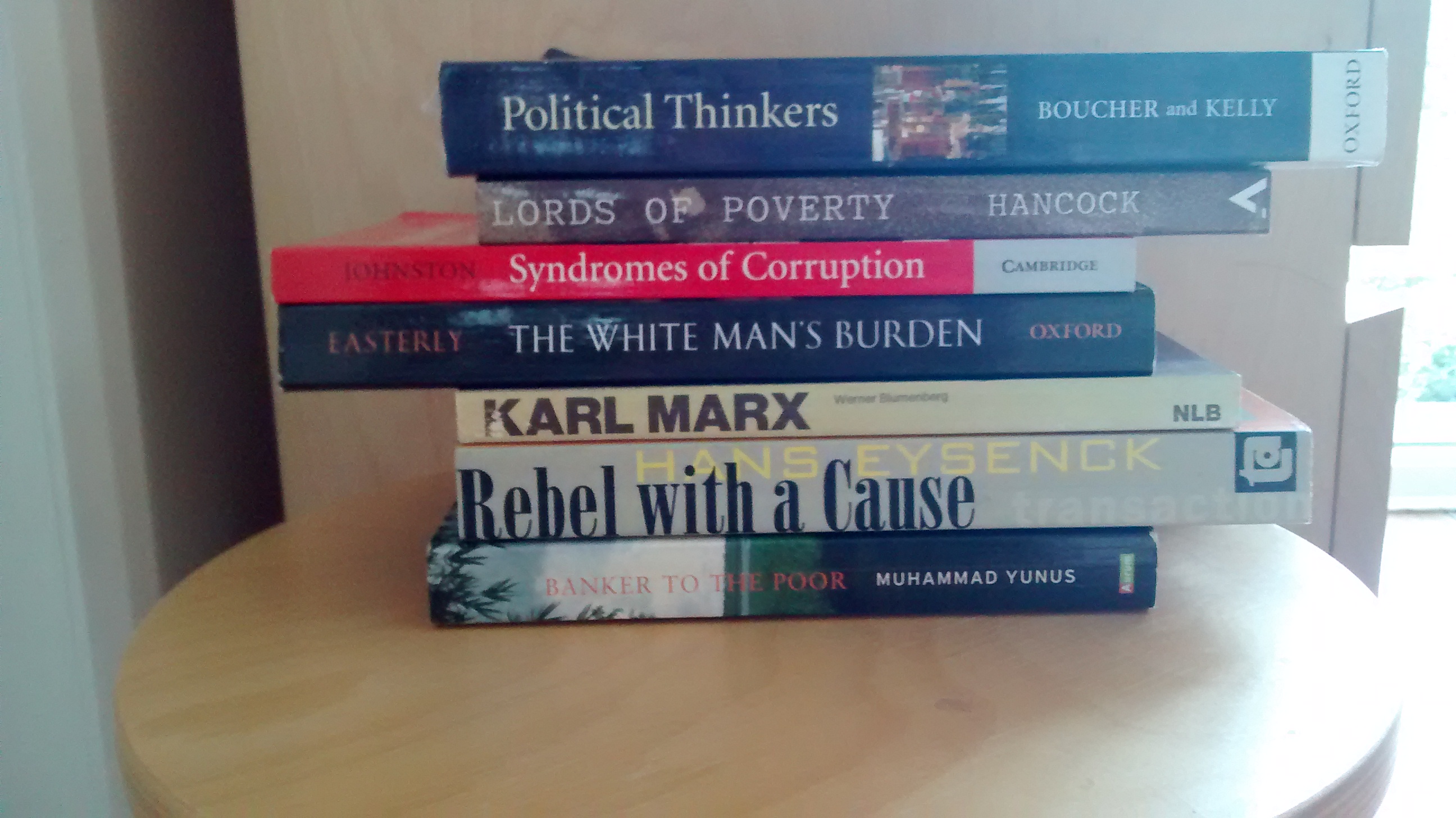
When I’d made a couple I decided to try a constructing a political poem using a selection of my old text books, and a few stolen from my boyfriend’s study:

IMG_20140513_183929818

Political thinkers,
Lords of poverty,
Syndromes of corruption,
The white man’s burden.
Karl Marx,
Rebel with a cause,
Banker to the poor.

I had such a great time trying this out that I passed the idea on to a friend who’s currently working overseas in Canada and feeling a little bored. She loves trying out new ways of stretching her creativity, so I gave her the task of taking titles from the public library and sending me the pictures to use alongside my own.

I absolutely love what she came up with – here are the pictures, and translations from french:

IMG-20140520-WA0000

The last week of May,
A taste of paradise,
A heart full of hope.
Not bad.

IMG-20140520-WA0001

Loving eyes,
The colour of lies,
Nothing more than one night,
The little bastard.

It can be quite therapeutic to try out, and if you have a lot of book titles you will be surprised what you can find. Sometimes the poems will just come together on their own  as was the case with last poem here, which uses a few titles by the same author.

This little activity got me thinking about the process of writing a poem. We didn’t really ‘write’ these poems, they already existed, and just needed putting together. So I started to wonder, how else can poetry be created from ‘found’ words? And, what other unusual methods of creating poetry are there? With this in mind I’ve decided to do some research into interesting techniques for constructing poetry, rather than writing it, and I’ve set up the ‘obscure poetry’ section of my blog in which to do this.

If any of you have any suggestions feel free to comment or drop me an email, ideas are always welcome 🙂

“How talented was death. How many expressions and manipulations of hand, face, body, no two alike.” ― Ray Bradbury,

St Cuthbert’s Corpse: A Life After Death – David Willem

Image

David Willem obtained a Bachelor’s degree in literary studies at the University of Portsmouth before beginning a career as a freelance writer and editor. Throughout this time he worked as a correspondent for several magazines and newspapers including the Guardian and the Times.  In 2002 Willem published his first book, Kicking: Following the Fans to the Orient, a fascinating look at relations between the English and the Japanese during the 2002 World Cup. Willem’s second book, St Cuthbert’s Corpse: A life after death was published by Sacristy Press in 2013.


The remains of St Cuthbert are said to reside inside Durham Cathedral. As with many saints, St Cuthbert became somewhat more famous after his death, which occurred in the year 687. The tale of St Cuthbert’s journey to its final resting place has much local fame, with several tales having emerged as to why Cuthbert may have ended up in Durham including the well-known ‘Dun Cow’ story. Perhaps most significant, however, are the stories surrounding St Cuthbert’s imperishable corpse. Thirteen hundred years after his death and the miracle of St Cuthbert’s seemingly incorrupt corpse still causes much fascination amongst historians, and theologians alike, it is even said to have inspired the construction of Durham Cathedral. Since St Cuthbert’s death his remains has been excavated on no less than six separate occasions. In St Cuthbert’s Corpse: A life after death David Willem, for the first time, amalgamates the historical accounts of each opening into one concise edition – providing the reader with a captivating glimpse into the life after death of St Cuthbert, from 687 to the present day.

Before reading St Cuthbert’s Corpse I was completely unfamiliar with this part of history, and will confess to having never even heard of St Cuthbert. While I am a massive fan of historical fiction, I don’t tend to read many historical texts, but was taken in by the striking front cover of the book, and its intriguing synopsis on the Sacristy website. I was not to be disappointed when I received the book, which is short enough to be read in a single sitting and offers a meticulously researched and crisp overview of the entire history of St Cuthbert’s corpse.

Willem has divided the book in several chapters, each tracing particular stage in the history of the corpse, with a short title and subtext explaining the era and time elapsed since St Cuthbert’s passing. Each chapter gives the reader not only the story of each excavation, but also a glimpse of each moment in history and an insight into the significance that the remains held to those alive at the time. Through this Willem has created an incredibly accessible piece, which is easily navigable by even the most budding historian.

The most enjoyable and perhaps frustrating part of the book is that there is no ending, and as a reader, you know that there will never be an ending. The question always remains as to the validity of the reports on the incorruptibility of St Cuthbert’s corpse. The accounts that exist of the times when the corpse was excavated follow on perfectly on from one another, but it is impossible to truly know the answer. I wonder perhaps if he will be excavated again one day, or if he has really been laid to rest this time?

Overall, I thoroughly enjoyed reading St Cuthbert’s Corpse, and took away knowledge of, what was to me, an entirely new piece of history, as well as a desire to know more. I would recommend the book to anyone interested in theological history, and to those unfamiliar with St Cuthbert’s story.

Many thanks to Sacristy Press for sending me a free review copy of the publication.

Another job well done — Commonwealth Health Partnerships 2014

I may have already mentioned how utterly manic the last few weeks have been…

Needless to say successfully managing several upcoming publications at once is no mean feat, but it does make holding the finished product all that more rewarding. For this reason it gives me great pleasure to present to you our latest publication:

ImageIntroducing Commonwealth Health Partnerships 2014 

Commonwealth Health Partnerships is the official annual Commonwealth reference source designed to ensure that ministers, policy-makers, officials and the development community can access analysis and thought leadership on:

  • Strengthening public health systems, and supporting healthcare delivery
  • Developments in priority aspects of healthcare such as  the treatment of heart disease & hypertension
  • Immunisation & public health education
  • Health workers – training, professional development, unions & migration
  • Key communicable & non-communicable diseases e.g. HIV/AIDS, malaria, tuberculosis, diabetes, cancer
  • In-country health structures & policies, including profiles of organisations committed to delivering public health in difficult circumstances.

Launched at the annual Commonwealth Health Ministers Meeting (CHMM), the publication provides a guide to current issues in global health for ministers, senior officials and other stakeholders.

The publication also includes extensive health profiles of the 53 Commonwealth member countries, incorporating up-to-date data on health systems and population health outcomes.

For information on our other publications, or to purchase a copy check out our website.

“Never be so busy as not to think of others.” ― Mother Teresa

I know I haven’t been posting quite as much recently. My ‘one review a week’ rule went out the window when my body decided to gift me a two-month spell of headaches and nausea. Now, don’t get me wrong, getting ill is never convenient, but this came at a really, really terrible time. We’ve been working on three books on top of one another at work, and there really hasn’t been much time for feeling sorry myself [although I will confess I’ve managed to fit a little of that in here and there].

Thankfully, last week was a bit of a turning point. Not only did one of the books go to press [Whoop whoop!] but I finally woke up without a nagging pain in the side of my face and a desire to crawl back under the covers. It really is amazing how good a couple of months of feeling awful can make you feel.

So to all of you reading this, I know some of you are waiting for reviews from me, don’t worry I haven’t forgotten you. I’ve got a mound of books to get through, but I am getting through them. The next one is coming, very soon!

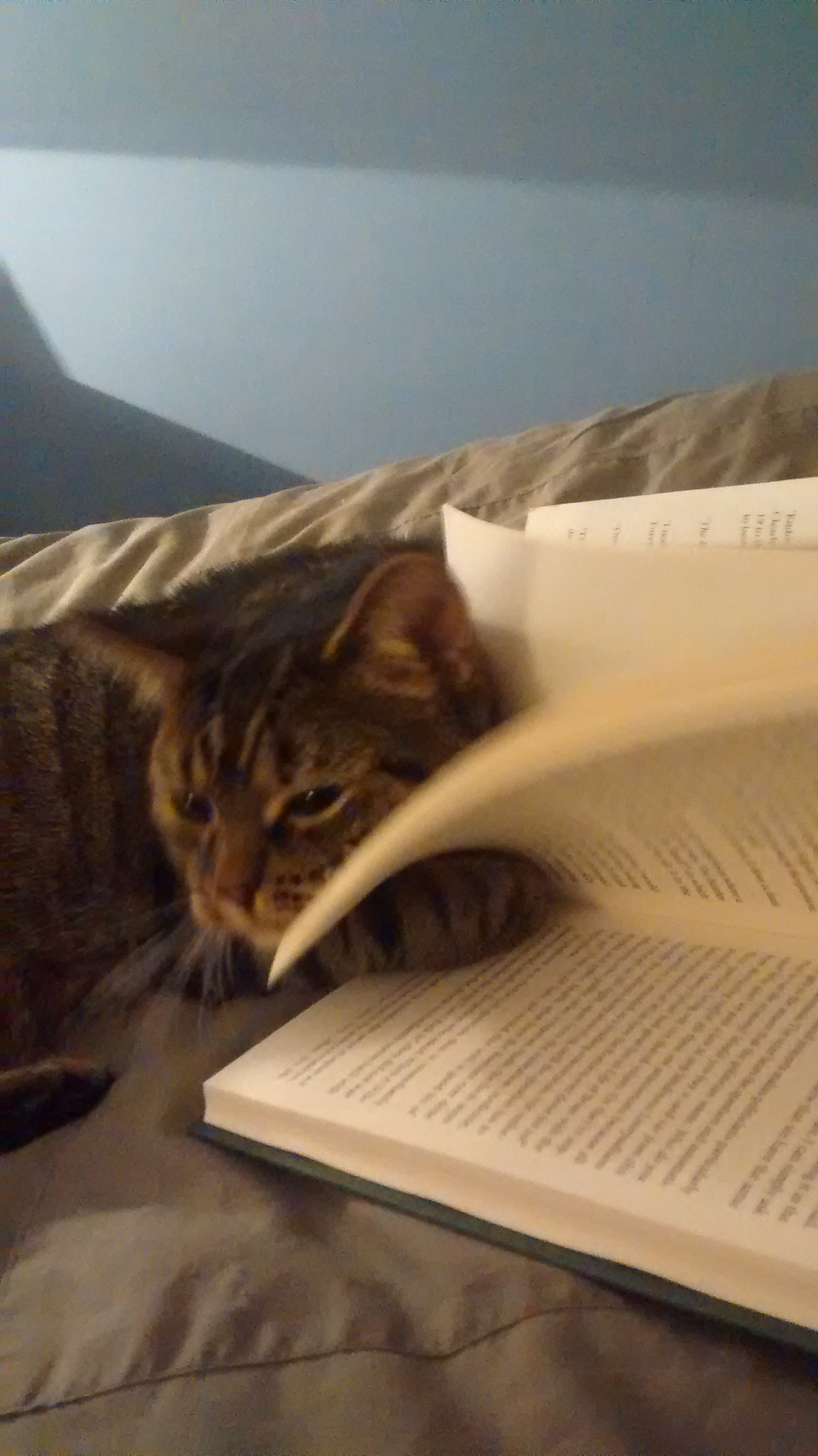
In the mean time, feel free to enjoy these pictures of Umlaut reading a book, and just be thankful you don’t need to use your own face every time you turn a page.

Image


Image


Image


“Your worst enemy, he reflected, was your nervous system. At any moment the tension inside you was liable to translate itself into some visible symptom.” ― George Orwell

Don’t get caught.

Dead and Buryd – Chele Cooke

dfw-cc-dab-cover-mid (2)

Chele Cooke recalls always having books around her while growing up, but she truly realised her love of reading as a teenager, when she discovered the Harry Potter books. Her taste in books is varied, having grown from her initial interest in fantasy – ‘I’ll give anything a try at least once,’ she tells me. Cooke began writing through play-by-post role plays, which she says was akin to ‘learning to walk before I ran’, and being able to submerge herself in another world helped with her own writing. This, coupled with a degree in creative writing, was the catalyst that launched her career as an author. Dead and Buryd, was released in 2013.


Dead and Buryd takes place on an alien planet plagued by harsh seasons; searing hot summers that give way to inhospitable, freezing winters. The planet’s natives, the Veniche have found themselves the effective slaves of their technologically advanced invaders, the Adveni. Any Veniche who steps out of line is liable for incarceration within the walls of the Adveni’s impenetrable prison, Lyndbury.

Cooke introduces the reader to Georgianna Lennox, a local medic, who works alongside the Adveni forces, treating those injured within the walls of the prison as a way of serving her lost people. When Georgianna’s friendship with a group of rebels – the Belsa – risks putting her own freedom at stake, she is faced with a difficult decision – what will she choose to put first, her family or the freedom of her people?

The first two chapters of the book form a sort of prologue to the story, setting the scene and introducing us to characters that come into play later on in the novel. This introduction to the novel works really well, serving to spark questions in the reader’s mind and piquing their curiosity. The history of the planet and the natives is quickly skimmed over in these opening chapters, and is elaborated upon at points throughout the novel. Through this gradual method of unravelling, Cooke lets the history of her world develop in the reader’s imagination, revealing little snippets of the story piece by piece.

The novel’s setting, an unfamiliar planet occupied by inhuman, almost robotic invaders, really appealed to me. Not only was the way in which Cooke portrays the setting particularly masterful – her descriptions allow your mind’s eye to create an almost perfect picture – but the harsh summers and harsher winters made me think of an exaggerated version of our own world. It almost seemed plausible to me that Cooke’s dystopia could be a future version of Earth, a world where the natural environment has been irreversibly damaged to such an extent that people are forced to live in tunnels to escape the searing heat, unable to spend even a short amount of time in the sun, in the heat of the day without fear of burning. Needless to say I was intrigued enough by the book from the onset that I didn’t want to put it down.

There are several central themes running through the novel, the most important of which is love. Love emerges in Cooke’s work in many different ways, but ultimately, there is a love which is central to the Veniche’s existence that the Adveni seem incapable of feeling. The Veniche are described as a very sentimental people – they have a strong allegiance to their kind, their tribes and ultimately their family. Georgianna herself works alongside the Adveni so that she can treat those of her people who are trapped away from the ones they love. Above and beyond this allegiance, is the love the Veniche develop for the one person they choose to ‘join’ themselves with. Being joined is described as something very final, which you can never distance yourself from. The topic is first approached in reference to a relationship between Georgianna’s brother and the man to whom he was joined. Georgianna first learns what it means to love by witnessing the love the two men share:

‘Watching her brother with Nequiel, However, she quickly learned that it wasn’t about finding someone suitable to join with, someone you could live with. It was about joining with the person you couldn’t live without.’

It is as though each Veniche is only one half of a person, and there is another half without which they cannot become whole. This is evident in the way loss is described:

‘Her brother was no longer the same person she had grown up with. He was quieter, more reserved, and less willing to talk about anything important.’

The Adveni, on the other hand, are clinical in the very sense of the word. Cooke creates an army of invaders akin to the Nazi’s Master Race. The allegiance that the Adveni have to their group goes beyond the heartfelt commitment of the Veniche; they have an ingrained herd mentality, going about their lives in favour of the greater good.

‘Unlike the Veniche, who paired most commonly for love, the Adveni were put to numerous tests. If their tletonise – the Adveni way of referring to what the Veniche people knew to be the aspects of a person passed on to their children – did not pass these tests, they were forbidden from creating offspring.’

The Adveni mating ritual is an example of survival of the fittest at its most horrifying – a greater force deliberately manipulating breeding patterns to create an indestructible army. Tactics frighteningly similar to those used by the Nazi’s during World War II. The Adveni do not have that one person who they feel they cannot live without; rather, they are matched up with the person best suited to their genetic makeup. For the Adveni, love exists only for the greater collective good.

A lack of love for one another is just a slight crack in the hard exterior that is the Adveni forces. They are feared and hated by the Veniche. The title of the novel alludes to this; the Veniche used the phrase ‘buryd alive’ to describe those taken captive by the Adveni, alive in almost every sense of the word, but unable to escape: ‘Though your life was over and there was no escape, your body remained alive.’

I love the way Cooke expresses Georgianna’s fear of the prison and the Adveni guards. While she tries to keep on the good side of the guards, she is always terrified of what may happen when the doors of the compound close behind her. Her fear is, understandably, multiplied when she has reason to be afraid:

‘If she showed up acting suspiciously, they’d know for certain that something was going on. The problem was, the harder she tried to think about other things, the more the plan filtered into her mind. As she walked, her only salvation became that the Adveni had no mind-reading technology, at least not that she knew of.’

This passage really stood out to me as a perfect portrayal of the reasoning everyone goes through when trying to behave casually in a risky situation. It’s a feeling so many people will be familiar with, as though your mind is playing tricks on you, feeding you morsels of hope before making you doubt yourself.

I found Georgianna to be, on the whole, an incredibly genuine and relatable character. In Georgianna, Cooke has created a fantastically well-rounded vessel to convey her story. The reader learns about the planet, the people, and the struggle almost exclusively through Georgianna, but they also get to know the heroine on a very personal level. In time it becomes apparent just how normal Georgianna is. Despite her situation, her allegiance with the rebels, the things that she does, and even the fact that she is from another world, there is an aspect of her personality that a lot of people can relate to.

The most obvious demonstration of Georgianna’s real character comes out in her feelings about Keiran. Georgianna has fallen foul to one of those complicated casual relationships, which I’m sure many people are familiar with. The way that she justifies the relationship to herself is so transparent. She begins by suggesting that she is fine with the way things are, but she always comes back to mentioning that she knows Keiran is with other women, and that she’s fine with it [I’m fine! Who else is fine?]. As time goes on, and Keiran’s comings and goings continue to plague Georgianna’s thoughts, it becomes apparent that she is not so cool with it after all:

‘Weird was hardly the word she’d give to it. She’d maybe been a little more emotional, but seeing as Keiran has his wonderful reputation with women, surely this wasn’t the first time a girl had realised she wasn’t happy keeping their relationship at just sex.’

When Georgianna realises she might want more from the relationship, she cannot keep the sarcasm out of her thoughts – Keiran has a wonderful reputation with women. However, she still attempts to appear reserved, as though she does not want to show her true self for fear of being hurt:

‘Finally looking up at him, she shrugged a little. Clasping her hands tightly in her lap, trying to stop herself from fidgeting, she found herself drumming her fingers nervously against the backs of her hands.’

Georgianna really is just so likeable and funny, despite her hard exterior. Forming a relationship with the heroine of the story like this really added to my enjoyment of the novel.

Overall, I thoroughly enjoyed reading Cooke’s work. The story has some fantastic plot twists and enough unanswered questions to have me eagerly anticipating the next in the series. Cooke’s writing style is smooth and fluid, maintaining a unity throughout the flow of the story. I am not an enormous Sci-Fi reader, and I can be easily put off by the random and incessant introduction of unnecessarily complicated devices, but I found Cooke to be very accessible. While new terminology is introduced to the reader, it is done so easily, and with explanation, so as to avoid over complication. Dead and Buryd gets a resounding ‘would recommend’ from me.

I am thankful to Chele Cooke for providing me with a free review copy of her work, and introducing me to the Out of Orbit series.

“The greatest gift you can ever give another person is your own happiness” ― Esther Hicks

“The greatest gift you can ever give another person is your own happiness”  ― Esther Hicks

I couldn’t resist sharing with you all this amazing gift my brother gave to me. It perfectly combines my love of literature and maps and will be given pride of place in my soon-to-be reading room.