‘The Essential Digital Detox Plan’ by Orianna Fielding

Being constantly connected to digital devices can sometimes be more of a hindrance than a help, as Orianna Fielding discusses in this elegant new publication from Carlton Books.
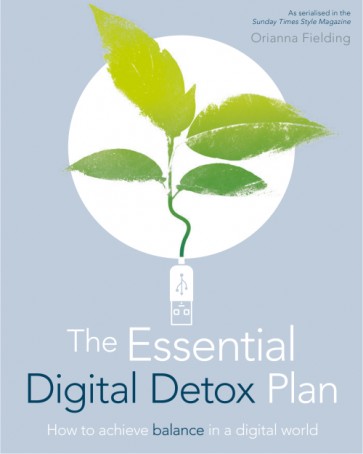
9781780979052

I once met a man who would send framed photos of himself to all his friends and family every year as Christmas presents. Weird isn’t it? Why would anybody want that as a gift? Not so strange, though, is the idea of sharing photos of yourself on social media for, presumably, the benefit of your many friends and followers. Remove the computer, though, and the whole thing gets really quite peculiar. Could you imagine yourself having just got back from holiday, picking up reams of glossy 4 by 7 prints from the pharmacy, slipping them into individually addressed envelopes and sending them out for all your friends to see? I’m willing to bet not, because that would make you seem more than a little overbearing, and possibly lead to a few restraining orders. So why is it ok, encouraged even, to do this online?

In The Essential Digital Detox Plan: How to achieve balance in a digital world, Orianna Fielding explores this concept, and many more, as she delves into the strange world of new social media, and offers advice for those who want to have more control over their digital consumption habits.

We have reached a stage, Fielding says, where connectivity permeates every aspect of our lives. Texting and reading on smartphones rather than conversing with those around us is now considered the norm, and we are constantly connected to our work and personal emails at the expense of missing out what is happening around us. It is important to realise, she says, that having access to the world in the palm of your hand also means the world has access to you. Eurphoria at the ability to be connected at all times can quickly be replaced with a debilitating dependence on being connected at all times.

The Essential Digital Detox Plan provides advice for how people can take control of their digital consumption habits, rather than allowing their digital devices to have control of them. The suggestions included in the text range from introducing phone-free meal times and tech-free zones in the house to taking unplugged time out at work to engage in a five-minute meditation ‘snack’. For the most committed out there, the back of the book serves as a step by step guide to full digital detox, from one hour to the full seven days.

The overarching theme of the book is not just about disconnecting from digital devices, but about adopting a slower, more conscious approach to life. Fielding stresses the important of taking the time to observe your surroundings and really ‘be’ in the present moment to indulge in experiences that, often, access to a smartphone or tablet can negate.

The steps, suggestions and advice included in the text stem from Fielding’s own journey to achieving a balance in her digital consumption habits. This gives a very personal feel to the text, but also means that at times Fielding’s style can see a bit self righteous, perhaps even presumptuous. But I think you are more likely to pick up on this or find it a little grating if you haven’t brought this book for advice.

It’s never fun to pick up on mistakes in reviews, but, for all the good I have to say about this book, I would not be a very good editor if I didn’t make mention of the glaring error in the preface. Fielding refers to the book by the wrong name (Unplugged), not once but twice. I assume, as this book was once serialised in a magazine, that it has been given one or two new lifelines along the way to full publication. No doubt at some point it was called Unplugged, but it isn’t now, and this really is something that should have been picked up prior to publication.

On the whole, though, I think The Essential Digital Detox Plan is a pretty good companion for those wishing to spend a little less time surrounded by technology, or take a more relaxed approach to their digital consumption. Even if you don’t want to go all out and commit to a full seven-day digital detox, the book contains a lot in the way of yoga and meditation exercises and other tips and tricks to help you take time out during your day.

This review was first published online for E&T magazine
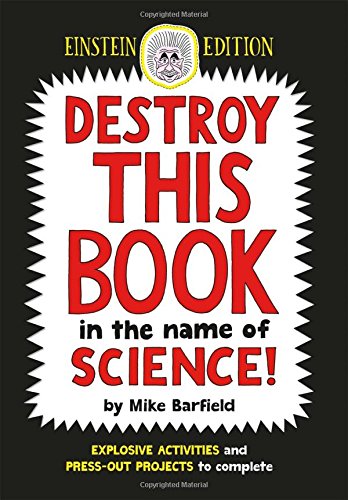
‘Destroy this Book in the Name of Science’ by Mike Barfield


Science is exciting and at no point is this more apparent than when viewed through the eyes of a child, as this fun-filled new publication from Mike Barfield goes to show.

51Vxelcs4pL

As an impressionable ten-year-old, mere mention of the word ‘science’ had me thinking about dissolving just about anything in huge beakers of acid. With real-world scientific knowledge limited to the realms of mixing salt in water and weird Brainiac-related science abuse involving walking on custard and testing out slippery socks, I just couldn’t wait to get to secondary school and discover what wonders awaited me in the teenage science lab. Who could possibly resist the temptation of flammable alkaline metals, fizzing rainbow-coloured liquids and sooty beakers tarnished by improperly adjusted Bunsen burners?

When I first visited my secondary school, the chemistry teacher set up an experiment to show that the colour of fire could be changed using different types of salt. I’ll never forget adding borax to the soft glow of a Bunsen burner and seeing the flame change to a vivid apple green. The teacher managed to feign delight at what was no doubt the same experiment he’d seen dozens of times already that evening, musing ‘I’d rather like a pair of trousers that colour’ as I happily trotted off for my next lab tour.

What’s the point of this weird childhood anecdote, you may ask? To show that children are impressionable and liable to be amazed by even the simplest feats of science. It’s a good thing, too, because we all know how important it is to get children interested in STEM from an early age. As a parent, older sibling, aunt, uncle or concerned observer, it’s never too soon to get the young Isaac Newtons in your life excited about the wonderful world of science – and what better place to start than in the home.

The good news is that hands-on, kid-friendly science doesn’t have to be limited to the chemicals, crystals and compounds in the average chemistry set. A solution comes in the form of Destroy this Book in the Name of Science, an entertaining new publication from author Mike Barfield, which proves the perfect literary addition to the lab/bedroom of curious children.

Complete with its very own cut-out Einstein mask, this book is filled with projects and tasks to push out and pull apart, with pages reserved for colouring, doodling, cutting, tearing and flat-out destroying – all in the name of science. With the help of a little glue and some determination, even the most fledgling of boffins can discover the physics behinds some exceptional magic tricks, build a working cardboard hoop glider to out-fly any paper aeroplane and race paper sea turtles with the help of just a little washing up liquid.

The comically illustrated book is a simple affordable method of awakening the latent scientist nestled within each young brain. I would recommend this book for adults wanting to engage children in a little scientific fun or, equally, tired editorial staff in need of a Friday afternoon pick-me-up.

This review was first published online for E&T magazine.

Redwall – Brian Jacques

Yet another book I wish I had known about when I was a child. I’m absolutely thrilled to know there are more in the series – I just need to find the time to read them!

51ofme5fdl-_sx306_bo1204203200_

This is the first in a series of wonderful children’s books about a peaceful community of field mice who live within the quiet confines of Redwall Abbey. The brotherhood slumbers quietly on the edge of the Moss Wood, providing a place of humble solitude and unquestioned refuge for any who seek it. They live a simple wholesome life enjoying the good things nature has to offer – like goat’s milk, honey and nut brown ale. I feel warm inside just thinking about it.

Of course, it takes conflict to make a story, and so be prepared, once you open this book, for the lives of the Redwall mice to be thrown into turmoil. Not a day is given over to the lives within the Abbey before Cluny the Scourge, a vicious, one-eyed rodent, whose nightmarish existence is the stuff of legends, rolls in from the wild woods beyond the horizon. The noisome creature sets his sights on Redwall Abbey, determined to turn the warm stone walls into a fetid nesting ground for himself and his band of vile vagabonds. This is the beginning of an epic battle, the likes of which the peaceful brotherhood of Redwall has not seen for hundreds of years.

Our unlikely hero is a small, clumsy field mouse named Matthias, a new addition to the Abbey, who has a lot to learn about the complex history of his new home as he fights to defend its boundaries from Cluny’s deadly crew. It will take more than just the mice to defend the Abbey, but enlisting help from their neighbours is not as easy as just asking for it. The Moss Woods are rife with historical conflicts, and the mice, though peaceful, have a rather unsettling past. Beyond tribal feuds, though, are two evils more sinister than the sins of every benign entity combined, and only communal action can ensure that these dark presences do not forever disrupt the quiet equilibrium of the forest.

This book has a lot to offer to different readers. On one level it provides a fantastic amount of action for children’s literature – I was inadvertently clenching my teeth while reading about the battle between the mice and Cluny, and was filled with genuine terror at the idea of ‘old poison teeth’. On a personal level, though, I could have happily read all about the mice of Redwall without there being any kind of altercation. Redwall is the kind of community that one feeds on hearing about. Like the woodland animals in the Lion the Witch and the Wardrobe – specifically Mr and Mrs Badger – or any one of Beatrix Potter’s books. I am in love with the life that the mice live – it is so wholesome and wonderful; a simple, healthy life full of good things. The Abbey stands as a natural organ of the forest and the mice and the other creature that live within the walls keep it running like a well oiled bicycle – what more could I ask for in a book? A quiet life makes for content reading.

I was really taken by the complexity of Jacques’ characters. My personal favourite is Basil Stag Hare, whose ghost-like reflexes, mildly misquoted malapropisms and insatiable appetite are nothing short of genius. When it comes to characters that are also hares, Basil Stag is easily one of the most excellent I have ever come across*. He is joined by a whole host of unforgettable faces, Ambrose Spike the greedy hedgehog, Constance the formidable badger, and Warbeak, a sparrow who is much too big for her tiny, tiny boots.

Overall, I really enjoyed my first dip into the realms of Redwall Abbey. Jacques has crammed so much into this first book, and I have no doubt the rest will not disappoint. I would strongly recommend giving Redwall a try if you are a fan of young adult literature, tales of idyllic livelihoods interrupted, or anything containing anthropomorphic mice.

*This may sound oddly specific, but as a lifelong fan of Harriet’s Hare it is no mean feat

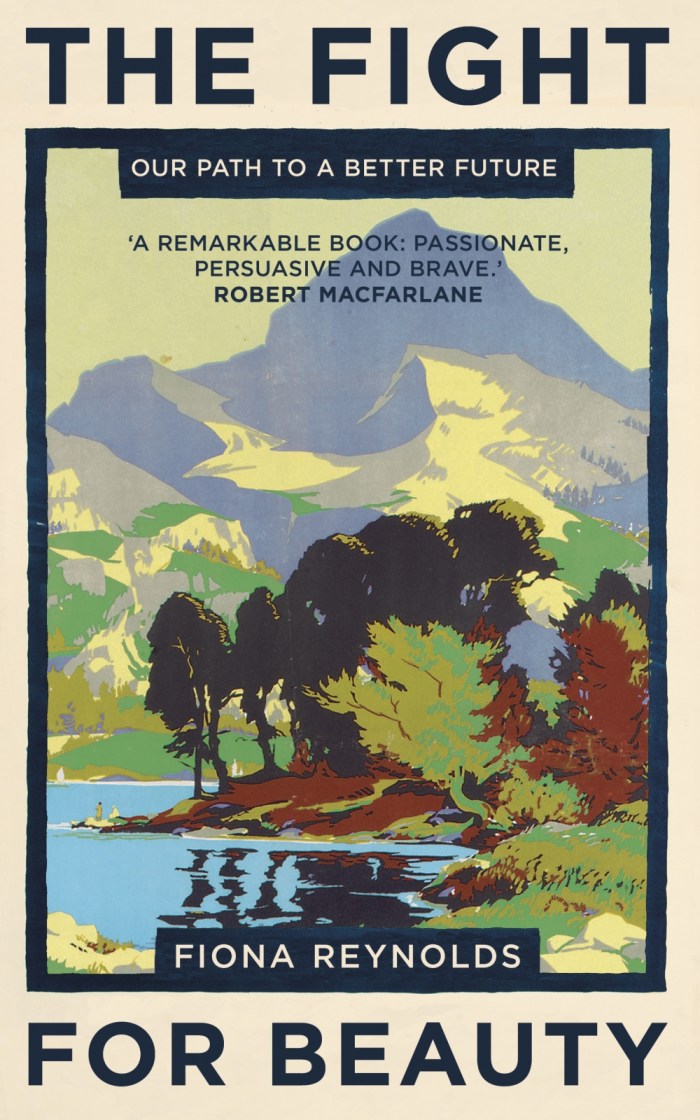
Book review: ‘The Fight for Beauty: Our Path to a Better Future’ by Fiona Reynolds

An enlightening journey through history’s many attempts to secure and protect what is beautiful in the world.

The-Fight-For-Beauty_9781780748757

Beauty is a complicated subject. We all know what it is, but as time goes by we become less comfortable with speaking about it, or so says author Fiona Reynolds in this stunning new publication from Oneworld.

Describing beauty of the natural world has become something sacred and very personal, where once it ran free within government documentation and legal literature, it is now replaced by more clinical attempts of ‘protecting biodiversity’ and ‘conserving habitats’. So much is the case that today, even while striving to protect natural beauty with climate change legislation and environmental protection orders, we do more than ever to ignore it.

Heeding the words of John Ruskin in the 19th century, Reynolds highlights the ever increasing drive for economic growth and desire for material possession in modern times. “Wherever I look of travel in England or abroad,” wrote Ruskin. “I see that men, wherever they can reach, destroy all beauty. They seem to have no other desire or hope but to have large house and to be able to move fast.” How much has changed since this time?

It reminds me of a recent news story about a real estate tycoon in the US who built the most expensive house to ever go on the market. The house is available for $250 million and comes complete with its own private cinema, massage parlour and luxury cars. What was the aim of this dwelling? To tap into the niche, super wealthy market of people willing to spend a quarter of a million dollars on a yacht, but who barely surpass $10 million when it comes to housing. A fantastic business venture if ever there was one – build a man a dream house and his friends will surely want one too – but it doesn’t do much to inspire hope in a future where consumerism isn’t everything.

Reynolds believes this state of economic affairs – where people strive for bigger and better possessions, and only things of monetary value have any real worth – makes it more difficult than ever to protect what matters, including the environment and our future.

In The Fight for Beauty: Our Path to a Better Future Reynolds collects words and aspirations of figures past and present who all endeavoured to achieve one thing: protection of the Earth and conservation of its natural beauty. The book examines ideas about nature, farming and urbanisation, explores mountain sides, secluded woodlands and protected heather-rich moorland, and delves into romantic thoughts and war poetry. Beginning with the impassioned minds of friends behind the Kyrle Society of the 19th century, whose calls for environmental protection gave way to the modern National Trust, Reynolds shows how definitions of beauty have been rearranged and reconsidered throughout history, before becoming somewhat lost within the fast-paced consumerist lifestyles of modern day.

The Fight for Beauty is at once intriguing, fascinating and incredibly moving. What could serve as an interesting account of the importance of the countryside throughout history is, on a much deeper level, a fervent call-to-arms to protect what, once gone, is gone forever. For Reynolds at least, inspiration from the past and from nature itself could provide an alternative path forward from human development, one where beauty is not forgotten.

This review was first published online for E&T magazine.

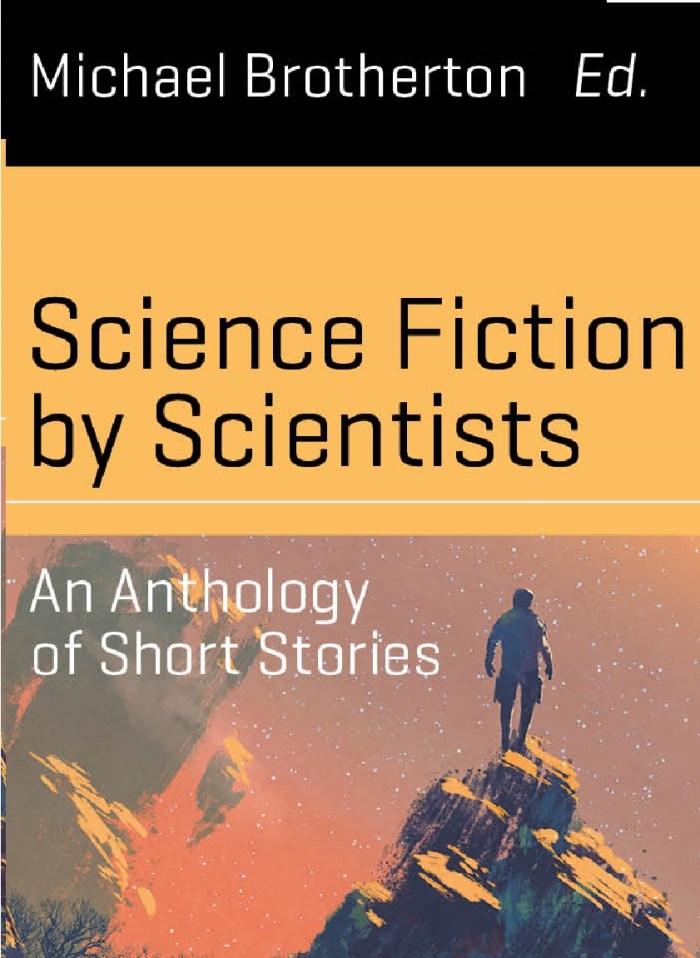
‘Science Fiction by Scientists: An Anthology of Short Stories’ edited by Michael Brotherton

Science and science fiction may seem like two sides of the same coin, but much of the genre gracing bookshelves and cinemas today is actually missing an integral piece of the puzzle – the ‘science’.

SF by Scientists (front cover)

Without science, says Michael Brotherton, sci-fi is little more than a western set in space, or a fantasy set in the future. As a lover of all things scientific and a trained astrophysicist, Brotherton characterises science fiction as providing a glimpse into amazing futures not outside the realms of possibility, or terrible and grotesque scenarios that we should try to avoid.

It may not surprise you to learn that many renowned sci-fi authors were trained in science – Isaac Asimov had a PhD in biochemistry, and Arthur C Clarke was known for his essays on space travel. Perhaps it is the accuracy, or indeed the believability of their fiction, the notion that these situations are not outside the realms of possibility, that makes their work so profound.

As editor of ‘Science Fiction by Scientists’, Brotherton introduces the latest generation of science-trained sci-fi writers, among them current researchers pursuing a love of fiction on the side, retired experts, or those who have set aside prosperous careers to write full time.

In ‘Down and Out’ by Ken Wharton, the reader meets Ogby, a strange, spiderlike creature living within the nutrient-rich oceans of a mysterious, ice-​encrusted land, with odd perceptions of gravity, sinking to the bottom of her habitat by filling one of her many gaseous bladders with air.

In ‘Supernova Rhythm’, Andrew Fraknoi writes of an optimistic young research scientist who discovers a strange pattern of exploding stars in galaxy NGC 6946, and so finds that there may be life forms billions of years ahead of us developmentally, whose actions we cannot possibly understand.

Alongside tales of obscure lands, terrifying futures and pending zombie apocalypses, the authors have taken time to explain a little of the science behind the sci-fi, unveiling origins of the tales and shedding some light on their motivation. In this way, we learn that Obgy is an alien lifeform from Europa, the ice moon of Jupiter, who scuttles upside-down upon the layers of ice enclosing the moon’s subterranean ocean; that a new musical piece created by a group of astronomers uses notes supplied by supernovae in far-off galaxies and that future scientists could theoretically sequence the DNA of hundreds of species of animals to be contained, and later deployed, within a single piece of fruit.

‘Science Fiction by Scientists’ is an interesting and intriguing anthology of short stories, which is sure to set the reader’s mind in motion a little better than the average collection of sci-fi shorts. Leisure is combined with learning to leave not just a sense of wonder and amusement, but also the desire to find out a little more about each author’s particular field.

For those interested in exploring further, a more challenging read comes in the form of ‘Murder on the Einstein Express and Other Stories’, also from Springer. This short anthology by assistant professor in mathematics and physics Harun Šiljak, touches on the realms of the theoretical, physical and computational to create obscure tales, including an Alice in Wonderland-type adventure set within the realms of mathematical analysis.

This review was first published online for E&T magazine

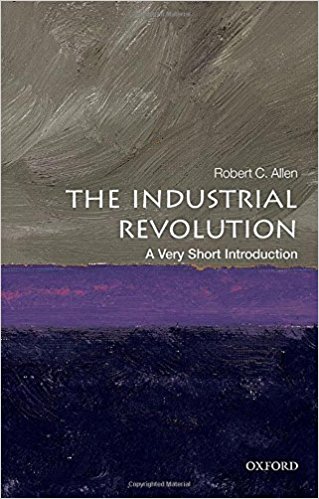
‘The Industrial Revolution: A Very Short Introduction’ by Robert C Allen

From British feudalism to the Internet of Things, this concise analysis of the Industrial Revolution provides the perfect introduction to one of the most complex times in human history.

51hK1TCIs1L._SX317_BO1,204,203,200_

Look back at the work of any 16th century painter and you will see a life very different to that we live today. Streets were strewn with farm animals and bore witness to all manner of slaughtering, plucking, sheering and bathing alongside horse drawn carts transporting livestock, cloth and grain – a food economy if ever there was one. The land was central to life, with arable plots taken up by livestock and agricultural farming, while towns and cities blossomed along riversides. Craftsmen, placed by the water’s edge for trade, would carve, sand and smooth their wares from metal and wood using hardy hand tools, before selling their goods in local markets. Homes were heated, and food cooked, using wood fires and charcoal, and sanitation left much to be desired.

Fast forward to today and life has moved on somewhat. Hand tools are relegated to those who enjoy gardening and crafts, with production carried out in connected factories, assisted by robotics and autonomous systems. Our houses are heated with oil, gas or renewable sources, and come complete with electric lighting and pristine running water. Most people now live within the confines of the city, which in themselves are vast and busy, with buildings stretching up and out as far as the eye can see. Areas of countryside, rather than offering the gift of life themselves, are set aside for those wishing to ‘reconnect’ with nature and escape the hectic urban life.

So how did we get from one to the other?

The answer lies in the Industrial Revolution, a decisive journey that occurred halfway between life depicted in oil works of the 1500s and today. In this latest Very Short Introduction from Oxford University Press, author Robert C. Allen traces the beginnings of the Industrial Revolution to the humble shores of the British Isles, and analyses the wider global effect of the two centuries of industrial development which helped to shape the course of recent history.

It is a tumultuous story that begins, as with this review, with the wholesome lives of aristocrats, tradesman and labourers in 16th century Britain, where seeds of revolution were sown long before the first cogs of the industrial machine began to turn. The years that followed were a turbulent time, filled with growth, but also contradiction. Alongside the progression man made, was life rife with poverty, unemployment, squalid housing, pollution and protest.

In just over 100 pages, Allen crams 500 years of human development and clears up any uncertainties one might have as to the roots, development and consequences of this Revolution. Despite developments around the world, it was Britain that first saw the ripples of industrialisation, which Allen traces from the English Channel, undulating out into mainland Europe and beyond.

‘The Industrial Revolution: A Very Short Introduction’ is a wonderfully accessible introduction to an incredibly complex period of human history. The revolution itself was made from simultaneous developments across trade, commerce, agriculture, mechanics and economics, and so this introduction, far from being just about the rise of industry, takes into account a breathtaking array of subject matter, but does so within the most manageable of formats. Allen has created another truly fantastic edition to the Very Short Introduction series. This book would make a wonderful addition to any bibliophile’s collection, but would be most ideally suited for those with an interest in industry, British history or international development.

This review was first published online for E&T magazine
Asteronymes – Claire Trévien

images

Asteronyme is the word for a sequence of asterisks used to hide a name or password. I wonder what this book of poetry is hiding.

Poetry is a like a window into a person’s soul, but not all windows are clear. Words can paint the desires and emotions often left hidden in the depths of the unconscious mind but it is not always apparent what emotions the words are hiding, just as you can never been sure of the meaning behind the asterisk in any given password.

In some ways I find that poetry is the most personal form of literary expression. There is always passion in writing – even the most terrible novel, or simplest anecdote can tell you something about a person – but delve into the world of the poetical and you have something more. Sometimes the simplest method of expression is in poetical thought, but to express doesn’t mean to be understood.

The poems nestled within this obscure blue cover relay extremely personal experiences, and linguistic experimentation. Trévien takes the reader with her on a journey through the Scottish Island of Arran, a remote place wrought with contradiction, where ancient rocks and history meet the cruel harsh reality of digital life.

Alongside caves adorned with the mythical carvings of old, where snow-peaked mountains meet coastal palm trees and the post-industrial rush of life, past, present and prelife experiences come together to explore the remote Scottish countryside. Trévien’s voice emerges in an explosion of lyrical, poetic exploration which speaks of the destruction of timeless places by the passing of time itself.

Ruin, neglect and progression come together in an expression that is all at once playful, creative, and explorative, and challenges the boundaries of traditional poetical construction. Trévien’s words are at times humorous and crass, and other mournful and waning, serving as an elegy to destruction and neglect throughout time.

I don’t often take the time to read modern poetry, preferring instead to stay loyal to my grandfather’s dusty edition of Palgrave’s Golden Treasury, and a crumbling copy of Gray’s Elegy Written in a Country Churchyard, but I’m very pleased I decided to pick up this humble little collection up. It really is a breath of fresh air, and I found myself wanting to experiment with some of the new techniques and styles uncovered within the text. To be sure my attempts are nowhere near as eloquent as Trévien’s, but it was lovely to have the desire reawakened within me.

If you are looking for a new collection to revive your senses and inspire your creative spirit you really need look no further than Asteronymes. Trévien is definitely a very exciting new voice to the world of poetry.

Not forgotten – Lesley Ann Anderson

not-forgotten

You have probably wondered what happens to us after we die – is there a heaven or hell? Can we expect to be reincarnated into something very distinct from our human selves? Do we become absorbed into an inky black nothingness, remaining only as memories after the lights turn out? Or maybe there is something different waiting for us after death. In Not Forgotten, author Lesley Ann Anderson explores this final idea. Delving into the complex nature of life after death – not just in the form of what happens to people that die, but of the lives of those left behind. .

The storyline centres on the rather complicated lives of seventeen year old Anna Munro and her dad, Mick. Mick is a bit of an oddball, having been thrown full force into fatherhood by the untimely death of his wife when his daughter was just a toddler. He spends his days indulged in a constant attempt to escape from reality and the hardships of fatherhood and life as a widower, absorbed in walks, books and music. For Anna life is not so simple and escape doesn’t come in the form of nature or the arts. Every night when Anna goes to sleep she feels herself being lifted from her earthly body, or has her semi conscious hours plagued by ghostly figures and incessant whispering.

The teenage years are a difficult time for any young girl, but particularly so for Anna, with new and strange things happening to her body and mind she turns to her father for help only to find out something very new and strange about herself. Assistance comes in the form of Anna’s maternal grandfather, Henryk – a beautiful, old country soul who escaped Poland for the green hills of Scotland during the Second World War. To help Anna understand her new found powers Henryk takes her to Poland, to the ancestral home of her great grandmother Rosalia.

Not Forgotten is a complex and intriguing book, exploring the many avenues of life and death. There is no central character but rather a range of people with conflicting desires and emotions, who have all been scarred by the tragic nature of human mortality. Anderson delves into relationship between love, loss and life, painting a striking picture of life after death, as those left behind struggle with conflicting emotions and grieve for those who have moved on.

Death is not final, and does not only come to us at the end of our lives, rather it is always with us, moulding and shifting our desires, our hopes, and our dreams, and preparing us for the inevitable, from the moment we are born to the day we die.

‘Man of Iron: Thomas Telford and the Building of Britain’ by Julian Glover

A new biography of one of Britain’s greatest engineers, whose work is still with us today.

9781408837467If ever a man could give hope to those of humble origins it is Thomas Telford. Born into a lowly shepherding family, in a ramshackle farmhouse in the hills of Dumfriesshire, Telford never knew his father, and at school succeeded in learning little more than the basics of the ‘three R’s’. Yet, despite this modest beginning, he went on to become one of Britain’s greatest engineers. So, what’s his story?
In ‘Man of Iron: Thomas Telford and the Building of Britain’, the first comprehensive modern biography of Telford, journalist Julian Glover draws on historical anecdotes, letters, records, reports and contemporary accounts to provide a strikingly clear portrait of the man who helped shape Britain. A simple, smiling boy from the south of Scotland, known affectionately as ‘Laughing Tam’, who despite his fame and success, never forgot his roots.

Born in 1757, a time when the industrial revolution was beginning to sweep through Britain, Telford left school at the age of 14 and was apprenticed to a stonemason. The piecemeal work of building new roads and farmhouses on a local estate inspired Telford’s initial interest in structural engineering. He began studying at night, determined to learn all there was to know about construction.

This passion formed a career that spanned almost eight decades. It helped create the basic building blocks of Britain, constructing roads, bridges and aqueducts, facilitating trade and renovating the country for a time of industrial transformation.

Among his most remarkable work was the design of the Menai Bridge in  north Wales, one of the first structures based on the suspension principle. It spanned 180m – the longest such bridge of the era. He was one of the first British engineers to trial such a procedure. At the time, his creations were considered some of the most remarkable in Europe, but perhaps what is most notable is that almost all of his work remains standing – and in use – to this day.

While his influence on the backbone of Britain is obvious, the person behind the engineer is less known, and for some, this may be the most interesting aspect of this book. Telford was a complex man, as his interests and talents were not limited to engineering. While contributing to the industrialisation of Britain, he was also fascinated by the natural landscape, and was actually a keen poet. In his musings, he wrote of the ‘artificial joy’ of towns, preferring the quiet solitude of the country. It may seem somewhat oxymoronic, but even as he built the structures that supported urban life, he did so with a passion to enhance the countryside, not replace it.

The influence of Telford across Britain is well recognised and celebrated. The Institution of Civil Engineers, of which Telford was the first president, continues to celebrate the legacy of his work long after his death. ‘Man of Iron’ keeps with this culture of recognition and celebration by revealing the history of Telford for all to understand and enjoy. It is a beautifully written biography, reading almost as a work of classic literature, rather than a piece of non-fiction.

Glover spares no words in greatly detailing every aspect of Telford’s life, from his poverty-stricken yet somewhat idyllic childhood in the green woods of the Scottish countryside to his vibrant life travelling and working across the British Isles. It is just as easy to envisage a grubby-faced but smiling young Telford stumbling over bracken-rich fields of Eskdale as it is to recall the wondrous unveiling of his remarkable works of civil engineering.

This review was first published online for E&T magazine.


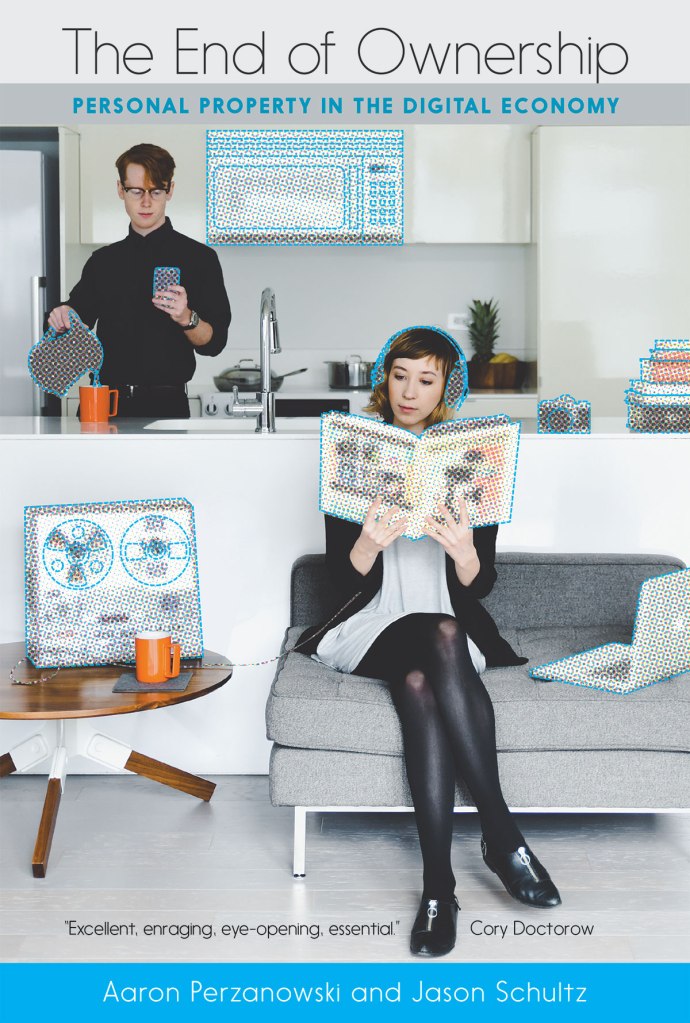
‘The End of Ownership’ by Aaron Perzanowski and Jason Schultz

If you buy a book at the book shop, you own it, and are free to do exactly as you wish with it. You might be surprised to hear that the same is not true of ebooks and other downloaded media. In fact, as Aaron Personowski and Jason Schultz discuss, the digital world is an incredibly complicated place when it comes to ownership.

9780262035019_1

Chances are if you own an iPod, Kindle or even a desktop or laptop you are no stranger to the world of the digital download. It is becoming more and more common to simply pay for a digital copy of a song, book or film, rather than worrying about cumbersome physical objects. Who even has time to wait for an Amazon delivery these days, anyway? The digital download has done wonders for the instant gratification of consumers, but at what cost? Like it or not, each time you click ‘pay now’ on a digital purchase, you are entering a new and confusing world, rife with rules, regimes and regulations that restrict how you interact with your downloads.

Authors Aaron Perzanowski and Jason Schultz use their book to delve into the complex, jargon-ridden world of the rights of digital consumers, to uncover the mystery of whether we can really be considered ‘owners’ of our digitalia. As the owner of a physical object you enjoy certain freedoms; if you have a collection of print books, you are free to annotate them, modify them, or even destroy them if you want to. The same however, cannot be said to the ‘owners’ of downloaded goods.

Every time you buy an ebook from Amazon or a song from iTunes you sign an end-user licence agreement (EULA) – let’s be honest, you have probably never read it – the contents of which are far removed from the freedom we enjoy with physical ownership. Consumers do not actually own digital purchases, they license them and have the permission to read, listen to, play, or watch them. Slightly more worrying is the fact that the company providing the software used to access these files effectively has control over a user’s digital library.

Here’s an interesting case. In July 2009 Amazon remotely, and without warning, wiped (irony of ironies) George Orwell’s ‘Nineteen Eighty-Four’ and ‘Animal Farm’ from all Kindle ereaders, following a dispute with the publishers.

Small fry, perhaps? Permissible collateral damage? Well, what happens when devices, or corporations, become obsolete? That’s what happened to HDGIANTS Inc, a former distributor of high-quality audio and video files. When it went bankrupt, its servers were switched off, and with that, portions of the digital libraries of thousands of paying customers evaporated.

So how content should consumers be with their content? A bookshop cannot, as Schultz and Perzanowski point out, creep into your house in the middle of the night and reclaim the contents of your physical shelves – so why can digital providers? Is it fair that book lovers and audiophiles are charged prices akin to a physical copy for a digital download that is completely at the mercy of publishers and licensers? What is the benefit to the consumer of opting for digital files? Are the benefits of reducing waste and getting instant gratification really worth it?

‘The End of Ownership’ presents the confusing world of the digital consumer in wonderfully accessible prose, replacing hideous jargon with the simplest of analogies, from thieving bookshops to the goblins from Harry Potter. It will answer the questions you have regarding digital ownership, and it’s inevitable that more than a few of them have never even crossed your mind.

In an increasingly complex world, plagued by unreadable (certainly unread) terms and conditions, it is more than a little refreshing to have something explained in good, plain English.

This review was first published online for E&T magazine.