February cheer from Prudence and the Crow

I know, I know, February ended yesterday. In my defence I have been incredibly busy – there was this trip to Germany, multiple training courses and then I got obsessed with a computer game, it’s just been crazy!

This month’s – or rather last month’s – box of treats, as usual, did not disappoint. Prudence and the Crow have clearly picked up on my love of children’s literature, and are doing their best to introduce me to all sorts of wonderful names and stories.

IMG_20160216_180442

And, as luck would have it, this one came with another inscription!

IMG_20160217_175042

I wonder how old Trevor is now…

Perhaps I’ll ponder that over a cup of nighttime tea 🙂

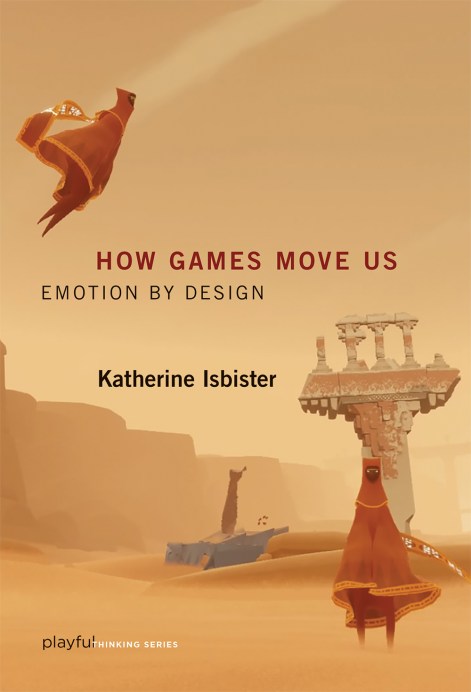
How Games Move Us: Emotion by Design – Katherine Isbister

“If I was feeling depressed or frustrated about my lot in life, all I had to do was tap the Player One button, and my worries would instantly slip away as my mind focused itself on the relentless pixelated onslaught on the screen in front of me.” ― Ernest Cline

9780262034265_0

What do you see when you hear the word ‘gamer’? If your immediate vision is that of someone pasty white, sat hunched over a keyboard, face lit only by the pale blue light of a computer monitor, insistently clicking away for hours on end with no real aim in mind, then get ready to re-evaluate your stereotype.

For years now filmographers and music researchers have analysed the emotional effect of film and music, while the computer game industry has been largely ignored as un-emotive. Katharine Ibister poses the question – why should games be any different?

In ‘How Games Move Us’, Ibister attempts break down the negative stereotype surrounding computer games and open up public conversation up to a more sophisticated approach to computer games as a cultural medium. The book serves as an exploration of the emotional experience of gamers, as well as how different games are used, explored and experienced by different people

“People talk about how games don’t have the emotional impact of movie. I think they do – they just have a different palette. I never felt pride, or guilt, watching a movie.” – Will Wright, designer of The Sims.

Far from being devoid of emotion, video games, Ibister argues, can actually elicit strong emotional responses in players in a multitude of ways, ranging from a simple feeling of anxiety in horror-based survival games (think Amnesia, or Silent Hill); to the inexplicable feeling of guilt which arises from spanking a pet Tamagotchi, or worse, letting it die. Delving further into the simulated world of gaming, Ibister also analyses how certain games create strong emotional bonds between players and non-player characters, and social connections among players in networked games.

Ibister analyses the techniques used by game designers to create these emotional responses, drawing examples from across the gaming industry. Ibister analyses games ranging from much-loved classics such as The Sims and Little Big Planet, to more obscure, one-off projects, including Anna Anthropy’s cooperative maze-navigation game Keep Me Occupied, and the once great massively multiplayer online role-playing game City of Heroes.

Many of you may take issue with a researcher attempting to define games as a whole – Ibister does not try to do this. The huge variety of games are not merely thrown into the melting pot labelled ‘computer games’ –  she differentiates but does not attempt to define, focusing on certain games within sub genres while acknowledging the partiality of her analysis.

How Games Move Us is an incredibly interesting, enlightening, and poignant read, and will no doubt evoke similar feelings in a reader as it strives to explain in a gamer. Ibister presents a new way of thinking about and understanding games, a medium which, though misunderstood, offers players

This review was first posted on WordPress for E&T magazine.

Bridges – Christian Menn


“In ancient Rome, the highest priests held the title of pontifex, which means builder of bridges. By providing a link between gods and men, these pontifices were indeed builders of spiritual bridges between heaven and earth.”– Christian Menn

Menn_Umschlag_TS_39L.p1.PDF
Scheidegger and Speiss, 1st edition 2015, 352 pp, ISBN 978-3-85881-455-5, £70 Hardcover

The humble bridge, while it may not strike you as one of the most exciting topics of conversation to introduce at a dinner party, is without a doubt one of the most significant early feats of structural engineering, which revolutionised travel dating back as far ancient Rome.

Of those involved in modern bridge design and construction, few are more noteworthy than renowned Swiss structural engineer Christian Menn, whose work spanned the latter decades of the 20th century, went on to inspire a generation of future bridge designers, and continued a long-standing tradition of Swiss excellence.

This stunning publication from Scheidegger and Speiss features more than 30 of Menn’s revolutionary designs, both built and unrealised, across 276 full colour and black and white images, with in-depth captions analysing the specifics of each project.

Menn’s text highlights his thinking and philosophy, approaching the circumstances and design process surrounding each individual project, demonstrating the passion and enthusiasm one expects more from an artist than an engineer. The book offers a fascinating insight into not just Menn’s experience as a bridge designer but also the art and history of structural engineering.

While many of Menn’s designs have become landmarks admired for their stunning design work and elegance, some of those displayed within the book will not take the layman’s breath away, instead appearing as those to be driven across and forgotten. Nonetheless each is a spectacular feat of design and engineering, a lifetime of work and passion, and years of combined construction, creating what is truly a work of art in its own right.

This review was first published on online for E&T magazine.

30-Second Meteorology – Adam Scaife and Julia Slingo

“The storm starts, when the drops start dropping. When the drops stop dropping then the storm starts stopping.” ― Dr. Seuss

30-second-meteorology-1-9781782403104-976x976
Ivy Press, 160 pages, ISBN: 978-1-78240-310-4, Hardback £14.99

Did you know that Horace-Bénédict Der Saussure invented the cyanometer? No? Do you even know what a cyanometer is? Well, having read 30-Second Meteorology I can tell you it is a quantitative scale by which to measure the blueness of the sky.

Want to know more? Read on.

The latest edition from the makers of the 30-second book series – 30-Second Meteorology: The 50 most significant events and phenomena, each explained in half a minute – will introduce you to the science behind, and the history of, the Earth’s most significant atmospherical phenomena in easy to digest, 30-second sections.

The book analyses weather from the basic, to the complex – from chapter one, The Elements, which focuses on the basic features of weather, in the form of air, clouds and rain, right through to the final, Extreme Weather, section which gives time to the wilder side of meteorology, exploring tornadoes, hurricanes, and the terrifyingly named ‘sudden stratospheric warming’, and everything between. Discover the nature of Earth’s atmosphere, the science behind weather forecasts and predictions, and the history of the aptly named trade winds.

If you are put off by the idea of a science book for dummies then rest assured that this book doesn’t just take the science behind meteorological events and cut down into bite-sized chunks

Complete with concise biographical profiles of the top names in meteorological history – including Svante Arrhenius, the man who first noted the link between atmospheric CO2 and the greenhouse effect, and Lewis Fry Richardson, the brain behind modern weather forecasting – and an historical look at the origins of weather systems and the technology used in measuring and predictive metrological events, 30-Second Meteorology is the perfect quick guide to the history of meteorology, which anyone can enjoy.

I don’t want to spoil the surprise, but crack this book open and you can expect to find out, amongst other general knowledge gems, which 17th century Italian physicist invented the barometer.

This book is also beautiful, and a snapshot of the cover image alone doesn’t do that justice. An ugly edition can spoil a good book, but this one does not disappoint – hardbound and fully illustrated with stunning vintage photomontage prints by Nicky Ackland-Snow the book is an actual pleasure to read. I could have spent hours studying the typography and design alone.

Overall, this is a really fun, interesting book to read – a sure-fire success with fans of weather systems and general knowledge alike. With a concise forward by Met Office Chief Scientist Professor Dame Julia Slingo, and contributions from top names in the field of meteorology, 30-Second Meteorology is the perfect book for anyone, outside of the field of academic meteorology, who wants a better understanding of weather systems and the history meteorology as a science.

This review was first posted on WordPress for E&T magazine.

A Stranger Came Ashore – Mollie Hunter

“I believe in everything until it’s disproved. So I believe in fairies, the myths, dragons. It all exists, even if it’s in your mind. Who’s to say that dreams and nightmares aren’t as real as the here and now?” ― John Lennon

9780863158834
Beautiful cover huh? It’s not mine though.

It was a dark and stormy night in Black Ness, the wind was cruel and the rain fell in harsh, icy sheets. All through the town not a soul could be seen, but down in the bay a lone figure made his way through the waves, the sole survivor of a merchant ship, dashed to smithereens on the sharp rocks. Late that night, as the town settled down to sleep, a stranger came ashore.

A Stranger Came Ashore delves into the myths of the selkie-folk – seals that can assume a human form, and are often seen with their heads bobbing just above the waterline, staring into shore with strangely human eyes. The myths are known most commonly in the Orkney Islands and the Shetland Islands – the latter being where this story takes place. While the myths of the selkie-folk vary from place to place, one thing is always consistent, in order to assume human form, a selkie must shed its skin, at which point it becomes instantly vulnerable, for if a selkie should lose its skin it cannot return out to sea.

I love to read up on local myths and legends, not only does it give a great insight to the culture of a place, but I find the thrill of the unknown absolutely irresistible. I like to look up local legends and famous haunted spots anytime I visit a new city – an odd quality perhaps, but there you go. So, basically, I was absolutely thrilled to discover this book.

I have heard of selkie-folk before, but the only stories I can recall are about the female selkie. These stories are often more tragic than dark: the woeful tale of a beautiful selkie woman lured onto land by a human man, who inevitably steals her seal skin and takes her for a wife. Typically, the woman in the story eventually reclaims her skin, usually because one of her children stumbles upon it, and flees back to her home beneath the waves never to be seen again. Tales of the female selkie are somewhat notorious for following this theme, as is eloquently summed up by Sofia Samatar in Selkie Stories are for Losers:

I hate selkie stories. They’re always about how you went up to the attic to look for a book, and you found a disgusting old coat and brought it downstairs between finger and thumb and said “What’s this?”, and you never saw your mom again.

A Stranger Came Ashore is different to the ‘selkie stories’ so abhorred by Samatar, however, and instead focuses on the insidious, manipulative side of the male selkie.

The male selkie when in human form is said to be a wonderfully handsome creature, with magical powers of seduction over Earth-borne women. In selkie lore, the male selkie enjoys nothing more than coming onshore, shedding his skin, and seeking out unsatisfied women, both married and unmarried, to satisfy his cravings. Indeed, according to 19th century Orkney folklorist, Walter Traill Dennison, selkie males ‘often made havoc among thoughtless girls, and sometimes intruded into the sanctity of married life.’ Scandalous!

Enter Finn Learson – the protagonist, and guest selkie, of A Stranger Came Ashore. Finn Learson appears to the Henderson family one dark and stormy night, knocking on the door of their simple butt and benn house to seek refuge from the weather. Assuming him to be a victim of a ship wreck, the family offer him a bed by the fire, and are quickly taken by the young man’s charms. Indeed no one is more taken with Finn Learson than young Elspeth Henderson, who, though she herself is bequeathed to the wonderfully eligible Nicol Anderson, is instantly bewitched by the stranger’s deep brown eyes. The only members of the family who are not fooled by Finn Learsons’s charade are Robbie Henderson, and his grandfather, Old Da – both of whom are horrendously outspoken, one for being young and impressionable, the other for being old and somewhat ridiculous. Soon after Finn Learson’s arrival Old Da’s health takes a sudden turn for the worse and he confesses his suspicions to Robbie. Informing the boy that Finn Learson is none other than the evil great selkie of Shetland legends, and he has come to take Elspeth.

Poor Robbie Henderson knows in his heart there is something wrong with Finn Learson but he is never to be believed by his family, who see only the polite young man that the great selkie wants them to see. The selkie-folk are nothing but a myth – and Old Da is guilty of filling Robbie’s head with fantasy. With no one in his family willing to listen, Robbie turns to the only person who might be able to help, a man who fills his belly with terror: Yarl Corbie – the local schoolmaster. Yarl Corbie is a brutal, terrifying and mysterious man, who agrees to lend a hand to Robbie, if only to fulfil his own personal vendetta.

On the night of Up Helly Aa – a pagan festival celebrated in the Shetland Islands – Finn Learson makes his move. As the daylight fades, the young men of Black Ness are transformed into the Earth spirits of old and a dreamlike state of merriment falls over the town. Finn Learson weaves through the celebrations, leading the beautiful Elspeth from house to house, while Robbie follows. The pair fly through the crowds, dancing in the moonlight and jumping from place to place like shadows in candlelight. There is mystical, almost spiritual feel to the festival, as though Robbie is chasing an apparition – in a blink of an eye all could be lost.

One moment he had the will-o’-the-wisp figure of Elspeth in full view as she danced ahead of him across the hill. The next moment, his weary eyelids drooped, and before he could blink them open again, the green of the northern lights had vanished behind one of the sky’s spells of total darkness.

As she slips through the crowds Elspeth is blind to her fate. Obliviously living out what could be her last moments on Earth; she dances closer and closer to the great selkie’s home beneath the waves.

This book is positively brimming with everything I love: myths, legends, premonitions, dark tidings, strange characters, and creatures that lurk in the shadows. It’s is a creepy, thrilling read, which also offers an insight into some truly fascinating culture. A Stranger Came Ashore would be the perfect novel for anyone with an interest in myths and legends, but would be particularly well suited to a young Goosebumps or Point Horror enthusiast who fancies sinking their teeth into something a little more substantial.

Fardwor, Russia! A Fantastical Tale of Life under Putin – Oleg Kashin

“I predict we will abolish suffering throughout the living world. Our descendants will be animated by gradients of genetically pre-programmed well-being that are orders of magnitude richer than today’s peak experiences.” ― David Pearce

Fardwor,+Russia!+by+Oleg+Kashin+-+9781632060396
Translated by Will Evans, Restless Books, 12 January 2016, 224 pp, ISBN 978-1-632060-39-6 £9.99 paperback

Oleg Kashin is a rather notorious Russian journalist whose open criticism of the Putin government may or may not have motivated unknown assailants to beat him to within an inch of his life back 2010. You’d think such an event would put the dampeners on a guy, but apparently Kashin was undeterred and returned full force to publish his first work of fiction, Fardwor, Russia! A Fantastical Tale of Life Under Putin, in Moscow, just two months later. Now, in a new edition translated by Will Evans, Fardwor, Russia! has been made available for international audiences with a taste for controversial political satire. The ridiculous sci-fi dystopia nestled within the garish pink cover bears more than a slight similarity to Russia under Putin and, with new stories of corruption in the Kremlin making the front page of international news sites each month, it has never been more topical.

The main protagonist of Fardwor, Russia! is Karpov, an enthusiastic young scientist who, with the help of his deceased grandfather, invents a revolutionary new growth serum that actually works. In an old wooden shack, which serves as a makeshift laboratory, Karpov spends his days experimenting on common sewer rats and creating unspeakable monstrosities, while his long-suffering wife, Marina, sits mournfully in their dusty apartment lamenting a life left behind in Moscow.

Delighted with his results, Karpov begins offering the serum to local farmers, promising fully grown livestock in exchange for new-born piglets and calves, before tracking down a circus midget. Unfortunately for poor, deluded Karpov he is wholly unequipped to deal with the full force of his discovery, and before he can reap any rewards all hell breaks loose. The meat industry is furious with the prospect of cheap meat resulting from an abundance of livestock; a dwarf oil oligarch makes use of the serum before running away with Karpov’s wife; and a giant cat goes on a rampage and eats a man’s face and heart. But it is not until the professional scientists get hold of the serum that things get really ugly.

Fardwor, Russia! is wonderfully strange and fantastically frightening, a gruesome yet hilarious tale of genetic engineering gone awry, combined with a grim political parable of the danger of power in the wrong hands. A ludicrous satire with a serious twist – Fardwor, Russia! is a must read those with an interest in Russian politics, or fans of science fiction that borders on the ridiculous.

This review was first posted on WordPress for E&T magazine.

Murder in Retrospect – Agatha Christie

“Nothing whets the intelligence more than a passionate suspicion, nothing develops all the faculties of an immature mind more than a trail running away into the dark.”
― Stefan Zweig

This is my first experience of Agatha Christie, courtesy of my good friends Prudence and the Crow. I will read just about anything, but and while I love a bit of mystery, murder mysteries don’t often cross my radar. Of course, I am familiar with Christie’s work – you can’t very easily go through life without hearing a thing or two – and have seen the odd film or TV adaptation of the famous Hercule Poirot, but that’s about it. In fact, it never even really occurred to me that I hadn’t read any of her work until I received this book. In signing up to PATC I wanted to widen my readership and force myself to discover new books, and this is exactly what I got.

2755981666_c9e5754e58_b

Amyas Crale was murdered, poisoned in fact, of that there is no doubt. But who placed the poison in his cup? This is the question Hercule Poirot is hired to answer, some sixteen years after Amyas’ wife, Caroline, was found guilty of the murder. The couple’s daughter, Carla Lemarchant, approaches Poirot to investigate after receiving a letter from her mother, written just before she passed away, protesting her innocence. Poirot willingly accepts the case, but soon fears that it may be just as clear cut at it originally appeared. All leads seem to point Caroline, but something’s not quite right. It’s up to Poirot to revisit the past, and solve a murder, in retrospect.

Murder in Retrospect was published under the name of Five little Pigs in the US, whether or not this changes your understanding of the novel I cannot say, but for me, at least, it was a bit of a dead end. The ‘five little pigs’, alluded to in the American title, are the five suspects in the murder case – Amyas’ good friend, Philip Blake; Philip’s brother, Meredith Blake; Amyas’ mistress, Elsa Greer; Caroline’s younger half sister, Angela Warren; and Angela’s governess, Cecilia Warren.  Each suspect is represented by a different little piggy from the well-loved nursery rhyme I’m sure you are all familiar with – and they vaguely fit into these roles, Elsa Greer, the greedy little swine with whom Amyas is said to be madly in love, is the piggy with the ‘roast beef’, for example.  “This little pig went to market, this little pig stayed at home…” Poirot mutters to himself, briefly profiling the different suspects, as Carla explains the background of the murder case. Really, this is as far as the Five Little Pigs analogy goes – it doesn’t really add much to the story, it’s more just comes across as an odd little mannerism of Poirot’s. There is, of course, no evil, murderous pig in the nursery rhyme.

When reading a mystery novel, half of the thrill is in trying to work out the answer for yourself, and generally speaking, it’s quite easy to spot the different motives characters might have for wanting knock off the murder victim. This book, though, is a bit different. From the very beginning it’s difficult to comprehend exactly how Caroline Crale could possibly be innocent – she was furious with Amyas, she threatened to kill him, she served him the beer which dealt the fatal blow, and, no one else really has a motive. The only thing which doesn’t add up is why, if she was guilty, Caroline would suddenly attempt to reclaim her innocence on her death bed. Why would she write a letter to her daughter asking for her to find the truth, if indeed she was guilty? It is almost infuriating to read, because it seems so obvious for Caroline to be the one who poisoned Amyas, but of course, no mystery novel is complete without a mystery, and so it must be one of the other five – but how?

The book follows the classic structure of a mystery, but with one key difference – Poirot never actually visits the scene of the crime, and relies instead on just the testimony of the suspects. As an inspector Poirot is perhaps best known for this. So, in this case, Christie chooses to exaggerate Poirot’s main character trait, by having him to solve a crime completely in retrospect, sixteen years after it took place, with only the, somewhat blurry, statements of those involved. This requires revisiting the day of the murder through the minds of the five suspects, and as such, the reader must reread the same story over and over again. I normally hate it when authors choose to write a book from two different points of view, with alternating chapter retelling exactly the same scenes – get on with it already! – but in the case of a crime scene I think it works really well. With each retelling of the story, another piece of the puzzle is added, creating a richer image of the scene, and leading the reader, as always, to the wrong conclusion, before the true murderer is finally revealed.

My overall opinions having finished the book are definitely positive; Murder in Retrospect is a creative twist on a traditional murder mystery novel which is sure to be a hit with fans of the genre. It took me right until the end to solve the puzzle, and I was lead of a marvellous goose chase throughout, falling into each and every trap that Christie set – what more could you ask for? I’m sure I don’t need to recommend Agatha Christie to anyone, if you are a fan of murder mysteries then you will undoubtedly like this one – but you already knew that, didn’t you?

I would be lying if I said I didn’t enjoy reading the book, but I’m not sure whether I will delve further into Christie’s vast repertoire. It is easy to see why there has always been such a strong following of murder mysteries and of Christie in particular – there is certain thrill in trying to solve a puzzle before the detective which can be somewhat addictive – but I’ve never really been particularly taken by the genre as a whole. On the whole, it was interesting to experience Christie’s work for the first time, but I think, for now at least, the case is closed for me.


Just Draw It! – Sam Piyasena and Beverly Philip

“Every child is an artist. The problem is how to remain an artist once he grows up.” 
― Pablo Picasso

I met up with Search Press at last year’s London Book Fair and they kindly sent me a copy of one or two of their books to review. Among those I received was Just Draw It! The dynamic drawing course for anyone with a pencil and paper. Get prepared for a rather lengthy, creative review!

51WV4N8s4sL

Just Draw It! begins with a short note, explaining the aim of the book, which serves as a beautiful insight into the background, as well as the dreams and aspirations, of the authors. In creating Just Draw It! Authors Sam Piyasena and Beverly Philip planned to help people revisit their childhood, and to rediscover and nurture their dormant creativity. They explain that they both loved drawing from a young age – “Both of us spent most of our childhoods bent over a sheet of paper with a pencil in one hand and a glass of lemonade in the other” – and that, for them, time spent with a pencil and paper served as a form of escape, as well as a way of making sense of the world around them. This, they suggest, is common in many children, but is often lost as a child gets older and the focus in school shifts towards reproducing the realistic, rather than exploring creativity.  At this point, that which once provided joy and freedom can be lost, and many people go through their adult lives thinking that they cannot draw.

In writing Just Draw It! the aim was clear – to provide a way of allowing people to reconnect with the simple, unadulterated pleasures of childhood, and learn to enjoy the simple act of making marks on paper.

Just Draw It! begins with the basics, exploring simple line and mark making, the ‘very heart of drawing itself’. A series of tasks explore making lines through different mediums, focusing on how the simple action feels. The artist is encouraged to draw using ink and sticks, make marks in the sand, draw on windows and create simple line images.

As the book progresses, light and dark, dimensions, form, movement and texture are all explored, allowing the artist to rebuild their knowledge of art by beginning with the very basics, and working up. The focus is never on the realistic – but on the process itself.

The final chapter is perhaps the most exciting, as it is completely dedicated to creativity. There are some amazing activities to be found nestled in the back of the book, graffiti, drawing from dreams, overlapping, sketching with your eyes closes, combining textures – there is so much to explore.

I had an amazing time using this book – it was so much fun to discover so many methods of creation that I’d never tried before, even as a child. I was also able to involve my friends in some of the activities, which was a definite hit during social occasions. I’m not the most artistic person in the world, but I do really enjoy getting creative when the opportunity arises. I can be quite shy, but if this book has taught me anything is that it is that it really doesn’t matter what my drawings etc look like.

So, I’ll share a few of my pictures with you.

The very first task in the book is to attach a large piece of paper to the wall and put on a piece of music to listen to, then, with your eyes closed, to allow the sounds to inspire your movement as you begin to make marks. Initially I didn’t have a large piece of paper so I used a page in my sketch book and a pencil, and then later revisited the task with a torn up paper bag and a box of oil pastels (they were always my favourite medium). I really loved having the freedom to just do whatever I wanted, and was actually quite pleased with the results of this task – I’ve even had a few guests comment on my art work, which is still pinned to the wall in my reading room where I first made it.

Another task in the lines and marks section was to create a simple line drawing and then trace over the lines with ink before blotting the original to make a copy. This task didn’t quite go according to plan – I think my initial paper was too absorbent – and I ended up with a rather smudged copy in my sketch book. The ink also passed through the pages and made another, fainter copy, which I then traced over to create a second copy. Even though this didn’t go as it was supposed to, I really like the result – and I absolutely loved using ink for the first time. There was something really satisfying about the fluidity of the pen nib and the ink and it passed over the paper.

I asked a friend if she wanted to accompany me down to the woods for this next task. We wandered down to my local nature reserve, armed with a huge sheet of paper and a pot of ink, and got ready to unleash our creativity. With the paper pinned to the uneven ground using dirty rocks, and with an assortment of sticks, twigs and other plant material at the ready, we let loose, doodling, stamping, splashing and dripping to our heart’s content. It was so much fun, and I now have another interesting piece of artwork to show my guests.

This next task was also carried out with a friend – ‘Just a minute’ – the idea behind this is to draw the profile of a person, with whatever medium you like, in just 60 seconds. My friend and I had spent an exhausting afternoon preparing for a dinner party before we sat down with a large glass of red and decided to draw one another – later on we drew one of the dinner party guests together, I started the image and she finished it.


The last piece I’m going to share with you is from the final, super creative section of the book, and was by far my favourite activity. This one involved using sharpies, or markers to deface, or add to, images in a magazine. Again, I sat down to do this with a friend, we actually managed to fill up an entire afternoon with repurposing (read – destroying) black and white photos from old copies of the New Statesman. Here are a few (many) of our creations.

It actually pains me to write this, given how much I love this book, but I do have just have one small gripe – this book is definitely not for ‘anyone with a pencil and paper’ as the titles claims. In fact, there are a lot of tasks which require some pretty specialist art equipment, the sort of stuff that art students and fanatics might have lying around, but those wishing to revamp their creativity probably won’t. Needless to say, armed with my tin of pencils and new sketchbook I was pretty ill equipped for what this book had in store for me. If you want to complete the book in its entirety you may find yourself having to invest in canvasses, sewing equipment, permanent markers, fine liners, polystyrene cups, Indian ink, paint, paintbrushes, conte crayons and a putty rubber (whatever that is).

On the whole, I think this book is something really special. If you want to revisit your childhood, and explore a lost love of art and drawing, or even if you are casually interested in drawing and want a fun project to complete, then this is definitely the book for you. I also think this book would be a good addition to any budding artist’s bookshelf; it is full of great ideas for exploring different mediums and methods of creation. I’ve said it before, and I’ll say it again, I had a great time trying this book out, and I am definitely going to keep using it.

I received a free copy of the book from the publishers in exchange for an honest review, all opinions are my own.


Short Works – Ross Tomkins

“Trees are poems the earth writes upon the sky, We fell them down and turn them into paper, That we may record our emptiness.” ― Kahlil Gibran

9780262162555However uninspiring the title, Short Works, may appear, this is much more than just a book of poems, translations and short stories. The work nestled within this simple cover, accumulated over five decades, is nothing short of a literary treasure trove. It makes me wonder whether there is perhaps something more to the title Short Works – is this just a literal description of the contents in its rawest form, or does it mean something else? The works are really not short at all. I would go so far as to say they are relatively ‘long’ works. While the reader could easily make short work of reading the book – I myself succeeded in a lazy afternoon – it is clear that the author took more than a little more time in writing the book. Perhaps I’m looking too much into this – but I like to think that the, perhaps somewhat dull, title has a deeper meaning, one which alludes to something of the comedian in the author’s personality.

The first half of this book is a collection of poems, past and present, which speak volumes as to the life of the author. Tomkins’ wonderfully melodramatic and fantastic younger years overflow with the essence of youth, while largely avoiding the embarrassment of childhood innocence. Later years fall into the metaphysical, the metaphorical, and the philosophical. The works clearly span not just decades, but continents, and more than one or two frames of mind, exhibiting a truly unique voice, at times jumbled and jarring, at others fantastically vivid, presenting creatures, settings, times and places that form and reform before your eyes, like images from the screen of Disney’s Fantasia.

The author’s words are at times beautiful:

Under an opal moon
Metallic scorpions scuttle

Toad winks, blinks, and gulps
Wings sticking tattered to damp lips.

At others morbid:

I remember hide and seek
And a dog dead under a bush,
Its pebble-teeth scattering the path,

But always, above all, vivid and resounding.

I was delighted by the section given over to ‘Poems from Poems’ – although I can’t be sure, exactly, what Tomkins means by this. I imagine this section is where translations and found poetry come into play*. I absolutely love constructing poetry from other poetry, it has a charm all of its own, and I like to think that the author shares and has explored this passion. A story does not need to have a meaning before it is written, sometimes, it is in the writing that a meaning is born. This section of the book goes to show just this.

The section of short stories is perhaps the most difficult to pass judgment on – with so much content, how can you give adequate coverage to everything? On the whole, Tomkins’ short stories are well-written – remarkably well-written in fact – concise, intricate, and beautifully flowing. The works really bring character and setting to life, with the imagery exhibited in the poetry brought to a whole new level, delivering a picture the reader can really see. The stories are so open to interpretation, leaving their mark and giving the reader something to think about long after they have turned the final page. The characters, each unique in their own way, have hidden secrets, desires and aspirations that the text can only allude to, a mystery which can only be imagined, a silent, niggling message which can never be fully understood. I love the power of the short story to make you think, fill out the characters and create your own story, within the verbal landscape of the author.

I was particularly taken by ‘The Sands of the Sea’ – although ‘Mr Lippstadt’s Holiday’ was certainly not without its charm – being drawn in firstly by the delicious descriptions of Ferdy’s newly found bookshop. I was delighted by the description of the books as living creatures, hopping from shelf to shelf, following Ferdy on his search, as though desperately excited at the prospect of purchase. The last book, however, is something more insidious, with the elusive work crawling through the bookcases before coming to rest, like some predator, to lie in wait, inconspicuously, silently, on a final dusty shelf.

“And what rough beast, its hour come round at last, Slouches towards Bethlehem to be born.”

Overall I found Short Works to be refreshing, thoughtful and surprisingly readable. While undoubtedly magnificently written, this book is not self-important or difficult for the sake of difficulty. The poems and short stories alike are sure to delight wordsmiths, and leave the reader with one or two things to think about.

* Explanatory note from the author: ‘What they are in fact are translations in the form of condensations where I hope I succeeded in cutting away fluff and padding to get at the raw heart of the poems – pushing towards the interplay of images and away from the explanatory.’

Design Meets Disability – Graham Pullin

“Perfection is achieved, not when there is nothing more to add, but when there is nothing left to take away.” ― Antoine de Saint-Exupéry

9780262162555In Design Meets Disability, author Graham Pullin approaches assistive technology from the point-of-view of the end user, encouraging designing for the person, rather than the disability. He advocates for moving away from the cold, clinical, “pink moulded plastic” of the 20thcentury and into something new, unique, and desirable. If assistive technology is to become a large piece of someone’s life why should its purpose be purely functional? Is there not room in the marketplace for fashionable, assistive technology? 


From their humble beginnings, balanced on the noses of monks and scholars in the 13th century, eyeglasses have undergone a fantastic transformation. The handheld lorgnette donned by ladies in the 19th century gave way to the inexpensive pince-nez of the early 20th  – but It was not until the latter half of the century that eyeglasses were transformed from a mere medical necessity to something more.

By embracing the design culture of the fashion industry, eyeglasses were transformed from something purely functional, to something beautiful – so much so that by the 21st century able-eyed teenagers were popping out the lenses of thick rimmed glasses to add to their everyday outfits. So, if eyeglasses can make the move from medical necessity, to fashion accessory then why can’t the same be true of hearing aids, prosthetic limbs, wheelchairs and communication aids? Of course it can, Pullin suggests, when design and disability meet.

Throughout the course of the book Pullin explores new forms of design for disability – where appearance and functionality complement the results from clinical trials – and meets with prolific designers behind ground-breaking disability design projects. Design, he argues, should be inspired by disability, allowing the two fields to combine to enrich one another.

The meeting of design and disability has further benefits – as well as making designs for disabled people desirable, it can also allow for the making of inclusive designs, which are, not just desirable to all, but useful to all. As explored in this month’s Engineering & Technology magazine by Tereza Pultarova, who looks at the role of digital technology in catering for the needs of blind people. The high-tech age, she suggests, has brought about the “biggest improvement in the lives of blind people since the invention of the white cane” – and this is not purely through new devices being created to cater to this specific group of people, but in making ordinary technology accessible for everyone, including blind people.

Think about the different ways everyday technology and devices function that can be of assistance to disabled people – these days all phones vibrate, which allows for those with limited hearing to know when they are being contacted, while functions included in the Google Search and Chrome smartphone applications allow users to communicate with their phones and tablets using their voice. Design for disability does not, and indeed, should not, have to be exclusive. Take, for example, Pullin’s presentation of watches designed for blind people –some of the designs are seriously beautiful – there are textured watches and those which vibrate, or prick the wearer to tell the time. These watches are not just useful for those with limited sight, but anyone who wants to option of checking the time in a meeting without appearing rude!

As Tom Pey, chief executive of the Royal London Society for Blind People points out in this month’s article: “If technology is simply for blind people, it is doomed to fail. What you need to do is to design the technology in a way that can benefit everybody.”

This review was first posted on WordPress for E&T magazine