‘The Trainable Cat’ by John Bradshaw and Sarah Ellis

There is such a thing as cat whispering and it’s really not that difficult. This new book by self-proclaimed cat enthusiasts John Bradshaw and Sarah Ellis outlines simple ways that owners can make life happier for themselves and their furry four-legged friends.

methodetimesprodwebbin6693f1c2-57d5-11e6-8ed5-6667a5bfca5c

There are two kinds of people in this world, those who love cats, and those who are wrong. Or, if you want me to be a little less biased, cat people and dog people – no prizes for guessing which category yours truly falls into. One of the biggest gripes dog people seem to have with cats is their brazen ‘up yours’ attitude to anything and everything. A cat will do as it pleases, when it pleases, and there is little if anything you can do to stop them. Dogs are trainable, dogs are reliable, cats, on the other hand, are a law unto themselves.

While the idea of a trained cat might seem contradictory, in ‘The Trainable Cat’, authors John Bradshaw and Sarah Ellis show that stress-induced behaviour in cats, such as shredding furniture and fighting against vet visits, can be prevented, making life happier and healthier for cats and owners alike. Your cat is just as intelligent as the dog next door, and far from being untrainable and ignorant, is continually learning and adjusting its behaviour to outside stimuli. You may assume that when your cat jumps up onto the work surface for the fourth time while you are baking, it is deliberately ignoring your pleas for peace, but have you ever stopped to consider that your response to the cat is actually encouraging it?

Starting from the basics, Bradshaw and Ellis delve into the inner workings of the feline mind, to uncover how and why cats learn the way they do, and what cat owners can do to make training easy for the cat and themselves. Cats have excellent memories, they say, and are therefore perfectly suited to training, but are rather different to dogs and thus have their own specific requirements. Through multiple enlightening and often humorous scenarios, Bradshaw and Ellis lay out different training approaches and programmes that can be used to teach cats by rewarding good behaviour while limiting the less appealing sides of a cat’s psyche – including those that result claw-marked furniture and bloody corpses.

Think you can’t train a cat? Think again! The video below shows one of my own beloved moggies playing fetch cat-sized stick (aka hairpin). A bit of positive reinforcement in the form of delicious cat snacks goes a long way.

This book isn’t just a training manual, though. As well as offering advice for the cat lover who wants to ensure they are getting the most out of their relationship with their humble friend, it’s also packed full of awesome cat-related general knowledge titbits. The geek within me revelled in the discovery that the reason one of my cats sometimes sits with her mouth gormlessly hanging open is because she has smelled something interesting and is literally ‘tasting’ the air. The fact that cats like to seek out tiny spaces to hide is because, as retractably clawed animals, they are unable to dig and so, in the wild, would have had to seek out natural crevices to protect themselves from predators.

This book delivers on random information, psychological insight, scientific analysis and all-round cuteness, securing it a high position on my list of favourite books reviewed for E&T so far. I can’t confirm as yet whether Bradshaw and Ellis’s advice has in fact made life happier for me and my cats, but it has certainly given me a better understanding of crazy and endearing things they do. Whether you want to train your cat, are interested in the inner workings of the feline mind, or are a hard-core ‘dog person’ in need of a ‘reality check’, this book is guaranteed to make you think, smile and truly appreciate the unique personalities of these complex creatures.

This review was first published online for E&T magazine

‘Visions of Numberland’ by Alex Bellos and Edmund Harriss


‘Visions of Numberland’ by Alex Bellos and Edmund Harriss takes the reader on a mystical journey through the mysteries and of mathematics in a fun twist on the bewildering adult colouring book market. Who said colouring needs to be relaxing?

9781408888988

The adult colouring book market is a strange one. Early last year, five of the top ten books listed on retail giant Amazon’s bestseller list were adult colouring books. This poses the question: what on earth are people doing with their lives? When you’ve spent a long hard day at the office it can be all too easy to take feelings of stress home with you, but does the answer really lie in resorting to simpler, more childish times?

Some behaviourists and more than a few adult-colouring book fanatics seem to think so, but I am unconvinced. I’ve tried out a few of these books, and they can be quite fun, but are hardly the perfect solution to an overworked millennial. Firstly, you need to try and actually find the time to sit down and colour. I don’t know about you, but between the all important glass of red and my commitment to vegetating in front of The Walking Dead with my significant other, my evening schedule is pretty tight…

Still, I took some time out this week to try out a new adult colouring book that has graced Amazon’s ever-growing bookshelves. ‘Visions In Numberland’ by Alex Bellos and Edmund Harriss promises the would-be colourer a “colouring journey through the mysteries of maths”, but is it really any different from the bewildering array of adult colouring books already on offer?

Short answer: yes, if not we wouldn’t really be featuring it in and engineering and technology publication, would we?

This book is different from the rest. It is so very, very different. Where traditional adult colouring books offer freedom and relaxation to work through inner stress, this book serves as a tour of some of the most fundamental discoveries in the field of mathematics, in which the reader is invited to explore them through colour and imagery.

Ultimately though, there is no freedom, and there is certainly no relaxation.

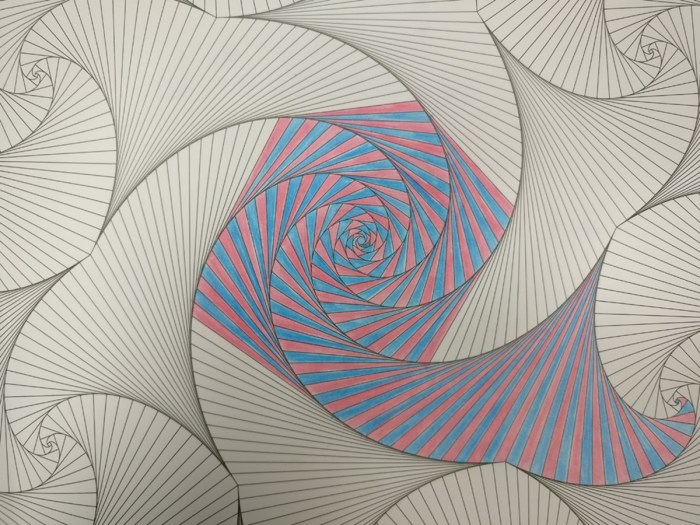
On my first visit to Numberland I visited the ‘Curve of Pursuit’ – that is, a path taken by a point that is always moving towards another point. The authors create the image of four dogs standing in each corner of a square room, if each dog races towards the dog that is anticlockwise from it, so that each dog is running at the same speed and at all times running towards its quarry along a straight line, the dogs will follow a logarithmic spiral.

The image seen below is my attempt to colour in a collage of several of the so-called ‘canine chases’. Beautiful isn’t it? I’d have loved to have finished it, I’m sure the result would have been quite spectacular, but this was as much as I could possibly complete in one go without passing out. By the time I put my pencil down to take a, quite well-deserved, break I was seeing spots.

7d21bc08dc5dc29d972687bd93a367896d6e256e

Perhaps it was the perfectionist in me, but there was no way I could colour in the image in anything other than logical steps and colours, which sort of blew the ‘relaxing’ aspect of colouring right out of the water. It felt more like a mission I needed to complete. Seeing the image emerge was pretty satisfying though, once I got past the stress of falling into a mathematical borehole.

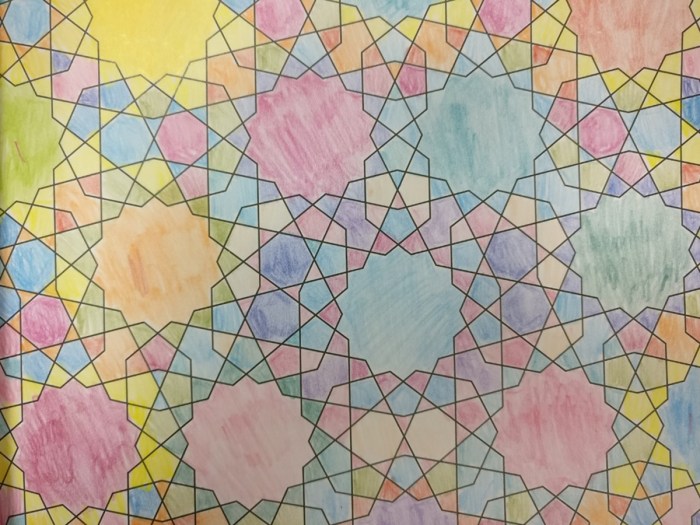
I enlisted some help from one of the other editorial members of E&T, who also found the whole experience a little stressful. They did actually manage to finish theirs though, and so we have below an elegantly coloured pattern of 14 pointed stars placed on a grid made up from two varieties of rhombus and entitled ‘Diamonds in the Sky’.

99bf339870df0efe62d9199caaa18d57b199c0dd

Travelling though the book reveals firm mathematical darlings like arithmetic and geometry, as well as more abstract modern examples including graph theory and dynamical systems, and gives the reader the opportunity to colour in existing patterns, as well as create their own using relatively easy-to-follow guidelines. My personal favourite is a task in which a series of concentric pentagons are arranged in a convex spiral serving to create a hall-of-mirrors-esque illustrated algorithm – a strikingly simple step-by-step guide to one of the most complex mathematical systems.

I would include a picture, but as I said, the guidelines are only ‘relatively’ easy to follow.

Stress and wonderment aside, there was one thing I found slightly troubling but ultimately endearing about this book. A mistake. How humbling that a colouring book which shows the universe through the eyes of the world’s greatest mathematicians falls prey to one of the most human characteristics. I do hope this wasn’t put there as a test, but if it was I spotted it. The rogue number 12882 highlighted in the image below has no place in that rectangle on Pascal’s triangle, and should of course be 8326 like its partner in the seventh hexagon across – and yes, ladies and gents, I did discover this by colouring in all the numbers with a ‘6’  using the same colour and noticing a discrepancy.

3ad5a2ced6dfec317d75c61d93997f60953439df

My personal feelings towards ‘Visions of Numberland’ are mixed. It’s a fun approach to some really fascinating theories which can be approached without any prior knowledge to mathematical systems and the images are nothing short of spectacular, but some of the tasks take a lot of commitment to complete and could well leave your mind buzzing. I’m inclined to want to read the book, and learn more about the mathematical patterns, but without actually doing any more colouring in.

This could be one for the maths-lover in your life, or someone who has outgrown standard adult colouring books, and wants to take on something a little more challenging. Whatever you do, though, don’t buy this book thinking it will help you to unwind; if you do you could set yourself on track for a full-on nervous breakdown.

This review was first published online for E&T magazine
‘Mathematics: How it Shaped our World’ by David Rooney


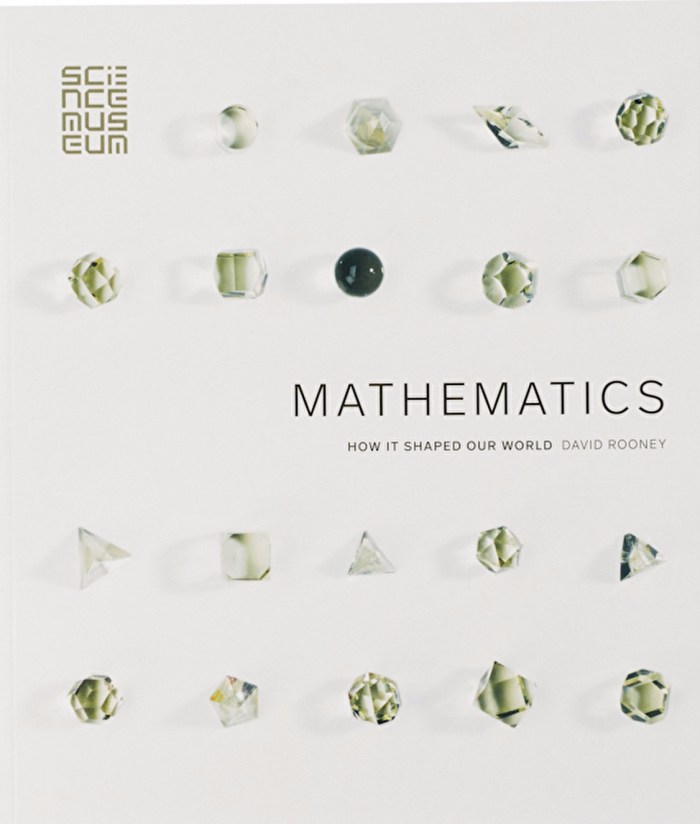
In December 2016, I attended the opening at London’s Science Museum of ‘Mathematics: the Winton Gallery’, an inspirational exhibition which seeks to highlight how mathematics has played a central role in human development throughout history. Now the same brains behind the gallery have launched a new book, which brings this wonderful story into the home.

2000x2000.fit.403818_1

This beautiful new book, written by David Rooney, curator in the technologies and engineering group at the science museum and lead curator of the Winton Gallery, explores how mathematics has influenced the world throughout the last 400 years.

The fascinating yet misunderstood field of mathematics, though considered by many to be a rather forbidding and remote subject, is not just present within university and financial institutions, but has importance within all of our daily lives. The Winton Gallery was created as an accessible and fun avenue into understanding mathematics in a bid to change the public’s relationship with mathematics and its history.

‘Mathematics: How it Shaped our World’ by David Rooney supports this quest for anyone unable to visit the Science Museum or for those simply wanting to continue the journey at home. Beautifully illustrated by full-colour photography throughout, this attractive publication would make an excellent addition to any coffee table or bookshelf, whether for casual perusing or an all-out maths fest.

Mathematics is as old as time itself, but with any book there needs to be a beginning. This one emerges on board the merchant ships of the early 18th century with the invention of overseas trade. Mathematics’ relationship with trade is much more complex and far-reaching than the changing hands of currencies. At the heart of trade is measurement: it is in the designing and construction of ships; in the navigation and the building of trade networks; in the buying and selling of goods, and even in the forming of codes for transmitting secret information. As Rooney points out, whole empires have been built and fortunes made and lost off the back of world trade – a fact that resonates just as much now, with the cheap outsourcing of production overseas, as it did 400 years ago.

From trade and travel we move on to war and the many technological advances that mathematical innovation has awarded to the fight for peace throughout history, from the ‘differential analyser’ of the Second World War, to the invention of radar and subsequent rise of ‘operational research’ – a form of mathematical decision making – within military practice. With each chapter in the book Rooney introduces a new concept or sector which has been affected in untold ways by the power of mathematics – exploring economics, weather patterns, surveillance systems, computing, medicine, risk analysis, health and beauty and the very nature of life and death itself.

The book is rounded off nicely by a series of short essays from key figures in the study of mathematics, which look at, among other things, the position of women within mathematical history, with particular attention to key female figures such as Émilie du Châtelet and Mary Sommerville and the ever-changing nature of the mathematics landscape in the present day.

There is no question of the importance of mathematics in the minds of most people. Those who shy away from the simplest of calculations and cringe every time it comes to splitting a bill at a restaurant will know the perils of lacking basic mathematics skills, but – as Rooney demonstrates – this is really just the beginning. Where some introductory or historical texts seek merely to inform, this one strives to engage intellectual thought and questioning, positioning it firmly above the rest. Whether you are a mathematician by trade, a closet maths fanatic or a self-proclaimed sum-dodger, this book is sure to give you food for thought.

This review was first published online for E&T magazine
‘Intellectual Property: A Very Short Introduction’ by Siva Vaidhyanathan

From over-the-counter medicines to the corrugated cardboard sleeve on a Starbucks coffee cup, intellectual property law hides in plain sight behind a surprising array of everyday objects, and it doesn’t always have the best of intentions.

9780195372779

Back in December I reviewed ‘The End of Ownership: Personal Property in the Digital Economy’, a book that looks at licensing agreements which come attached to any digital download, and dictate any use, or pleasure, you can take from digital property. If, like me, you love to get into the nitty gritty of what you can and can’t do with information, you no doubt read the review, and bought and consumed the book too.

Where ‘The End of Ownership’ looked at the changing relationship with how we own intellectual property of others, this latest book explores how the very nature of intellectual property has changed over time. ‘Intellectual Property: A Very Short Introduction’ one of the latest great additions to OUP’s mini introduction series, considers  how copyright and patenting laws have changed over from avenues designed to protect and nurture creativity, to tools used for economic gain. That’s right, guys, the reason Amazon want to retain total control over your digital library is because it is in its economic interests to do so.

Author Siva Vaidhyanathan recounts how he first became interested in rules and regulations of intellectual property while working for a large media company that claimed his creative work as its own. As a content producer, Vaidhyanathan saw his work used, reworked and quoted completely outside of the realms of his control. This set the ball rolling for a complex journey into the confusing, and often contradictory, matrix of ownership and creativity.

The story begins with the American music scene, tracing changing dynamics of hip-hop in the 1980s and early 1990s, a time rife with sampling lawsuits inevitably leading to dumbing down of some of the defining characteristics of the music genre. It becomes all the more complex at the turn of the century, with the rise and fall of the first widespread file sharing service – Napster – and the resulting global ‘free culture’ movement of the early 21st century.

This book, though, looks at more than just the relationship between intellectual property and creativity, and how copyright and patent legislation has evolved over time. Rather, it is an approach to understanding your rights as a copyright holder. As Vaidhyanathan says, if you send or receive emails, texts and use social media, you are a copyright holder and more than likely an infringer too. What’s more, if you own a smartphone, tablet or e-reader, and consume digital media therewith, then a substantial portion of the price you pay will go to cover license patents.

You might take for granted that you can buy over-the-counter allergy medicine at a cheap price from your local pharmacy – this wouldn’t have been the case many years ago, when medicine was still covered by patents dictating who could sell it. Patents and copyright licensing are everywhere, from medication on your prescription and CDs in your local HMV, to the unassuming corrugated cardboard sleeve designed to stop you burning your hand on your morning Starbucks flat white. In fact, as Vaidhyanathan points out, Starbucks is just as much an intellectual property company as it is a food and beverage supplier. The coffee company has its own entertainment arm, and produces and sells music it feels will appeal to its clientele. This is just one of the reasons for the eye watering price tag on the aforementioned flat white; all those lawyers don’t come cheap.

Intellectual property is a hugely complicated and confusing theme to try and get your head around, but one thing is clear, it’s all about the money. Intellectual property as it is today is present because there are people who want it to exist. There are companies and individuals with huge economic interests invested in restraining the global movement for standardisation of intellectual property. Copyrights, patents and other laws dictating how property can be used say as much, if not more, about the world in which we live – they do creative content they are designed to protect. Where once intellectual property protection existed to protect and foster creativity, today it has taken on a whole new political, economic and cultural identity.

‘Intellectual Property: A Very Short Introduction’ serves as a wonderfully accessible avenue into a wholly confusing topic, making it another truly spectacular addition to the QUP ‘Very Short Introduction’ series. This is a book for law buffs, experts on rules and regulations, and anyone looking to widen their economic and political understanding of the world – or make a splash at an incredibly specific pub quiz.

This review was first published online for E&T magazine

‘The Fourth Industrial Revolution’ by Klaus Schwab


By definition, revolution means covering new and unknown territory and the ‘fourth industrial revolution’ is no different. What can we expect and how can we best utilise the new technology at our disposal?

9781524757403

The ‘fourth industrial revolution’: everyone is talking about it, but no one seems to really know what it is. Hindsight is 20:20, of course, and maybe things will only really become clear once we’re hurled full force into the fifth industrial revolution, which I can only hope will in some way involve alien technology. If you’d asked the textile workers of the 19th century to define the industrial revolution they’d probably have struggled, too.

While previous industrial revolutions brought about mechanisation, mass production, computer control and automation, the fourth industrial revolution is thought to be fundamentally different. Rather than focusing on a specific development or technology, the fourth industrial revolution encompasses a range of new and existing technologies that bring together the physical, digital and biological worlds and will be felt across all industries and economies.

It is thought that this dramatic leap forward in industrialisation will be felt across industries and will change the way that we live, work and relate to one another. In The Fourth Industrial Revolution, Schwab introduces us to the key technologies driving this revolution and discusses the effect that these will have on governments, businesses and citizens as a whole.

The book serves as more than just an introduction to a conflated term, though, as Schwab seeks to address the many societal concerns over developments within industry, as well as outlining what can be done to ensure that we make the most of this exciting, but largely unknown, new phenomenon.

Intelligent machines play a big role in any conversation about the fourth industrial revolution. For many, this is one of the most concerning aspects of this new wave of industry, aggravating societal fears surrounding the role of the human workers in the workplace of the future. Schwab discusses this area in great detail, striving to dispel rumours that factory workers will inevitably be displaced by robotics, and instead looks into how industries are developing practical applications to work alongside traditional workers. The rise of intelligent machines does not mean that we face a man-versus-machine dilemma, he says. In fact, in the vast majority of cases, the fourth industrial revolution will serve to enhance human labour and cognition, meaning that leaders need to prepare workforce and develop education models to work with, and alongside, robotics.

The main concern that seems to arise from Schwab’s analysis is that of societal control of the new wave of industry. The fourth industrial revolution has the potential to transform the way we live and work, but success rests in the combined hands of organisations, citizens and governments. If organisations fail to adapt and governments fail to adequately employ and regulate new technologies, we see ourselves headed down a very different path. With this is mind, Schwab calls on leaders and citizens to “shape a future that works for all by putting people first, empowering them and constantly reminding ourselves that all of these new technologies are first and foremost tools made by people for people.”

Schwab’s message is one of collaborative growth and how to best utilise the new technology at our disposal, while simultaneously addressing the challenges that go alongside – a sentiment echoed in the billing of the World Economic Forum Annual Meeting 2016, which was held under the theme “Mastering the Fourth Industrial Revolution”.

The Fourth Industrial Revolution is a fascinating, comprehensive and enlightening dialogue highlighting the many different benefits and challenges that humankind can expect as we move further forward into a new and unfamiliar wave of industrial development. Those with an interest in where we are headed as a society, but who find themselves overwhelmed by the synonymous talk of ‘Industry 4.0’, ‘smart factories’ and ‘factories of the future’ can hope to find their questions answered and concerns addressed by this illustrative and informative new publication.

This review was first published online for E&T magazine
‘Pyjamarama Funfair’ and ‘Pyjamarama Fever’ – Barrier-grid animation from Michaël Leblond and Frédérique Bertrand

Pyjamarama Funfair and Pyjamarama Fever, two fun new books from Thames and Hudson, introduce children to the wonder of animation in non-digital form.

In response to changing times, and rather picky customers, children’s author Michael Leblond and acclaimed illustrator Frédérique Bertrand have released this dynamic book duo, filled with awesome, printed animations and interactive pages, as the ultimate solution for when you cannot prise your child away from their smartphone.

These exciting new publications utilise an old graphic design technique to create a swirling, fun-filled world of moving pictures, without a hint of technology. In Pyjamarama Fever and Pyjamarama Funfair Leblond and Bertrand use barrier-grid animation, an effect created by moving a striped acetate overlay across an interlaced image, to create an optically illustrated world for children to interact with, and explore.

The Pyjamarama series tells the story of a little boy who puts on his pyjamas and turns out the lights to go to bed only to fall into a magical, dazzling dream world filled with bright colours and flashing lights. In the past Pyjamarama has taken children across the world to the sights of New York and Paris, but the newest additions to the series stay a little closer to home.

In Pyjamarama Funfair, our little friend finds himself in a magical funfair, where bright swirling lights, rampant rapids, twisting roller coasters and rough dodgems dart and dance across the page. In Pyjamarama Fever the same little boy is sent to bed feeling a little under the weather, before succumbing to a strange but dazzling delirium filled with strange shapes, shimmering stripes, swirling spots, and pyjama-clad firefighting mums and carwashing dads.

As our pyjama-clad hero dreams, children reading the book are able to interact with the images. Sliding the acetate sheet, which comes included with each Pyjamarama book, across the page brings the illustrations to life: cogs turn, lights flash, dots dance and waves flow with just a slight turn of hand. The images flickering across the pages, however simply explained, are pretty cool to say the least.

These innovative books are highly interactive and a great way of encouraging children to rediscover the magic of the printed word. The illustrations, which in themselves are pretty mesmerising, are awarded a whole new level of awesomeness when combined with the acetate sheet. It’s a simple, effective animation technique that children, and the majority of parents and carers, are sure to love – they certainly proved popular among the E&T editorial team.

So if you are looking for a new way to keep your children occupied outside of school, with the added benefit of giving them a break from digital technology and a chance to rediscover the magic of books, then look no further than a little Pyjamarama fun.

This review was first published online for E&T magazine

‘Atari Age: The Emergence of Video Games in America’ by Michael Z Newman

A fascinating historical analysis of the emergence and development of video games in America.

9780262035712_0

Retro video games have developed a real cult following over the years. In a time when on-screen graphics are frighteningly real, the simple, blocky pictures and monotonic themes speak of an era when consoles, and times, were simpler. Or were they?

Each time a Space Invaders remake is announced, there are more than a few people who insist on focusing on the negative side of our digital friends. In Atari Age, author Michael Z Newman looks at the impact of early video games on the American culture they grew from, as well as their effects, both positive and negative, on society. The history unveiled by Newman is remarkably complex – an evolution in content, design and public opinion.

The story begins in penny arcades, where leather-capped youths lined up for the likes of the fortune teller and peep show, before progressing swiftly along to the days of pinball’s reign. The emergence of video games and their eventual move into the American home, Newman says, was a process of evolution which began within the arcade.

While penny arcades and pinball soon fell by the wayside, video arcades gained popularity, evolving from a media seen as unreliable, due to their liability to break down and difficulty to fix, to one which inspired, excited and enthused American youths. Indeed, arcade games became such an important aspect of popular culture that, during the height of the game’s popularity, a single establishment in Piccadilly Circus is said to have had 10 Space Invaders machines all in a row and no doubt constantly in use.

To explain their popularity, Neman points to the adaptive nature of the video game. Unlike pinball, a video game gets harder as a player gets better, and thereby encourages greater investment. Indeed, the medium itself continued to adapt to the point where it soon outgrew arcades, a feat that pinball and penny slots never achieved, and made its home right in the heart of the American family. With the release of the Magnavox Odyssey and Pong and 1972, the family television became the new arcade.

As video games evolved, so too did public opinion. Whereas games seem to have developed almost naturally, changes in societal understanding have been far more complicated. The Magnavox Odyssey was originally seen as a device for turning the TV in a participatory experience, but this idea was quickly joined by fears that spending too much time playing games could be harmful. This is a swing we have continued to experience today, as games have evolved to be more ‘active’, but still bear the yoke of technological fear.

Using original marketing and advertising materials, Newman weaves an image of a two-way development of video games and public opinion. The book highlights the ever-changing face of media in the eyes of the American public, as it moved from an enjoyable medium, to something to fear, and back again. Newman’s technological timeline says as much about the society that video games emerged in as it does about power of the medium itself.

There is something nostalgic – or is it regretful – about this book, as though you are viewing the past through sepia-tinted glasses. The pages conjure up images of American families huddled round the comforting glow of the TV, or, perhaps the dusty grey screens editorialised in George Orwell’s 1984.

This is a book for those fascinated by sociological viewpoints of American society, but will likely sit well with fans of retro video games, if only for the novelty of 1970s gaming advertorial.

This review was first published online for E&T magazine

‘The Essential Digital Detox Plan’ by Orianna Fielding

Being constantly connected to digital devices can sometimes be more of a hindrance than a help, as Orianna Fielding discusses in this elegant new publication from Carlton Books.

9781780979052

I once met a man who would send framed photos of himself to all his friends and family every year as Christmas presents. Weird isn’t it? Why would anybody want that as a gift? Not so strange, though, is the idea of sharing photos of yourself on social media for, presumably, the benefit of your many friends and followers. Remove the computer, though, and the whole thing gets really quite peculiar. Could you imagine yourself having just got back from holiday, picking up reams of glossy 4 by 7 prints from the pharmacy, slipping them into individually addressed envelopes and sending them out for all your friends to see? I’m willing to bet not, because that would make you seem more than a little overbearing, and possibly lead to a few restraining orders. So why is it ok, encouraged even, to do this online?

In The Essential Digital Detox Plan: How to achieve balance in a digital world, Orianna Fielding explores this concept, and many more, as she delves into the strange world of new social media, and offers advice for those who want to have more control over their digital consumption habits.

We have reached a stage, Fielding says, where connectivity permeates every aspect of our lives. Texting and reading on smartphones rather than conversing with those around us is now considered the norm, and we are constantly connected to our work and personal emails at the expense of missing out what is happening around us. It is important to realise, she says, that having access to the world in the palm of your hand also means the world has access to you. Eurphoria at the ability to be connected at all times can quickly be replaced with a debilitating dependence on being connected at all times.

The Essential Digital Detox Plan provides advice for how people can take control of their digital consumption habits, rather than allowing their digital devices to have control of them. The suggestions included in the text range from introducing phone-free meal times and tech-free zones in the house to taking unplugged time out at work to engage in a five-minute meditation ‘snack’. For the most committed out there, the back of the book serves as a step by step guide to full digital detox, from one hour to the full seven days.

The overarching theme of the book is not just about disconnecting from digital devices, but about adopting a slower, more conscious approach to life. Fielding stresses the important of taking the time to observe your surroundings and really ‘be’ in the present moment to indulge in experiences that, often, access to a smartphone or tablet can negate.

The steps, suggestions and advice included in the text stem from Fielding’s own journey to achieving a balance in her digital consumption habits. This gives a very personal feel to the text, but also means that at times Fielding’s style can see a bit self righteous, perhaps even presumptuous. But I think you are more likely to pick up on this or find it a little grating if you haven’t brought this book for advice.

It’s never fun to pick up on mistakes in reviews, but, for all the good I have to say about this book, I would not be a very good editor if I didn’t make mention of the glaring error in the preface. Fielding refers to the book by the wrong name (Unplugged), not once but twice. I assume, as this book was once serialised in a magazine, that it has been given one or two new lifelines along the way to full publication. No doubt at some point it was called Unplugged, but it isn’t now, and this really is something that should have been picked up prior to publication.

On the whole, though, I think The Essential Digital Detox Plan is a pretty good companion for those wishing to spend a little less time surrounded by technology, or take a more relaxed approach to their digital consumption. Even if you don’t want to go all out and commit to a full seven-day digital detox, the book contains a lot in the way of yoga and meditation exercises and other tips and tricks to help you take time out during your day.

This review was first published online for E&T magazine

‘Destroy this Book in the Name of Science’ by Mike Barfield


Science is exciting and at no point is this more apparent than when viewed through the eyes of a child, as this fun-filled new publication from Mike Barfield goes to show.

51Vxelcs4pL

As an impressionable ten-year-old, mere mention of the word ‘science’ had me thinking about dissolving just about anything in huge beakers of acid. With real-world scientific knowledge limited to the realms of mixing salt in water and weird Brainiac-related science abuse involving walking on custard and testing out slippery socks, I just couldn’t wait to get to secondary school and discover what wonders awaited me in the teenage science lab. Who could possibly resist the temptation of flammable alkaline metals, fizzing rainbow-coloured liquids and sooty beakers tarnished by improperly adjusted Bunsen burners?

When I first visited my secondary school, the chemistry teacher set up an experiment to show that the colour of fire could be changed using different types of salt. I’ll never forget adding borax to the soft glow of a Bunsen burner and seeing the flame change to a vivid apple green. The teacher managed to feign delight at what was no doubt the same experiment he’d seen dozens of times already that evening, musing ‘I’d rather like a pair of trousers that colour’ as I happily trotted off for my next lab tour.

What’s the point of this weird childhood anecdote, you may ask? To show that children are impressionable and liable to be amazed by even the simplest feats of science. It’s a good thing, too, because we all know how important it is to get children interested in STEM from an early age. As a parent, older sibling, aunt, uncle or concerned observer, it’s never too soon to get the young Isaac Newtons in your life excited about the wonderful world of science – and what better place to start than in the home.

The good news is that hands-on, kid-friendly science doesn’t have to be limited to the chemicals, crystals and compounds in the average chemistry set. A solution comes in the form of Destroy this Book in the Name of Science, an entertaining new publication from author Mike Barfield, which proves the perfect literary addition to the lab/bedroom of curious children.

Complete with its very own cut-out Einstein mask, this book is filled with projects and tasks to push out and pull apart, with pages reserved for colouring, doodling, cutting, tearing and flat-out destroying – all in the name of science. With the help of a little glue and some determination, even the most fledgling of boffins can discover the physics behinds some exceptional magic tricks, build a working cardboard hoop glider to out-fly any paper aeroplane and race paper sea turtles with the help of just a little washing up liquid.

The comically illustrated book is a simple affordable method of awakening the latent scientist nestled within each young brain. I would recommend this book for adults wanting to engage children in a little scientific fun or, equally, tired editorial staff in need of a Friday afternoon pick-me-up.

This review was first published online for E&T magazine.

Redwall – Brian Jacques

Yet another book I wish I had known about when I was a child. I’m absolutely thrilled to know there are more in the series – I just need to find the time to read them!

51ofme5fdl-_sx306_bo1204203200_

This is the first in a series of wonderful children’s books about a peaceful community of field mice who live within the quiet confines of Redwall Abbey. The brotherhood slumbers quietly on the edge of the Moss Wood, providing a place of humble solitude and unquestioned refuge for any who seek it. They live a simple wholesome life enjoying the good things nature has to offer – like goat’s milk, honey and nut brown ale. I feel warm inside just thinking about it.

Of course, it takes conflict to make a story, and so be prepared, once you open this book, for the lives of the Redwall mice to be thrown into turmoil. Not a day is given over to the lives within the Abbey before Cluny the Scourge, a vicious, one-eyed rodent, whose nightmarish existence is the stuff of legends, rolls in from the wild woods beyond the horizon. The noisome creature sets his sights on Redwall Abbey, determined to turn the warm stone walls into a fetid nesting ground for himself and his band of vile vagabonds. This is the beginning of an epic battle, the likes of which the peaceful brotherhood of Redwall has not seen for hundreds of years.

Our unlikely hero is a small, clumsy field mouse named Matthias, a new addition to the Abbey, who has a lot to learn about the complex history of his new home as he fights to defend its boundaries from Cluny’s deadly crew. It will take more than just the mice to defend the Abbey, but enlisting help from their neighbours is not as easy as just asking for it. The Moss Woods are rife with historical conflicts, and the mice, though peaceful, have a rather unsettling past. Beyond tribal feuds, though, are two evils more sinister than the sins of every benign entity combined, and only communal action can ensure that these dark presences do not forever disrupt the quiet equilibrium of the forest.

This book has a lot to offer to different readers. On one level it provides a fantastic amount of action for children’s literature – I was inadvertently clenching my teeth while reading about the battle between the mice and Cluny, and was filled with genuine terror at the idea of ‘old poison teeth’. On a personal level, though, I could have happily read all about the mice of Redwall without there being any kind of altercation. Redwall is the kind of community that one feeds on hearing about. Like the woodland animals in the Lion the Witch and the Wardrobe – specifically Mr and Mrs Badger – or any one of Beatrix Potter’s books. I am in love with the life that the mice live – it is so wholesome and wonderful; a simple, healthy life full of good things. The Abbey stands as a natural organ of the forest and the mice and the other creature that live within the walls keep it running like a well oiled bicycle – what more could I ask for in a book? A quiet life makes for content reading.

I was really taken by the complexity of Jacques’ characters. My personal favourite is Basil Stag Hare, whose ghost-like reflexes, mildly misquoted malapropisms and insatiable appetite are nothing short of genius. When it comes to characters that are also hares, Basil Stag is easily one of the most excellent I have ever come across*. He is joined by a whole host of unforgettable faces, Ambrose Spike the greedy hedgehog, Constance the formidable badger, and Warbeak, a sparrow who is much too big for her tiny, tiny boots.

Overall, I really enjoyed my first dip into the realms of Redwall Abbey. Jacques has crammed so much into this first book, and I have no doubt the rest will not disappoint. I would strongly recommend giving Redwall a try if you are a fan of young adult literature, tales of idyllic livelihoods interrupted, or anything containing anthropomorphic mice.

*This may sound oddly specific, but as a lifelong fan of Harriet’s Hare it is no mean feat