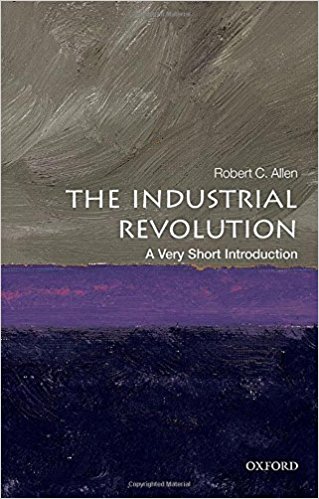
‘The Industrial Revolution: A Very Short Introduction’ by Robert C Allen

From British feudalism to the Internet of Things, this concise analysis of the Industrial Revolution provides the perfect introduction to one of the most complex times in human history.
51hK1TCIs1L._SX317_BO1,204,203,200_

Look back at the work of any 16th century painter and you will see a life very different to that we live today. Streets were strewn with farm animals and bore witness to all manner of slaughtering, plucking, sheering and bathing alongside horse drawn carts transporting livestock, cloth and grain – a food economy if ever there was one. The land was central to life, with arable plots taken up by livestock and agricultural farming, while towns and cities blossomed along riversides. Craftsmen, placed by the water’s edge for trade, would carve, sand and smooth their wares from metal and wood using hardy hand tools, before selling their goods in local markets. Homes were heated, and food cooked, using wood fires and charcoal, and sanitation left much to be desired.

Fast forward to today and life has moved on somewhat. Hand tools are relegated to those who enjoy gardening and crafts, with production carried out in connected factories, assisted by robotics and autonomous systems. Our houses are heated with oil, gas or renewable sources, and come complete with electric lighting and pristine running water. Most people now live within the confines of the city, which in themselves are vast and busy, with buildings stretching up and out as far as the eye can see. Areas of countryside, rather than offering the gift of life themselves, are set aside for those wishing to ‘reconnect’ with nature and escape the hectic urban life.

So how did we get from one to the other?

The answer lies in the Industrial Revolution, a decisive journey that occurred halfway between life depicted in oil works of the 1500s and today. In this latest Very Short Introduction from Oxford University Press, author Robert C. Allen traces the beginnings of the Industrial Revolution to the humble shores of the British Isles, and analyses the wider global effect of the two centuries of industrial development which helped to shape the course of recent history.

It is a tumultuous story that begins, as with this review, with the wholesome lives of aristocrats, tradesman and labourers in 16th century Britain, where seeds of revolution were sown long before the first cogs of the industrial machine began to turn. The years that followed were a turbulent time, filled with growth, but also contradiction. Alongside the progression man made, was life rife with poverty, unemployment, squalid housing, pollution and protest.

In just over 100 pages, Allen crams 500 years of human development and clears up any uncertainties one might have as to the roots, development and consequences of this Revolution. Despite developments around the world, it was Britain that first saw the ripples of industrialisation, which Allen traces from the English Channel, undulating out into mainland Europe and beyond.

‘The Industrial Revolution: A Very Short Introduction’ is a wonderfully accessible introduction to an incredibly complex period of human history. The revolution itself was made from simultaneous developments across trade, commerce, agriculture, mechanics and economics, and so this introduction, far from being just about the rise of industry, takes into account a breathtaking array of subject matter, but does so within the most manageable of formats. Allen has created another truly fantastic edition to the Very Short Introduction series. This book would make a wonderful addition to any bibliophile’s collection, but would be most ideally suited for those with an interest in industry, British history or international development.

This review was first published online for E&T magazine

Asteronymes – Claire Trévien

images

Asteronyme is the word for a sequence of asterisks used to hide a name or password. I wonder what this book of poetry is hiding.

Poetry is a like a window into a person’s soul, but not all windows are clear. Words can paint the desires and emotions often left hidden in the depths of the unconscious mind but it is not always apparent what emotions the words are hiding, just as you can never been sure of the meaning behind the asterisk in any given password.

In some ways I find that poetry is the most personal form of literary expression. There is always passion in writing – even the most terrible novel, or simplest anecdote can tell you something about a person – but delve into the world of the poetical and you have something more. Sometimes the simplest method of expression is in poetical thought, but to express doesn’t mean to be understood.

The poems nestled within this obscure blue cover relay extremely personal experiences, and linguistic experimentation. Trévien takes the reader with her on a journey through the Scottish Island of Arran, a remote place wrought with contradiction, where ancient rocks and history meet the cruel harsh reality of digital life.

Alongside caves adorned with the mythical carvings of old, where snow-peaked mountains meet coastal palm trees and the post-industrial rush of life, past, present and prelife experiences come together to explore the remote Scottish countryside. Trévien’s voice emerges in an explosion of lyrical, poetic exploration which speaks of the destruction of timeless places by the passing of time itself.

Ruin, neglect and progression come together in an expression that is all at once playful, creative, and explorative, and challenges the boundaries of traditional poetical construction. Trévien’s words are at times humorous and crass, and other mournful and waning, serving as an elegy to destruction and neglect throughout time.

I don’t often take the time to read modern poetry, preferring instead to stay loyal to my grandfather’s dusty edition of Palgrave’s Golden Treasury, and a crumbling copy of Gray’s Elegy Written in a Country Churchyard, but I’m very pleased I decided to pick up this humble little collection up. It really is a breath of fresh air, and I found myself wanting to experiment with some of the new techniques and styles uncovered within the text. To be sure my attempts are nowhere near as eloquent as Trévien’s, but it was lovely to have the desire reawakened within me.

If you are looking for a new collection to revive your senses and inspire your creative spirit you really need look no further than Asteronymes. Trévien is definitely a very exciting new voice to the world of poetry.

Not forgotten – Lesley Ann Anderson

not-forgotten

You have probably wondered what happens to us after we die – is there a heaven or hell? Can we expect to be reincarnated into something very distinct from our human selves? Do we become absorbed into an inky black nothingness, remaining only as memories after the lights turn out? Or maybe there is something different waiting for us after death. In Not Forgotten, author Lesley Ann Anderson explores this final idea. Delving into the complex nature of life after death – not just in the form of what happens to people that die, but of the lives of those left behind. .

The storyline centres on the rather complicated lives of seventeen year old Anna Munro and her dad, Mick. Mick is a bit of an oddball, having been thrown full force into fatherhood by the untimely death of his wife when his daughter was just a toddler. He spends his days indulged in a constant attempt to escape from reality and the hardships of fatherhood and life as a widower, absorbed in walks, books and music. For Anna life is not so simple and escape doesn’t come in the form of nature or the arts. Every night when Anna goes to sleep she feels herself being lifted from her earthly body, or has her semi conscious hours plagued by ghostly figures and incessant whispering.

The teenage years are a difficult time for any young girl, but particularly so for Anna, with new and strange things happening to her body and mind she turns to her father for help only to find out something very new and strange about herself. Assistance comes in the form of Anna’s maternal grandfather, Henryk – a beautiful, old country soul who escaped Poland for the green hills of Scotland during the Second World War. To help Anna understand her new found powers Henryk takes her to Poland, to the ancestral home of her great grandmother Rosalia.

Not Forgotten is a complex and intriguing book, exploring the many avenues of life and death. There is no central character but rather a range of people with conflicting desires and emotions, who have all been scarred by the tragic nature of human mortality. Anderson delves into relationship between love, loss and life, painting a striking picture of life after death, as those left behind struggle with conflicting emotions and grieve for those who have moved on.

Death is not final, and does not only come to us at the end of our lives, rather it is always with us, moulding and shifting our desires, our hopes, and our dreams, and preparing us for the inevitable, from the moment we are born to the day we die.

‘Man of Iron: Thomas Telford and the Building of Britain’ by Julian Glover

A new biography of one of Britain’s greatest engineers, whose work is still with us today.

9781408837467If ever a man could give hope to those of humble origins it is Thomas Telford. Born into a lowly shepherding family, in a ramshackle farmhouse in the hills of Dumfriesshire, Telford never knew his father, and at school succeeded in learning little more than the basics of the ‘three R’s’. Yet, despite this modest beginning, he went on to become one of Britain’s greatest engineers. So, what’s his story?
In ‘Man of Iron: Thomas Telford and the Building of Britain’, the first comprehensive modern biography of Telford, journalist Julian Glover draws on historical anecdotes, letters, records, reports and contemporary accounts to provide a strikingly clear portrait of the man who helped shape Britain. A simple, smiling boy from the south of Scotland, known affectionately as ‘Laughing Tam’, who despite his fame and success, never forgot his roots.

Born in 1757, a time when the industrial revolution was beginning to sweep through Britain, Telford left school at the age of 14 and was apprenticed to a stonemason. The piecemeal work of building new roads and farmhouses on a local estate inspired Telford’s initial interest in structural engineering. He began studying at night, determined to learn all there was to know about construction.

This passion formed a career that spanned almost eight decades. It helped create the basic building blocks of Britain, constructing roads, bridges and aqueducts, facilitating trade and renovating the country for a time of industrial transformation.

Among his most remarkable work was the design of the Menai Bridge in  north Wales, one of the first structures based on the suspension principle. It spanned 180m – the longest such bridge of the era. He was one of the first British engineers to trial such a procedure. At the time, his creations were considered some of the most remarkable in Europe, but perhaps what is most notable is that almost all of his work remains standing – and in use – to this day.

While his influence on the backbone of Britain is obvious, the person behind the engineer is less known, and for some, this may be the most interesting aspect of this book. Telford was a complex man, as his interests and talents were not limited to engineering. While contributing to the industrialisation of Britain, he was also fascinated by the natural landscape, and was actually a keen poet. In his musings, he wrote of the ‘artificial joy’ of towns, preferring the quiet solitude of the country. It may seem somewhat oxymoronic, but even as he built the structures that supported urban life, he did so with a passion to enhance the countryside, not replace it.

The influence of Telford across Britain is well recognised and celebrated. The Institution of Civil Engineers, of which Telford was the first president, continues to celebrate the legacy of his work long after his death. ‘Man of Iron’ keeps with this culture of recognition and celebration by revealing the history of Telford for all to understand and enjoy. It is a beautifully written biography, reading almost as a work of classic literature, rather than a piece of non-fiction.

Glover spares no words in greatly detailing every aspect of Telford’s life, from his poverty-stricken yet somewhat idyllic childhood in the green woods of the Scottish countryside to his vibrant life travelling and working across the British Isles. It is just as easy to envisage a grubby-faced but smiling young Telford stumbling over bracken-rich fields of Eskdale as it is to recall the wondrous unveiling of his remarkable works of civil engineering.

This review was first published online for E&T magazine.


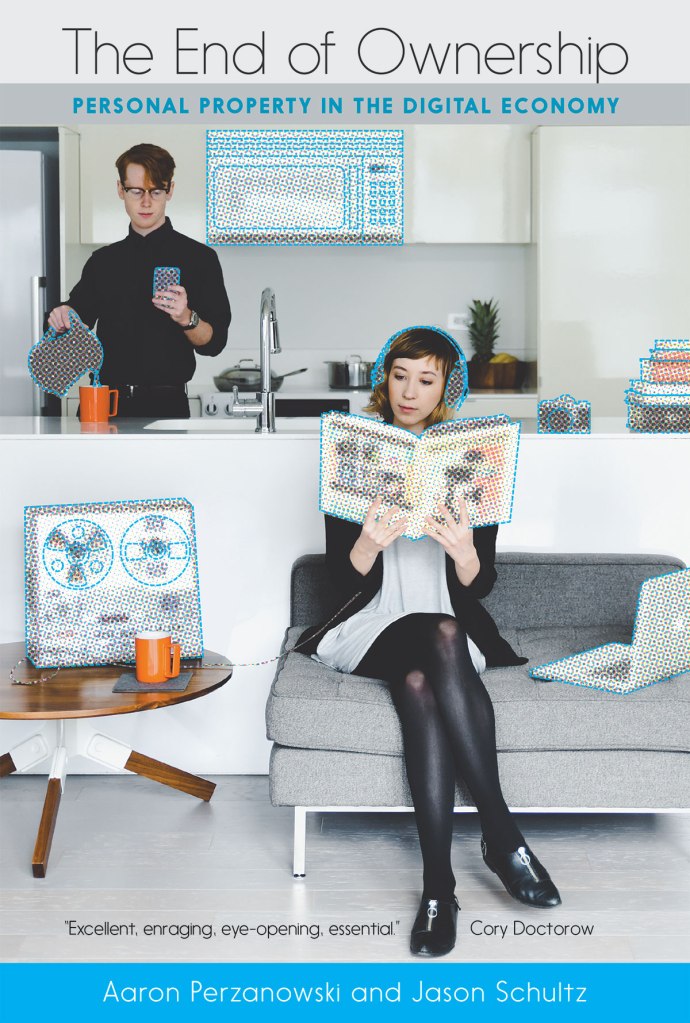
‘The End of Ownership’ by Aaron Perzanowski and Jason Schultz

If you buy a book at the book shop, you own it, and are free to do exactly as you wish with it. You might be surprised to hear that the same is not true of ebooks and other downloaded media. In fact, as Aaron Personowski and Jason Schultz discuss, the digital world is an incredibly complicated place when it comes to ownership.

9780262035019_1

Chances are if you own an iPod, Kindle or even a desktop or laptop you are no stranger to the world of the digital download. It is becoming more and more common to simply pay for a digital copy of a song, book or film, rather than worrying about cumbersome physical objects. Who even has time to wait for an Amazon delivery these days, anyway? The digital download has done wonders for the instant gratification of consumers, but at what cost? Like it or not, each time you click ‘pay now’ on a digital purchase, you are entering a new and confusing world, rife with rules, regimes and regulations that restrict how you interact with your downloads.

Authors Aaron Perzanowski and Jason Schultz use their book to delve into the complex, jargon-ridden world of the rights of digital consumers, to uncover the mystery of whether we can really be considered ‘owners’ of our digitalia. As the owner of a physical object you enjoy certain freedoms; if you have a collection of print books, you are free to annotate them, modify them, or even destroy them if you want to. The same however, cannot be said to the ‘owners’ of downloaded goods.

Every time you buy an ebook from Amazon or a song from iTunes you sign an end-user licence agreement (EULA) – let’s be honest, you have probably never read it – the contents of which are far removed from the freedom we enjoy with physical ownership. Consumers do not actually own digital purchases, they license them and have the permission to read, listen to, play, or watch them. Slightly more worrying is the fact that the company providing the software used to access these files effectively has control over a user’s digital library.

Here’s an interesting case. In July 2009 Amazon remotely, and without warning, wiped (irony of ironies) George Orwell’s ‘Nineteen Eighty-Four’ and ‘Animal Farm’ from all Kindle ereaders, following a dispute with the publishers.

Small fry, perhaps? Permissible collateral damage? Well, what happens when devices, or corporations, become obsolete? That’s what happened to HDGIANTS Inc, a former distributor of high-quality audio and video files. When it went bankrupt, its servers were switched off, and with that, portions of the digital libraries of thousands of paying customers evaporated.

So how content should consumers be with their content? A bookshop cannot, as Schultz and Perzanowski point out, creep into your house in the middle of the night and reclaim the contents of your physical shelves – so why can digital providers? Is it fair that book lovers and audiophiles are charged prices akin to a physical copy for a digital download that is completely at the mercy of publishers and licensers? What is the benefit to the consumer of opting for digital files? Are the benefits of reducing waste and getting instant gratification really worth it?

‘The End of Ownership’ presents the confusing world of the digital consumer in wonderfully accessible prose, replacing hideous jargon with the simplest of analogies, from thieving bookshops to the goblins from Harry Potter. It will answer the questions you have regarding digital ownership, and it’s inevitable that more than a few of them have never even crossed your mind.

In an increasingly complex world, plagued by unreadable (certainly unread) terms and conditions, it is more than a little refreshing to have something explained in good, plain English.

This review was first published online for E&T magazine.

The Night Circus – Erin Morgenstern

It occurred to me yesterday that 2016 was a terrible year for my personal book reviews. I read and reviewed 28 books for E&T – and loved every second of it I might add – but I really did let my personal stuff fall by the wayside. Turns out there are a few I reviewed, and then left the word documents gathering theoretical dust in my hard drive, so I’m dusting them off this week and will be posting them fresh for you all to see.


nightcircus

I’ve had this book for a while, but only decided to pull it down from the shelves in my reading room after David Bowie passed away. As I said, I have let things slip.

I was so upset by his death, so much more so than any other person that I cannot claim to ‘know’ in any real sense. Perhaps it was the very public way that he decided to go, to give it all up with one final hurrah, but it had a very real effect on me, and I spent many nights listening to Black Star and Lazerus while quietly sobbing.

Anyway, shortly after his death I was in Waterstones and saw a copy of The Night Circus with ‘DAVID BOWIE’S FAVOURITE BOOK’ emblazoned across the front. Now don’t get me wrong, this wouldn’t have been enough to make me actually buy the book – I’m still not sure how I feel about this marketing tactic – but it did make me go home and start reading the copy that I already had.

It was the beginning of a week spent reading in the bath until my skin was grey and clammy and the water temperature had dropped a little below tepid. I was absolutely enamoured by this book, a book I had had on my shelf for months – David Bowie’s favourite book.

Imagine you are a small boy, who doesn’t yet know his place among friends or family and is striving to find meaning is his life. One day, as if from nowhere, a mysterious circus tent appears in your home town, and it calls to you.

The Night Circus – or Cirque to Reves – is different to other circuses – there are no sad looking clowns with oversized button holes, or dusty, skinny elephants tied to chairs, rather, it is a place of true magic. At the heart of the circus as some of the most incredible people you will ever meet, wonderful sorcerers, incredible contortionists, talented acrobats and marvellous mystics, all of whom are enamoured by the magic around them. It is beautiful, and captivating, but underneath the black and white façade, something far more sinister is going on.

The Night Circus is not a circus; it is a game of chess, the black and white squares on the board coming to life, twisting and turning into a stunning array of blacks and whites, each pattern striking out against the other. At either side of the board, hidden by their army, stand the two kings. The Night Circus is their pawn; it is a war, a vicious war fought by fame and glory – a war of magic, and fame, and destruction, fought between two competing shadows.

Erin Morgenstern has one of the most beautiful writing styles I have ever come across. The words flow across the page driven by rippling monochromic imagery, made of more than just the ink which paints the page. Even the simplest of phrases or gestures, are given a beautiful, flourishing turn – the opening of umbrellas after the rain becomes the ‘popping’ up of toadstools, lovers hold one another in an ‘emerald embrace’, and a ‘single perfect diamond’ stands out amongst a ‘sack of flawed stones.’

I really, really enjoyed this book. It is mysterious and intricate, filled with stories within stories and lives hidden behind the scenes, and there is so much waiting to be discovered. It struck me that Morgenstern constructed the book as if it is circus itself; with each page the reader is drawn closer and closer to the centre while glimpsing hidden corners and secret passageways that could unfold with the slightest touch. Along the way there is imagery within metaphors, magic overlapping magic and so much more than I could ever give credit to in such a short review.

I get the impression that there will always be more to this story than first meets the eye. There are hints and stories hidden within the text that may only emerge at a second, or maybe even a third reading. It is up to the reader to decide why the book was written and to think about the true meaning behind the circus. This in itself is beautiful; just like the fans of the circus I feel enamoured but ultimately clueless.

Fans of David Bowies, lovers of the obscure, seekers of magic or beauty – read The Night Circus. I implore you.


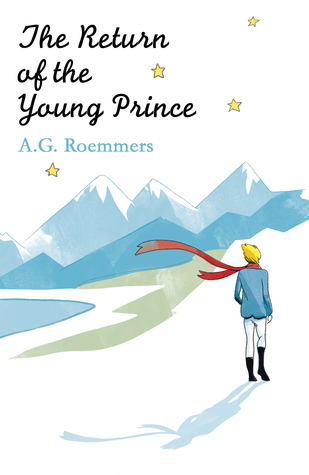
The Return of the Young Prince – A.G. Roemmers

A few months ago I came into work to see a news story left on my desk. It was inconspicuous, a small sheet of thin paper roughly torn out of a little pamphlet, and it told me they The Little Prince was coming back. The little golden-haired boy whose story opened my eyes to a whole new way of thinking had touched another author enough to be brought back to life.

Then, one evening this October as the weather was just starting to turn, I was walking out from South Kensington tube station when I passed small, independent book shop, lit up against the coming dark with the most wonderful display of hardback books – he had arrived.

28957290Those of you who have read my blog a lot might know of my love affair with The Little Prince. I love French translations, and this one was so wonderfully magical and childish that it took me back to innocent place in the very far reaches on my memory. The golden-haired boy of Exupery’s tale holds a firm spot in my heart, and the idea of seeing him again filled me with so much joy.
I approached the book with a certain amount of caution, aware that it could so easily fall short of my rather high expectations – The Little Prince is a rather hard act to follow. I’m not going to pretend I didn’t have a few reservations while I was reading the book – there were the invariable comparisons to the original – but while I found it difficult at first after some time I realised that the book needed to be different. After all the original book is not just the story of The Little Prince himself, it is the story of the Aviator – that is, Antoine de Saint-Exupéry – and how his life was touched by The Little Prince. In the same way, The Return of the Young Prince is a tale of how The Little Prince touched A.G. Roemmers.

“I think this planet would be a lovely place if everyone on it greeted each other with a smile when they met”

In The Return of the Young Prince, a solo driver, setting out on an expedition across the mystical land of Patagonia, finds a young, starving teenager asleep at the side of the road – none other than The Little Prince, now grown, who has returned to earth in search of his friend the Aviator. The pair embark upon a journey of a lifetime, the man with a destination in mind, and The Young Prince, as he is now known, hoping that along the way he will find what he is looking for. The Young Prince and the driver speak, they are philosophical, quizzical, educational and at times humorous, the conversations passing between the pair serving to highlight, as in the original, the wonderful difference between the adult and juvenile brain, and that there are things in life that you cannot put a price on.

“I can tell you with certainty that your friend gave you the loveliest sheep in the world – the one that you imagined in your fantasy, the only one you could look after and that could go with you to your little planet. Didn’t you enjoy his company as you watched the sunsets? Didn’t you go to him in the night so that he wouldn’t feel alone and that you too wouldn’t feel so alone? Didn’t you think that he belong to you because you had tames him and that you belonged to him? There’s no doubt that he was more real, more alive, than the one you saw in the photograph, because that one was just a sheep, whereas the one inside the box was your sheep.”

There is so much I could say about this book, so many anecdotes I would love to pick apart and ponder over the hidden metaphors and morals. There are so many messages one could take from the story, though, that it would be unfair of me to do so and to taint your own experience of the book. Assuming of course that you are willing to give the book the time of day – I thoroughly recommend it.

It’s important to approach the book with an open mind. Do I prefer it to the original? Of course not. It’s a very different book, but while it changes some of the themes of the original, it does not detract from Antoine de Saint-Exupéry’s work. This is a book which speaks of how The Little Prince touched the life of the author, a man who has dedicated years of his life into researching and studying Antoine de Saint-Exupéry. The book does not try to pick up where Antoine de Saint-Exupéry left off. Rather, just like The Little Prince, it serves as a tale told by a man whose life was changed by his encounter with the golden-haired child of Antoine de Saint-Exupéry’s past.


The Power – Naomi Alderman

cover-jpg-rendition-460-707

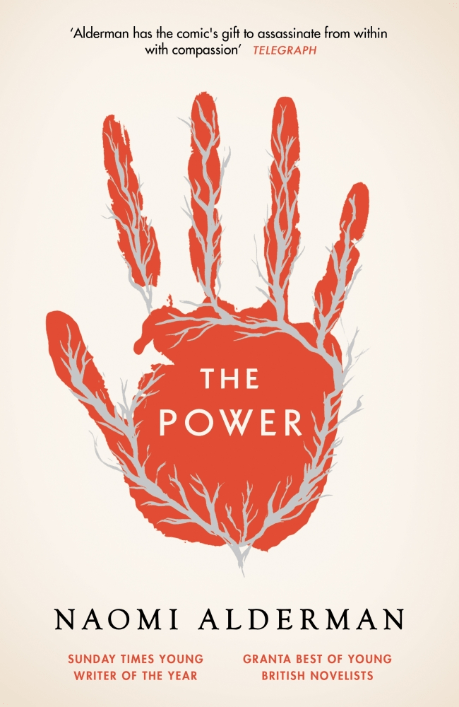
Equality, prosperity and power are just some of the aims of feminists past and present – but what would a world controlled by women actually look like? In her fourth novel, author Naomi Alderman inverts traditional gender roles to create a world where women quite literally hold all the power and men tremble at their feet.

Love it or hate it, utopian and dystopian fiction has a lot to say about how people live their lives and the desires, dreams and fears that lurk under the covers of society. Dystopic works throughout the 20th century have explored totalitarian states, brainwashing, societal complacency and overpopulation. They reflect societal fears of a future in which too much power has been lost to the state, through the wonderful world of science fiction.

This genre suits feminist complaints by questioning the conventional exercise of power between the sexes, often delving into frustrations of women in a patriarchal society. Previous works explored the prospect of women-led civilisations in which gender roles are reversed or worlds where women live alone, having somehow discovered the secret to asexual reproduction.

There is a reason you don’t get many all-male utopias, but I’ve often wondered why there aren’t more novels that explore what a world would be like where women not only ruled, but ruled with power. So many science-fiction novels strived to illuminate societal inequality through exaggeration and role reversal, or the creation of purer, softer societies where women rule each other with soft hands, but I have yet to come across a book which inverts the status to devastating effect.

‘The Power’ is just such a novel.

Naomi Alderman’s latest novel is a manuscript written 5,000 years in the future, documenting the rising power of a female elite. The story begins with the ‘Day of the Girls’, when teenage girls across the world wake with a strange new power. It starts as a subtle throbbing sensation between the collarbones and crackles across the skin, filling the air with electrostatic discharge and the smell of rain and rotten fruit, before emerging as a spark of light from the tips of the fingers.

What would the world look like if men were afraid of women rather than women being frightened of men?

A slight warning, while not fully divulged in this review, the book contains one or two themes that some readers might find disturbing.

Through the guise of a fictional future researcher, Alderman follows the stories of four characters and how they are affected as the world begins to change. We meet Roxy, a tough, foul-mouthed daughter of a London crime lord who is out to seek revenge; Allie, a dual-heritage girl from Jacksonville who, having suffered unspeakable abuse at the hands of her foster father, rebrands herself as charismatic faith-leader Mother Eve; Margot, the aspiring New England Governor along with her confused daughter Jocelyn; and Tunde, a plucky Nigerian journalist who strives to uncover the ugly truth behind the rising female power.

‘Men have evolved to be strong worker homestead-keepers, while women – with babies to protect from harm – have had to become aggressive and violent.’

A few videos emerge across social media platforms showing girls seemingly electrocuting men with their hands. The initial reaction is one of disbelief, but as more and more begin to appear, society is forced to attempt to address this strange new phenomenon. As childish tussles give way to deadly brawls and schools are forced to begin gender segregation, the very fabric of society unravels and young women are recruited to fight a bitter battle between the sexes that ravages Eastern Europe.

In Alderman’s present, electricity is no longer a thing of convenience, but a power to be held within the hands of women, to throw off the shackles of oppression. The future, however, is anything but bright, and all thoughts of equality are thrown to the wind. Ideas of a softer, more maternal society give way to hordes of women who rule with iron fists, as men are assigned their place on the bottom rungs of the ladder, forced into submission as slaves to the female race.

The storyline is complex and multi-layered, presenting a future where women have forgotten the male-dominated times of the past – the systems overthrown within the main body of text – and men are thought to be the fairer sex. This book is so much more than the latest attempt at a feminist dystopia. It is refreshing and insightful, combining a gripping storyline alongside an interesting analysis of societal ideas about equality and fairness within gender roles.

This review was first published on online for E&T magazine.

Head in the Cloud – William Poundstone

9781786070135_16_3_1_1
What’s the point in knowing anything when facts are so easy to look up? In this new release from Oneworld Publications, William Poundstone sheds light on the importance of knowledge, even when Google is just a stone’s throw away.

It is often said that we are living in an information age. Gone are the days of trawling through text books and library archives to find the material to complete your latest homework assignment. The internet possesses all the information you could ever need – and then some. Pick up your smartphone or connect to your computer and you have a wealth of data available at your fingertips. But while it’s true that it is incredibly easy to look up facts on Google, it’s not so easy to remember any of them. Some have argued that having such a wealth of information available to us is making us stupid.

In his new book, ‘Head in the Cloud: The Power of Knowledge in the Age of Google’, William Poundstone turns this theory on its head. Being better connected doesn’t necessarily mean we are better informed and the internet is not making us stupid, he argues. Rather, it is making us less aware of what we do not know. We’re living, Poundstone believes, in the golden age of rational ignorance. People are more interested in the lives of Kim Kardashian and Kanye West than bothering to learn who painted the Mona Lisa and millennials use acronyms such as BTDTGTTAWIO (been there, done that, got the t-shirt and wore it out), but are unable to recall the single word uttered by the raven in Edgar Allen Poe’s famed poem.

So what does being well informed actually mean? Does it really matter?

Speak to any self-proclaimed gamer and you will likely tap into a wealth of information that’s missing from the mind of the average Joe. Perhaps you don’t have a clue what processor lurks within your PC, or how to overclock the latest Nvidia graphics card, and why would you? Unless gaming happens to feature high on your list of priorities, you’ll probably never need to know this random information.

Equally, some of you will have got through life just fine without ever having known the catchphrase of Poe’s raven. If someone was to ask you who invented Post-It notes, what year Tinder was developed, or what the fastest land mammal on earth is, you could retrieve the answer from the cloud within a fraction of a section of clicking ‘search’ on Google. This poses the question: ‘What’s the point of knowing anything when facts are so easy to look up?’

Interestingly, it turns out that the benefits of staying well-informed extend much further than being everyone’s go-to teammate in the monthly pub quiz. Poundstone reports results of internet surveys analysing the rate of public knowledge, with outcomes suggesting that better informed individuals are, on the whole, healthier, happier and quite significantly wealthier. Not only this, but factual knowledge is heavily correlated with personality traits, including political opinion. Did you know, for example, that those who are able to locate a country on a map are less likely to be in favour of invading it? This is just the very tip of the iceberg when it comes to ill-informed voters.

‘Head in the Cloud’ is hilarious, humbling and brutally honest, and will likely make you doubt yourself, and everyone around you. This book is not merely a declaration of the woes of an ill-informed public, it also serves to highlight the benefits of broadening your horizons, offering insight and advice on how to best use todays media to stay informed. If you take only one thing away from this book, let it be the knowledge that there is no such thing as irrelevant information and that you could probably benefit from a little more time spent with an atlas, encyclopaedia and Oxford English Dictionary.

This review was first published in print for E&T magazine

Fluke: The maths and myths of coincidences – Joseph Mazur

 29250394

Whether surprising, creepy, or downright weird, we all love to hear about coincidences, but just how usual are these seemingly uncanny events that so often creep into our daily lives? In this new release from Oneworld Publications Joseph Mazur aims to find out by delving into the mathematics behind coincidence.

Picture this: you are sitting in a café in Agios Nikolaos on the island of Crete when you hear a familiar laugh at a table nearby. You look over and lock eyes with your own brother. You had no idea he would be there, and he is just as surprised to see you. Of all the places in the entire world, what are the chances that you two have ended up in the same place, at the same time, seemingly unbeknownst to one another? It seems hugely unlikely, and yet this is exactly what happened to author – and coincidence enthusiast – Joseph Mazur, back in 1968. Uncanny isn’t it?

This story is just the kind of thing the average mind laps up with delight. Coincidences make magnificent stories, be it a crazy tale of pure luck that unfurled just because you happened to be in the right place at the right time, a thrilling near miss, or a series of hugely unfortunate events. Tell a crowd a story of coincidence and they will response with surprise and wonder. Yet far from being unusual, coincidences are actually fairly commonplace. In fact, even the finest coincidence can be explained as mathematically predictable.

Of course, coincidences are not solely of the ‘uncanny’ variety. On any given day, we encounter a stunning variety of factors that dictate the path our lives will follow, and a five second change in routine could see you meet the love of your life, or get crushed to death by a falling flowerpot. The ‘what ifs’ of life fill everyone’s existence, with even the most logical mind susceptible to obsessing over the smallest factor which could hold the key to changing the course of history. You could spend your life trying to understand coincidences that govern life, but as Mazur’s beloved Uncle Herman once put it: “Everything that happens just happens because everything in the world just happened.”

In Fluke: The maths and myths of coincidence, author Joseph Mazur attempts to demystify the mathematics that dictate coincidence, to show the reader that if there is any likelihood that something could happen, no matter how small, it is bound to happen to someone at some time. After all, in terms of population, the world is a really, somewhat inconceivably huge place.

Through a delightfully written collection of some of the seemingly strangest coincidences, we learn that it is possible for a person to win the lottery four times, fans of plum pudding move in similar circles, and, in the case of George Washington at least, dreams really do come true. Mazur combines stories of coincidence with practical mathematical methods of appraising the likelihood of events occurring, exploring the nature of coincidence frequency to explain why they happen, and more importantly, why we are still so surprised by them.

The key to understanding coincidences is in mathematics, but the author concedes that there could be an element of fate in any situation, some larger entity at work governing the coincidence that we encounter throughout our lives. After all, it sometimes feels good to believe that there is a grand plan governing that which we cannot explain, and no one wants to believe that the coming together of soulmates is dictated by maths. What’s more, when you write a book on coincidences, you notice more than ever, Mazur muses, after having accidentally vacuumed up page 2072 in his 2262 page dictionary. The very page he would later need to look up the word serendipity. Now what are the chances of that?

This review was first published on online for E&T magazine.