Astrophotography -Rhodri Evans

astrophotography

For millennia people have been fascinated by the stars, looking up to the sky at night to search for answers, look for peace, and predict the future. As human beings we often forget our place within the wider universe, and nothing will better remind you of your relative unimportance than looking up at the night sky. It is worth noting however, that the stars above us, while intoxicating to view outside of the city lights, are just a small snippet of world outside our atmosphere. Astrophotography by Rhodri Evans serves as homage to the beauty of the space beyond our atmosphere, presenting some of the most breath-taking astral photos ever taken.

We begin with a reminder of the insignificance of our tiny home planet. Important, because it’s our home, because it is the only known place that possesses life and yet it barely registers as a miniscule blip on the radar when it comes to the wider universe. The billions upon billions of galaxies that exist beyond us got to show just how tiny we really are. This photo, taken from 6 billion kilometres away, sums up everything you have ever known, everyone that you have ever and will ever know, and the whole of human history in less than a pixel in a camera’s array. Do you feel small yet?

P3
A tiny blue dot – Earth seen from 6 billion kilometres away [NASA/JPL]
Part one of this pictorial tour through outer space stays close to home with a summary of our solar system. From our closest neighbour, the moon, round the sun and past the seven other planetary bodies that all call the solar system home, stopping along the way to look at neighbouring moons, and the satellites, shuttles and space craft that made this book possible. Those of you who can remember the golden years between 1930 and 2006 will no doubt rejoice at the inclusion of everyone’s favourite non-planet, Pluto, who was devastatingly demoted to dwarf planet status just ten years ago.

With each sequential part of the book, Evan travels further into outer space stopping next at the Milky Way, and all those that call the deliciously named galaxy home. The book explores the likes of the Orion Nebula, the Pillars of Creation, and, at the very centre, an elusive super massive black hole. A little further out takes us to the local group, the ‘neighbourhood’ of galaxies of which the Milky Way is part. Enter Andromeda, the large and small Magellanic Clouds, and the distant Pinwheel Galaxy. Further still and we reach the outer galaxies that lie in our immediate neighbourhood – galaxies of many shapes and sizes, distinct from the two spiral galaxies that dominate our local group. Some located 100 of millions light years away, these galaxies take the largest telescopes to explore.

The last stop on our astronomical tour takes us to the every edge of the universe. At which point we are, quite literally, looking back in time. The light from the far reaches of the universe has taken so long, some up to 13 billion years, to reach our tiny earthborn telescopes that we are viewing the stars as they appeared at just a few hundred million years old.

This book is not merely a stunning collection of photographs of the enormous cosmos of which we are just a tiny part, it is a homage to the astronomers, the physicists, and the multiple probes, spacecraft and satellites that are forever pushing further into the realms of unknown. Leaving no astrological stone unturned, from Europa, the ice moon of Jupiter, to the distant Sea Horse Nebula, Evan’s presents the most breath-taking astrophotography available, alongside the physics of the object itself, and the photo encapsulated in the book. Astrophotography interlaces hard science alongside stunning photography to give the reader a glimpse of the science behind the photo.

This review was first published on WordPress for E&T magazine
Head in the Cloud – William Poundstone

Head in the Cloud_9781786070135.jpg

It is often cited that we are living in an information age. Gone are the days of trawling through text books and library archives to find the material to complete your latest homework assignment. The internet possesses all the information you could ever need – and then some. Pick up your smart phone or connect to your computer and you have a wealth of data available at your fingertips. While it’s true that it is incredibly easy to look up facts on Google, it’s not so easy to remember any of them. Some have argued that having such a wealth of information available to us is making us stupid.

In his new book, Head in the Cloud: The Power of Knowledge in the Age of Google, William Poundstone turns this theory on its head. Being better connected doesn’t necessarily mean we are better informed and the internet is not making us stupid. Rather, it is making us less aware of what we do not know. We’re living, Poundstone argues, in the golden age of rational ignorance. People are more interested in the lives of Kim Kardashian and Kanye West than bothering to learn who painted the Mona Lisa and millennials use acronyms such as BTDTGTTAWIO (been there, done that, got the t-shirt and wore it out), but are unable to recall the single word uttered by the raven in Edgar Allen Poe’s famed short horror story. So what does being well informed actually mean? Does it really matter?

Speak to any self-proclaimed gamer and you will likely tap into a wealth of information that is missing from the mind of the average Joe. Perhaps you don’t have a clue what processor lurks within your PC, or how to overclock the latest Nvidia graphics card, and why would you? Unless gaming happens to feature high on your list of priorities, you’ll probably never need to know this random information. Equally, some of you reading this review will have got through life just fine without ever having known the catchphrase of Poe’s raven. If someone was to ask you who invented post-it notes, what year Tinder was developed, or what the fastest land mammal on earth is, you could retrieve the answer from the cloud within a fraction of a section of clicking ‘search’ on Google. This poses the question – ‘What’s the point of knowing anything when facts are so easy to look up?’

Interestingly, it turns out that the benefits of staying well-informed stems much further than being everyone’s go-to teammate in the monthly pub quiz. In Head in the Cloud, Poundstone reports results of internet surveys analysing the rate of public knowledge, with outcomes suggesting that better informed individuals are, on the whole, healthier, happier and quite significantly wealthier. Not only this, but factual knowledge is heavily correlated with personality traits, including political opinion. Did you know, for example, that those who are able to locate a country on a map are less likely to be in favour of invading it? This is just the very tip of the iceberg when it comes to ill-informed voters.

Head in the Cloud is hilarious, humbling and brutally honest and will likely make you doubt yourself, and everyone around you. This book is not merely a declaration of the woes of an ill-informed public, it also serves to highlight the benefits of broadening your horizons, offering insight and advice on how to best use today’s media to stay informed. If you take only one thing away from this book, let it be the knowledge that there is no such thing as irrelevant information and that you could probably benefit from a little more time spent with an atlas, encyclopaedia and Oxford English dictionary.

This review was first published on WordPress for E&T magazine

Computer Science: A Very Short Introduction – Subrata Dasgupta

51s6vpHzRKL

Computer science as a discipline first emerged in the 1960s and was perhaps somewhat neglected as a field of study, hidden as it was behind the shadow of the Iron Curtain, surpassed by the civil rights movement, and outdone by feminists fighting for equal rights. Yet the emergence of a new science – the science of a machine that would go on to revolutionise the 20th century – is arguably of no less important than many of the great things happening in this era.

The computer is one of the defining features of modern society, having revolutionised the way we live and work. The invention of the first electronic computer in the 1940s was without a doubt one of the most important developments of the 20th century. As I sit here typing this, I am accompanied by a chorus of colleagues tip-tapping at their laptops. Enter any office building and you will experience the same – nothing is done via pen and paper anymore. The majority of us own and use a computer and possibly even a smart phone and tablet. Yet despite this, the science behind the machine is less understood outside of the professional science community.

InComputer Science: A Very Short Introduction, Subrata Dasgupta offers the intellectually curious reader an understanding of the fundamental nature of computer science. This concise, enthusiastic and wholly-accessible overview of the topic was written to enrich the public understanding of this influential, yet strange new field of study, and, above all, to answer the question: what is computer science?

This review was first published on WordPress for E&T magazine

Materials: A Very Short Introduction – Christopher Hall

51WLqju+LJL

In its rawest form, a material is simply useful matter, which pretty much includes anything that can be utilised in some way, ranging from steel and concrete used in construction, through to gas, food and fertilisers used in production, and stretching as far as ivory and porcelain sold in small indigenous marketplaces. In its simplest form, a material is a material as soon as somebody uses it – simple enough, isn’t it?

While the concept of a material may be easy enough to understand, more complex is their effect of the societies that use them. Materials shape the cultures that apply them and advances in new technology depend on innovation in materials. Think about the exciting new improvements spreading in the news surrounding graphene production and utilisation. Without new materials, there are limits to how far technology can progress, and so how far a society can grow and adapt.

In Materials: A Very Short Introduction, Christopher Hall introduces new readers to the history, progression and development of material production, from the early days of gold, sand and string, through revolutions in industrial production, and into more modern issues of sustainability. If you want to learn more about how societies develop and adapt, then this is the ideal book to add to your collection. To understand change, you need look no further than the materials behind the scenes.

This review was first published on WordPress for E&T magazine
Structural Engineering: A Very Short Introduction – David Blockey

51w2amc1zjL

Last year, I took the elevator up 108 stories to the top of the International Commerce Centre in Hong Kong, a skyscraper so huge that it is often obscured by the clouds. Sitting in the skybar, sipping champagne with friends, it’s easy to ignore the work that must have gone into such a phenomenally huge building, although less easy to escape the feeling of being so gut-wrenchingly high off the ground.

At 484 m (1,588 ft), the ICC is by no means the tallest building in the world, not by a long shot. It pales in comparison to the Khalifa Tower in Dubai, which stands at a mammoth 829.8 m (2,722 ft) tall. What’s even crazier is the idea of the proposed Dubai City Tower, which, should it ever come to fruition, could reach a staggering 2,400 m (7,874 ft). The mind boggles at the mere prospect of such a structure, and this raises the question, how is such a building even possible? How can you even begin to plan for a structure that would extend more than a mile into the air?

In answer to this we turn to the structural engineer, the persona behind the building, responsible for taking materials from a mere pile of components, to a fully functional structure. Structural engineering, although often lumped into the same category as architecture, is far removed from the realms of beauty and design and instead takes the strategy behind construction into account. In Structural Engineering: A Very Short Introduction, David Blockey delves into the world of the structural engineer, with a brief glimpse into the science and engineering behind how large manmade objects are created.

This review was first published on WordPress for E&T magazine
War and Technology: A Very Short Introduction – Alex Roland

9780190605384‘Humans were born armed’ is the premise to the next of our Very Short Introduction series of reviews, War and Technology, which seeks to trace the combined history of, you guess it – war and technology. Some of you may take issue with the statement – how can a human be born armed? It is interesting to note however, that weapons formed from natural material and used to defend, hunt and fight, have been around before the first Homo sapiens, back to the time of archaic proto-humans. In the 19th century, Jurist Sir Henry Maine famously commented that “War appears to be as old as mankind, but peace is a modern invention.” The same, in fact, is true of technology. For as long as humanity has existed, we have strived to manipulate the world around us to achieve our means –including the creation  and use of weaponry. In effect, the use of weaponry and other military technologies is intrinsic to human nature.

Throughout history, factors such as politics, economics, ideology and culture have had a notable effect on the development of warfare, but no other single variable even comes close to the effect of technology. The changes of warfare patterns,, from the Stone Age right up  to the Atomic Age can each be comprehended by the development of new technologies, such as early stone axes of prehistoric man and nuclear warheads, which now lay dormant on the shores of every developed nation. The so-called ‘principles of war’ – objective, offensive, mass, economy of force, maneuverer, unity of command, security, surprise and simplicity – can be applied and understood throughout history, but none can explain the evolution of technology. As author Alex Roland points out, Alexander the Great may have conquered Afghanistan and gone on to be remembered as one of history’s greatest captions, but he would be baffled and bemused by satellites, aeroplanes and explosives. The fundamentals of war are timeless, but technology is incessantly changing.

In War and Technology A Very Short Introduction, Roland attempts to follow the history of these two subjects and open the inquisitive reader’s eyes to the complex growth and collaboration of these two innately human phenomena. Exploring warfare from land, sea, air and even space, while delving into the realm of cyber warfare, psychological warfare and the war on terror, Roland presents an analysis that, although largely western, is universally applicable in concept. Whether your interest is in war or technology, this book is sure to grab your attention and enrich your mind.

This review was first published on WordPress for E&T magazine

Digital Keywords: A Vocabulary of Information Society and Culture – Benjamin Peters

Digital Keywords_2322014794239559427

In 1976, Raymond Williams published his world-renowned reference book Keywords: A Vocabulary of Culture and Society, a text that would go on to change the way society approaches language, and make its way onto the reference shelf of political theorists, linguists, university students and academics alike. The text revealed how the meanings of 131 words were formed, altered and redefined within the changing society in which they were used.

Now, 40 years after Williams began the journey into the politics and culture behind language, his work has been continued – and readapted for the 21st century – in a book that seeks to carry on where he left off, by digging out the roots of digital language and discovering how it has shaped the newfound society we live in today.

Digital Keywords: A Vocabulary of Information Society & Culture takes 25 of the most important ‘digital’ words in the English language and assesses how their meanings have shifted over time, analysing the forces behind them, their meanings and their development. With essays from contributors across the fields of politics, communication, media and digital activism, the book seeks to discover how the digital has reconfigured culture, and how the development of keywords reflects cultural change, hinting at development and marking even the subtlest of societal revolutions.

In his introduction, Peters points to the words of technological historian Leo Marx: “The emergence of a keyword in public discourse – whether newly coined or an old word invested with new meaning – may prove to be an illuminating historical event. Such keywords often serve as markers, or chronological signposts, of subtle, virtually unremarked, yet ultimately far-reaching changes in culture and society.” These are the keywords that Peters attempts to uncover in this new and revolutionary publication – the words which, once studied, reveal a deeper meaning about society than the actual definition alludes to.

What a keyword does, says Peters, is both more relevant and more interesting than what it is. In this way, it is important to understand that Digital Keywords is much more than a concise dictionary or glossary of digital terms. The very meaning of the keyword itself takes second place to the history and development of the word, the society that gave way to its development, and its continually changing definition. In addressing ‘activism’ for example, in the first essay in this collection, contributing author Guobin Yang must take into account, not just activism in its original sense, but the rise of digital activism, and the words and movements that this form of activism gave way to by delving into online activism, cyber activism and hacktivism alike.

The one annoying thing about this text is that you cannot say it runs from A-Z as books of this nature often do, as Peters’ digital list is somewhat limited, assessing only select keywords from Activism to Surrogate. ‘A to S’ doesn’t have quite the same ring to it, does it? But, as the absence of Z suggests, the book itself is only the beginning. Each chapter is cross-referenced to linking keywords, both within the book and within William’s original selection, and there is also an extended appendix of further digital keywords for the reader to consult research themselves. It seems that, with the release of this book, the digital language journey is just getting started.

Digital Keywords serves as an in-depth interrogation of the meaning and development of digitised language, and strives to reveal the way in which the digital has reshaped society and rewritten culture. You can learn a lot about society from language, and those wishing to gain a deeper understanding of the modern, digital world we all inhabit would be well advised to begin by taking a look at this book. Just as Keywords made its way firmly onto reference shelves in the 1970s, so too will Digital Keywords today.

This review was first published in print for E&T magazine.

The Cambridge Phenomenon: Global impact – Kate Kirk and Charles Cotton

3-d_CPGITRANS_1024x1024.png

There’s a well-known saying, ‘it takes a village to raise a child,’ and in Cambridge, you could say ‘it takes a cluster to raise a company.’

For nearly 40 years, a technological powerhouse has been growing in the English countryside. Nestled on the southern tip of East Anglia, Silicon Fen, also known as the Cambridge Cluster, may pale in popularity to its older, wiser sibling – Silicon Valley in California – but is of no less importance locally and indeed, globally. Widely acclaimed as a centre of excellence for knowledge and education, Cambridge is ranked as the No.1 University in the world, but its contribution to technological development is less known.

It is remarkable to consider just how many life-changing technologies originated in a small city in the heart of the English fenland. From the discovery of the DNA double helix by Watson and Crick – the findings were announced in the Eagle pub, Benet Street on a cold lunchtime in February 1953 – to the first Acorn computer, the beige and black, blocky creatures loved by school children of the 80s and 90s. At the heart of the cluster you find the university, a place that nourished revolutionary academics including Isaac Newton, Charles Darwin and Lord Byron, whose fascination with the arts and science helped shape the romantic period. Still an academic centre of excellence, the university has transformed through the years into the advanced hub that it is today.

In their new book, The Cambridge Phenomenon: Global Impact, authors Kate Kirk and Charles Cotton attempt to highlight the influence that Cambridge has as a powerhouse for innovation and excellence – an influence that, according to the authors, has been largely underestimated. They argue that developments in Cambridge today and in the past have not only had a hugely positive impact on UK economy, but around the world in everything from computer chips to gene therapy.

Much of the technology we use is available thanks to Cambridge innovations, from the chips within a smart phone – the majority of which owe their existence to ARM – to anything equipped with Bluetooth technology. To date, some 4,300 knowledge intensive companies are located within a 20 mile radius of Cambridge, 15 of which are valued at over $1billion, two at over $10billion. 25 are the largest corporations in the world (such as Amazon, AstraZeneca and Microsoft) which have opened operations in the heart of the city.

In the forward to their first book, The Cambridge Phenomenon: 50 Years of Innovation and Enterprise, Microsoft founder Bill Gates wrote that the impact of Cambridge ‘reaches every corner of the globe’. In this year’s follow up publication, Kirk and Cotton advance on this point, highlighting the growth of the Cambridge cluster and the people and businesses behind this technological revolution. Cambridge is no longer just the birthplace of great technological advances, but a place to transfer knowledge and grow multinational business.

At the launch of the book, Kate Kirk commented in a similar vein that “the Cambridge phenomenon has reached a status of brain gain rather than brain drain. Instead of early-stage technology companies being bought up by overseas companies and taken away from Cambridge, we are now seeing multinational companies using acquisitions as a way of becoming part of the Cambridge ecosystem. These ‘sticky acquisitions’ are a major indication of Cambridge’s success.”

To this end, the book explores not just particular products and services that have emerged from Cambridge, but also the research institutes and technology sectors that are behind some of the city’s biggest successes. From life science and healthcare to inkjet printing, a wealth of technological innovation encourages competition and attracts talent to discover the potential of the Cambridge Cluster.

This book is important, not just in what it says, but in the work that it represents and the great minds that it credits. Much of the work within Cambridge gives birth to bigger and greater products and services. The effect that this small fenland city has in the wider world should not be underestimated.

This review was first published on WordPress for E&T magazine

Summer gifts from Prudence and the Crow 

Another month has passed, you know what that means? Not only are we over halfway through the year – scary huh? – but I have another bookish treat to share with you.

More splendid gifts from my friends at Prudence and the Crow, this time in the form of my old pal Paddington.

It’s not often that I take the time to revisit my much-loved childhood authors – although I will confess to having Beatrix Potter’s new release on pre-order – but I do so enjoy being given an excuse do so.

I was completely in love with Paddington when I was a little girl: bedsheets, teddy bear, fluffy bedroom rug – I had it all! His gentle, bumbling nature, toggled felt coat and somewhat magical stream of marmalade sandwiches hidden under his hat were a source of constant comfort to me. I only hope that as an adult I am still able to enjoy this delightful little bear as much as he deserves.  

Right now, with so many unpleasant things going on in life – let’s not mention them out loud, but I’m sure you know what I am talking about – I can think of nothing I want more than to curl up with a lovely vintage paperback, and a cup of rose lemonade tea. 

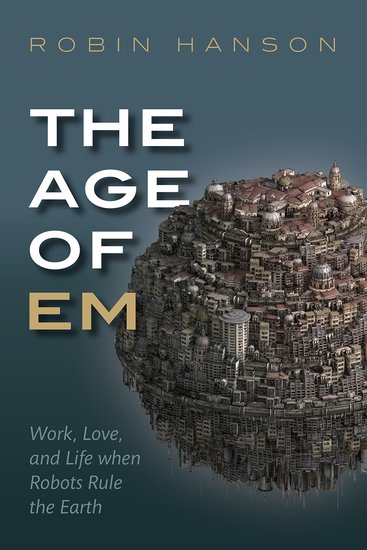
The Age of Em – Robin Hanson

9780198754626 (1)

Ever wondered what a world inhabited almost entirely by intelligent machines might look like? Or even, what smart robots might look like and what their uses, design, attitudes, strengths and weaknesses could be? If any or all of these questions are in the back of your mind, then The Age of Em could be just the book you are looking for. In this revolutionary new publication, economist Robin Hanson combines existing theories in physics, computer science and economics to create a realistic vision of a world dominated by robots.

Each day, advanced reports emerge of experiments in how artificial intelligence and robotics is revolutionising the way we live our lives, but the realisation of a truly intelligent machine still seems far over the horizon. What kind of robots could equal the actions of a human being? Hanson looks to the robotic brain emulation, or ‘em’ as a solution for a truly intelligent machine. The premise is simple enough; take a detailed scan of a human brain and then build a computer model that processes signals in accordance with the same characteristics as the brain. The result is a robotic brain, which can be trained to carry out tasks in the same way as a human baby.

A single brain emulation can be copied thousands of times, creating a literal army of robotic workers with human-like intelligence. The Age of Em serves as an in-depth portrayal of a future where this has become a reality –  ems are the norm and cities, streets, transport and leisure are all designed around these new inhabitants. The era of the em is as different from our own today, as we are from the lives of the farmers and foragers who came before us. Progress has changed once again, with further steps towards efficiency, rendering previous assumptions about life more or less redundant. Moral progress no longer holds such an important position at the forefront of society, with ems, the new master race, rejecting many of the values we hold dear.

It’s a strange world and one which many of you may find unsettling, but is no different than our present lives are from the eras that came before us. To most of us, our lives today may feel preferable to the work-intensive existence of our ancestors, we may even enjoy living as we do today. The em era is no different; it feels good to be an em.

Hanson’s work is revolutionary, not in what it says, but how it attempts to say it. While the majority of previous literary presentations of a world ruled by machines are firmly rooted in the realms of fiction, this text is hard-core theory, attempting to create a realistic image of what a world inhabited by future technology would look like.

Let’s not attempt to flatter the author or reassure the reader by saying that The Age of Em is an easy book to read. It most certainly is not. Those with little experience of economics, physics or computer science may well feel as though they are traversing a figurative Everest of text, but once over the peak, the expedition feels more than worthwhile.

This review was first published on WordPress for E&T magazine