Why you should read… and why you shouldn’t

Reading is good for you!

2936937247_a44e91ca09_z

I feel as though I am being inundated with pointless articles. Welcome to the internet amiright?

I’ve read, or rather glanced over, so many articles recently which highlight the benefits of reading. Sites such as Lifehack and the Huffington Post have outlined the wondrous effect that reading can have on a person’s physical and mental well-being. Urging people, who, in all honesty, probably found their site through a social network, to put down their mobile phones, get off Facebook and pick up a book.

Lifehack blogger Lana Winter-Hébert wrote one such article:

‘10 Benefits of Reading: Why You Should Read Every Day’.

‘When was the last time you read a book, or a substantial magazine article?’ She asks, ‘Do your daily reading habits center around tweets, Facebook updates, or the directions on your instant oatmeal packet? If you’re one of countless people who don’t make a habit of reading regularly, you might be missing out.’

The article listed the following ten ‘benefits’ of reading:

  1. Mental stimulation
  2. Stress reduction
  3. Knowledge
  4. Vocabulary expansion
  5. Memory improvement
  6. Stronger analytical thinking skills
  7. Improved focus and concentration
  8. Better writing skills
  9. Tranquillity
  10. Free entertainment

I have a few issues with this.

I love to read, but I’m not about to lecture anyone on why they should read. People have talked about the benefits of reading for a long time, but it is only recently that these odd attempts at quantifying the benefits of such practices have emerged.

Yes, reading can be beneficial, but so can eating organic produce, avoiding chocolate, giving up smoking, going for runs and abstaining from your morning coffee, and there are plenty of people who lack either the money, time or desire to do these things.

The article goes on: ‘There’s a reading genre for every literate person on the planet, and whether your tastes lie in classical literature, poetry, fashion magazines, biographies, religious texts, young adult books, self-help guides, street lit, or romance novels, there’s something out there to capture your curiosity and imagination.’

This is a little too presumptuous for my liking. Perhaps I am unique among book lovers in that I think there are some people who, as hard as it is to accept, just don’t like reading.

I think the main benefit to reading, and the main reason people should be reading, is because they enjoy it. Reading is a pastime, and it shouldn’t be made to feel like a chore.

If you enjoy reading, but rarely find the time to pick up a book then you could definitely do worse than to take half an hour at the end of the day to immerse yourself in a good novel. But if you don’t, then you don’t need to, and you shouldn’t feel peer pressured into doing so because of the supposed benefits.

‘These are a few of my favourite things’

I have something a little different to share with you today.

This weekend I went to stay with friends in Norwich.

First let me tell you a little bit about one of my friends. She loves stationery, I mean, she LOVES stationery. I like Paperchase as much as the next person, but my friend is literally obsessed. So when she told me she had bought me a gift from a recent trip to London it came as no surprise that it was stationery, after all it had to be stationery, it couldn’t possibly have been anything other than stationery.

Behold my new book review file:

IMG_20150301_173254528 (2)

Now I would expect anyone to be pretty chuffed with a gift like this, it’s a) adorable and b) practical, (I have been in dire need of something to keep all my book notes in) and practical gifts are always the best received.

But I like it for another reason…

Let me introduce you to Coopanda. He’s the adorable little fella on the front of the folder, and this is his story:

Coopanda loves reading a lot,
but he always feels hungry while reading.
So he have to eat chocolate cake instead,
or else he would turned a brown in a moument. 

Oh yes, Coopanda, the chocolate-cake-eating, book-loving, non-English-speaking, panda.

This story has transformed this adorable piece of stationary into something which combines three of my favourite things: reading; pandas; and Chinese which has been badly translated into English.

Now, you may think that’s a bit of a strange thing to like, in which case let me refer you to the wonders of Engrish.

Over and out.

Time magazine’s All-time 100 Novels

Time_Magazine_-_first_coverI recently stumbled, not for the first time, upon Time magazine’s All-time 100 Novels list.

If you’re unfamiliar with this (unlikely I know) in 2005 Time‘s critics Lev Grossman and Richard Lacayo picked the 100 best English-language novels published since 1923 (the beginning of TIME). If you’re wondering how they choose these books click here to find out.

Anyway, I perused the list a little, those titles in italics are ones I read before beginning Jade the Obscure, those in bold, after (you can click on there to see my reviews). I will confess to being a little embarrassed by how few I have read. Only eight out of 100!

I need to do something about this, so I’m going to head out and buy a copy of Lolita, I’ve been wanting to read it for a long time, in fact, there are several books on the list I’ve been meaning to read…

So, I’m going to make a concerted effort to try and fit this list into my pleasure reading. I’ve slipped the list into the pages at the top of my site, so you can check there to see how I’m getting on.

How many have you read?

  • The Adventures of Augie March – Saul Bellow
  • All the King’s Men – Robert Penn Warren
  • American Pastoral – Philip Roth
  • An American Tragedy – Theodore Dreiser
  • Animal Farm – George Orwell
  • Appointment in Samarra – John O’Hara
  • Are You There God? It’s Me, Margaret – Judy Blume
  • The Assistant – Bernard Malamud
  • At Swim-Two-Birds – Flann O’ Brien
  • Atonement – Ian McEwan
  • Beloved – by Toni Morrison
  • The Berlin Stories – Christopher Isherwood
  • The Big Sleep – Raymond Chandler
  • The Blind Assassin – Margaret Atwood
  • Blood Meridian – Cormac McCarthy
  • Brideshead Revisited – Evelyn Waugh
  • The Bridge of San Luis Rey – Thornton Wilder
  • Call it Sleep – Henry Roth
  • Catch 22 – Joseph Heller
  • The Catcher in the Rye – J.D. Salinger
  • A Clockwork Orange – Anthony Burgess
  • The Confessions of Nat Turner – William Styron
  • The Corrections – Jonathan Franzen
  • The Crying of Lot 49 – Thomas Pynchon
  • A Dance to the Music of Time – Anthony Powell
  • The Day of the Locust – Nathanael West
  • Death Comes for the Archbishop – Willa Cather
  • A Death in the Family – James Agee
  • The Death of the Heart – Elizabeth Bowen
  • Deliverance – James Dickey
  • Dog Soldiers – Robert Stone
  • Falconer – John Cheever
  • The French Lieutenant’s Woman – John Fowles
  • The Golden Notebook – Doris Lessing
  • Go Tell it on the Mountain – James Baldwin
  • Gone With The Wind – Margaret Mitchell
  • The Grapes of Wrath – John Steinbeck
  • Gravity’s Rainbow – Thomas Pynchon
  • The Great Gatsby – F. Scott Fitzgerald
  • A Handful of Dust – Evelyn Waugh
  • The Heart is a Lonely Hunter – Carson McCullers
  • The Heart of the Matter – Graham Greene
  • Herzog – Saul Bellow
  • Housekeeping – Marilynne Robinson
  • A House for Mr. Biswas  V.S. Naipaul
  • I, Claudius – Robert Graves
  • Infinite Jest – David Foster Wallace
  • Invisible Man – Ralph Ellison
  • Light in August – William Faulkner
  • The Lion, The Witch, and the Wardrobe – C.S. Lewis
  • Lolita – Vladimir Nabokov
  • Lord of the Flies – William Golding
  • The Lord of the Rings – J.R.R. Tolkien
  • Loving – Henry Green
  • Lucky Jim – Kingsley Amis
  • The Man Who Loved Children – Christina Stead
  • Midnight’s Children – Salman Rushdie
  • Money – Martin Amis
  • The Moviegoer – Walker Percy
  • Mrs. Dalloway  Virginia Woolf
  • Naked Lunch – William Burroughs
  • Native Son – Richard Wright
  • Neuromancer – William Gibson
  • Never Let Me Go – Kazuo Ishiguro
  • 1984 – George Orwell
  • On the Road – Jack Kerouac
  • One Flew Over The Cuckoo’s Nest – Ken Kesey
  • The Painted Bird – Jerzy Kosinski
  • Pale Fire – Vladimir Nabokov
  • A Passage to India – E.M. Forster
  • Play It As It Lays – Joan Didion
  • Portnoy’s Complaint – Philip Roth
  • Possession – A.S. Byatt
  • The Power and the Glory – Graham Greene
  • The Prime of Miss Jean Brodie – Muriel Spark
  • Rabbit, Run – John Updike
  • Ragtime – E.L. Doctorow
  • The Recognitions – William Gaddis
  • Red Harvest – Dashiell Hammett
  • Revolutionary Road – Richard Yates
  • The Sheltering Sky – Paul Bowles
  • Slaughterhouse Five – Kurt Vonnegut
  • Snow Crash – Neal Stephenson
  • The Sot-Weed Factor – John Barth
  • The Sound and the Fury – William Faulkner
  • The Sportswriter – Richard Ford
  • The Spy Who Came In From The Cold – John Le Carre
  • The Sun Also Rises – Ernest Hemingway
  • Their Eyes Were Watching God – Zora Neale Hurston
  • Things Fall Apart – Chinua Achebe
  • To Kill A Mockingbird – Harper Lee
  • To The Lighthouse – Virginia Woolf
  • Tropic of Cancer – Henry Miller
  • Ubik – Philip K. Dick
  • Under the Net – Iris Murdoch
  • Under the Volcano – Malcolm Lowry
  • Watchmen – Alan Moore and Dave Gibbons
  • White Noise – Don DeLillo
  • White Teeth – Zadie Smith
  • Wide Sargasso Sea – Jean Rhys

Author spotlight and Goodreads giveaway ― N Caraway

“Let us learn to show our friendship for a man when he is alive and not after he is dead.”  ― F. Scott Fitzgerald

I am currently helping to host a goodreads giveaway on behalf of my good friend and author N Caraway.

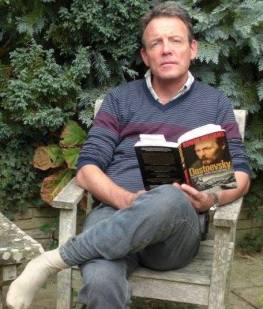
10409674_1437375683175728_2270036257601865586_nN Caraway was born in Cambridge in 1957 and studied at Cambridge University, where he read mediaeval and modern languages, specialising in Dostoevsky and Latin American literature. Before going to university he worked as a volunteer teacher in a rural school in Kenya, an experience which eventually set the course of his life. He has worked for a variety of development agencies mostly in Africa and Asia.

In 2002 he moved to Nairobi to work for the United Nations in South Sudan. This was during the last years of the conflict between government and rebel forces of the Sudan People’s Liberation Army. The UN operated a relief operation by air, using a network of small landing strips spread across a vast landscape without roads or electricity. This landscape provides the background for his first novel, The Humanitarian.


maneThe Manneken Pis

A lonely old man is living out the last days of his life in Brussels, a city that alternates between small-town non-entity and extreme surrealist quirkiness, symbolised by the famous statue of a small boy urinating. Increasingly confused by the effects of a heart attack, he tries to find meaning in one last rational act of kindness before he dies.

Set in the capital of a rapidly ageing Europe, the second novel by N Caraway is a tragicomic study of solitude and growing old that also provides a surprising new take on the theme of the classic Frank Capra movie, It’s a Wonderful Life.

N Caraway’s second novel, The Manneken Pis is set in Brussels, and inspired by the grotesque pageantry of the Balloon Day parade. Caraway’s protagonist, Harold Cumberlidge, suffers a heart attack after having the ‘monstrous calamity’ of a balloon fashioned to resemble the urinating Manneken Pis collapse on top of him. The event causes Harold to take a closer look at life; he begins to question his significance and that of the Europe which surrounds him. Then, befriended by an unlikely pair of characters, one of whom introduces himself as Harold’s ‘Guardian Angel’ in a scene that inevitably harks back to James Stewart contemplating suicide in Capra’s film, Harold becomes increasingly unhinged, as he obsesses over his own mortality. By the end of the novel it is up to the reader to decide for themselves exactly who, or what, is real.

The Manneken Pis serves as an analysis of the lonely life of an ageing EU bureaucrat. Harold Cumberlidge is an interesting character; a strange mix of old-world charm and grumpy bastard, who the empathetic reader will find themselves warming to very quickly. The extent to which Caraway delves into the inner workings of Harold’s increasingly frazzled mind makes one feel that the thoughts and musings of the character may be at least partly based on the authors own life experiences.

Caraway’s descriptions of Brussels, of Harold’s mindset, and the characters which surround the story are intricate, developed and well rounded. He really has a talent for descriptive writing, which shines through to the very smallest detail. Every part of the book is told as if you are the eyes within Harold’s head, down to the horrifying image of the Manneken Pis looming down on Harold, causing the heart attack which sets the rest of the book in motion:

‘There was a blinding flash as the sun caught his unguarded eyes full on and then the monstrous calamity of a giant figure tumbling down towards him, grotesque in its nakedness, leering and obscene, a gigantic naked child, milk-chocolate brown as though fashioned from an enormous turd, a canine crotte from the sullied urban pavements galvinised into monstrous life, plunging headlong down to smother him…’

The effect of description in Caraway’s prose, down to the very smallest thought which flits through Harold’s mind, is such that by the end of the book you really feel as though you know Harold on a personal level.

The story is intricate, touching and incredibly thought provoking, and touches on several exceptionally deep subjects, the most notable of which is the recognition of one’s own mortality. Caraway’s second novel is equal parts sadness and humour, which will leave the reader with several questions hanging in their minds and a deep feeling of empathy towards their fellow man.

There are four copies of The Manneken Pis up for grabs, Goodreads users can enter the giveaway by clicking here. The giveaway will run until the 2nd March.


The Humanitarian

Caraway is also offering review copies of his first novel The Humanitarian, which was featured on Jade the Obscure last summer.

51W+tDMNtgLAfter decades of civil war a peace deal is in the offing for the ravaged land of South Sudan, where the United Nations and a plethora of non-government organisations have come together to deliver emergency aid to the thousands of displaced and homeless people scattered in camps and villages across the vast wilderness of swamps and scrubland, where rogue militias, cattle raiders and bandits roam. Richards is a UN official on his final mission, leading a small team to a remote region. For him it is not just the war which is ending, but the world he has come to inhabit. Detachment and isolation from all that is around him begin to take hold and memories of another life threaten to break through the thin walls he has built around himself. As he sinks deeper into inner darkness a chance meeting with a young priest seems to offer the hope of a way back to belief in humanity and meaning, but the road is rough.

To read the review click here.

There are another four copies of The Humanitarian available to lucky winners, Goodreads users can enter the giveaway by clicking here. This giveaway will also run until the 2nd March.

While you’re at it why not visit him on Facebook and Twitter.

“I get up and pace the room, as if I can leave my guilt behind me. But it tracks me as I walk, an ugly shadow made by myself.” ― Rosamund Lupton

Now the Day is Over ― Marion Husband 

9781908381811-frontcover (2)

‘In my more lucid moments I know I’m dead…’ So begins Edwina’s story, a woman whose spirit remains, long after her body has decayed, trapped in the house she once inhabited. In Now the Day is Over, Edwina serves as the narrator of two stories, set in two time periods, before and after her death.

Edwina grew up in early 20th century Britain, and lived a life which spanned across the First World War. In her narration Edwina reveals her childhood, through her adolescence to her time spent serving as a wartime nurse, and later when she becomes the wife of a soldier. Through her words we learn of an unusual gift that Edwina possessed; a deep rooted empathy, the ability to sense a person’s deepest desires, which earned her a somewhat sinister reputation.

Later, in modern day Britain, Edwina takes the form of super-omniscient narrator, haunting the house which was once hers, commenting on the lives of the couple who now reside within her domain. Gaye and David Henderson are an unhappy, adulterous couple whose lives are plagued by guilt over the death of their young daughter, Emily. Through her narration, Edwina tells the story not only of Gaye and David, but also of herself, gradually revealing the horrors which tie her to the earth, as Gaye and David are tied to the past.

This was my first experience with Husband’s work, and I was completely blown away by the effect it had on me. The story itself combines two of the things I love the most; historical fiction set between the past and present, and ghost stories. I love ghosts. There is almost nothing I love more than to curl up on a dark night and indulge in ‘real’ ghost stories submitted to the likes of castleofspirits.com and reddit.com/nosleep.

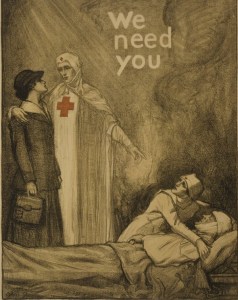
we need youWhile Now the Day is Over is not a ghost story in the traditional sense Husband is still able to give the house the domineering, omniscient, icy coldness expressed by those living is ‘haunted’ houses. Gaye and David often shiver, the cat hisses and the house seems devoid of life, cold, sterile. Even the garden is tainted; Edwina’s memories of the old plum trees planted by her brother and her the year before the war carry an ominous undertone, as though the plum trees embody some kind of darkness, a living representation of the guilt which holds Edwina’s soul. And when Edwina discovers that the trees remain only in her memory, the ‘smudge’ which they carry remains in the back corner of the garden, silently watching, spoiling the scene.

Edwina’s presence in the house is significant, not only in the grief which she represents but also in the power she possesses as a narrator. David and Gaye cannot see Edwina, and this allows her to accompany them on their most personal journeys; she is able to sit with David while he bathes – ‘I touch his knee that breaks through the water, wanting to calm him.’ – and accompany Gaye to a hotel to meet her lover. But Edwina is able to do something more than just see the characters at their most vulnerable – she has carried through to her death her insight into the minds of others. As a narrator she has the ability to tell exactly how someone is feeling and what they are thinking. This gives the reader an eye into the very soul of the characters.


‘I go upstairs, to the empty attic to rattle around in the cold and dim dusk like a good ghost. I need to be alone sometimes, without the distraction of the living and the belongings they surround themselves with.’


Through Edwina’s soothing narration Husband draws the reader deep into the pages of Now the Day is Over. I was completely drawn into the storyline, desperate to discover the circumstances which prohibit Edwina from moving on, as well as to uncover the circumstances of Emily’s death. The climax does not come until very late in the book. Gaye and David keep their cards close to their hearts, slowly releasing allusions to their daughter’s death; they think of Emily often, but do not talk about her.

Eventually each character is absorbed into the tension which has so slowly built up and, completely overwhelmed by grief, makes their confession. When they begin to tell their stories their grief rushes forward in an unstoppable stream, until their words are mixed and their stories combined, with Edwina frantically flitting between the two scenes, retelling the tragic tale of Emily’s death.

Edwina’s life was steeped in death. It seems only natural that her death should be the same – a house haunted not only by Edwina herself, but the ghost of grief which follows Gaye and David. Edwina takes the form of the personification of Gaye and David’s guilt, a black cloud hanging over the family, the memory which taints their futile attempt at a fresh start. Ignoring her presence will not make her leave; it takes Gaye and David’s attempt at positive steps to move on to make the shadow of Edwina begin to fade away. It seems fitting that the book finishes with the planting of new plum trees. Fresh saplings, to commemorate a life lost, and to represent the start of a new beginning, one in which the guilt has gradually begun to fade.Plum-trees_from_South-Hungary

I enjoyed every single moment of Now the Day is Over, and do not feel I can fault it in the slightest. The intricate storyline, complex characters and stunning language combine to create a truly remarkable novel. Before beginning my review I sat down to flick back through the pages of the book to get my creative juices flowing and was instantly drawn back in. I really had to fight to stop myself reading it all over again. As much as I’d like to, there isn’t the time right now.

Special thanks go to Sacristy Press for supplying me with a free copy of Now the Day is Over in return for an honest review.

“We write to taste life twice, in the moment and in retrospect.” ― Anaïs Nin

Zenith Hotel ― Oscar Coop-Phane

81OoFqSoNNL._SL1500_

‘When I wake up my teeth feel furry. There’s a foul taste in my mouth – a nasty sort of animal taste.’ – For Nanou, this is how each day begins. Nanou is a Parisian streetwalker ‘Not a call girl or anything. No, a real street whore, with stiletto heels and menthol cigarettes.’

In Zenith Hotel Oscar Coop-Phane details the not so glamorous life lived by Nanou. The book takes the form of a one day diary, interwoven with short portraits of the men who seek solace in the withered arms of Nanou. The book is original and incredibly moving, creating a world of solitude and sadness encompassed in the actions of just one day.

Nanou’s story is different to how you might expect. It is not a sob story dreamt up by Coop-Phane to make a reader feel better about their own sad existence – no, it is just a day. ‘I don’t intend to go into detail and tell you about my childhood, my love life and all my woes. I’m not going to tell you how I ended up like this’ say Nanou, she is clear that in knowing her past ‘you’d get too much of a kick out of it’, and she would not give you the satisfaction. Instead, all Nanou tells us is her day, so, – ‘If you were expecting me to talk about rape, being abandoned, HIV and heroin, you can fuck off, pervert’ – if you are looking for a misery maker this probably isn’t the book for you.

So why does Nanou write, if not to tell of her woes and mistakes in life? She doesn’t complain, and doesn’t even seem to see the worth or the point in her own writing. ‘I don’t know why I write. It churns me up, it soils me from the inside. To pass the time perhaps. That’s it. I write like some people do crosswords, it keeps me busy. I think about words, style and shape of the letters. I feel as if I am doing something without getting up off my arse.’

The book is structured into short chapters each detailing background of each Nanou’s clients – this is the only background information we are given, as though the messed up lives of her clients say more about her life than her own past – each chapter ends with a short interaction between Nanou and her client. Through each entry Coop-Phane digs into the very heart and soul of Nanou’s clients, voicing their innermost thoughts, desires and anxieties, while detailing Nanou’s complete lack of interest. These chapters come between passages written by Nanou herself, short ramblings scratched from the street corner, recording her day’s activities and musings.

Nanou’s life is routine, living hand to mouth with only but the smallest of pleasures to call her very own. ‘I drink my coffee all alone in my room. Smoking my fags. To cheer myself up, I tell myself I’m saving money.’ The reality is more depressing, it is not that Nanou cannot afford to drink her coffee out, but that she gave up socialising when the smoking ban was implemented, the pleasure of a combined nicotine and caffeine hit too great to spare for a chat with friends.

1024px-Rotlichviertel_Frankfurt_MainHer living quarters are dismal, the shared bathroom having fallen into the bleakest state of disrepair, Nanou resorts to borrowing the bathroom of another friend, where her morning wash routine is clinical, a mere formality rather than something to be enjoyed: ‘I wash with a mini soap. I like feeling the roughness of my skin, the way it goes taut and chapped after washing. Shower gel is too gentle. It leaves your skin slightly greasy, like when you oil it. I prefer it when my skin’s dry. I feel cleansed – disinfected.’

After leaving the discomfort of her living quarters for a day on the street Nanou meets an extraordinary circus of men. Among them Dominic, a young man who, having been convinced of his family’s desire to murder him, beat them to it and earned himself life in an institution, and Emmanuel a dreary school worker, who has no friends and spends each Saturday when his wife is away sneakily masturbating into their sofa.

Of course Nanou does not really notice these men. She is not really there when she sees them, making small talk, being kind and giving them what they want is all part of the service after all. It is just as much a part of prostitution as the selling of her body itself. These men use her as escape, as a method of running away from the harsh realities of life, which she herself has come to accept. The reality is that these men do not even come close to being with Nanou when they pay for her services: ‘I can tell you that when they screw me, when they get all horny jiggling about on top of my poor inert body, those sad suckers are well and truly alone.

640px-Prostitute_tj

Her work day is rhythmic, relentless and monotonous ‘like a factory worker in a production line. The same action relentlessly for years. No hope. A little factory worker of the flesh’. She gets no pleasure from the lifestyle, other than the cigarettes and coffee bought with her wages. As the day progresses Nanou’s thoughts become bleaker and bleaker, as though she has an intrinsic hatred of everything she stands for. She is not self-pitying, but self-loathing, considering herself to be of no worth other than a temporary recipient of other men’s primal desires: ‘I feel hollow – as commonplace as a chamberpot that you plonk down beside the bed.’

The day drags on, and the money comes easily, ‘but at what cost?’ she asks herself. She works the street all day, until finally, after her sixth client and a day spent absorbing the filth of the city, it is time to go home. ‘At last’ she thinks, ‘I can go to bed, turn on the television and light up another fag.’

Nanou is a streetwalker in Paris. Her heart has taken on the colour of the pavement. And when she falls asleep she knows ‘Tomorrow is another day.’

Taken at face value Zenith Hotel is a striking representation of the depressing life lead by a Parisian prostitute, but it is also deeply poetic, insightful, and beautiful in a way which speaks mountains about the work of Coop-Phane. Nanou is the picture of a life lost to the grime of the Paris streets, her ‘soul sweats the filth of the city’, and her words speak volumes.

I was given a free copy of Zenith Hotel by Arcadia Books, the publishers, in return for an honest review.

“Confession is not betrayal. What you say or do doesn’t matter; only feelings matter. If they could make me stop loving you-that would be the real betrayal.” ― George Orwell

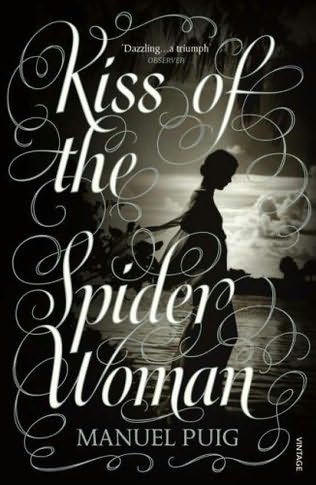
The Kiss of the Spider Woman – Manuel Puig
(El Beso de la Mujer Araña) 

n273641‘– Something a little strange, that’s what you notice, that she’s not a woman like all the others.’ This is how Argentine author Manuel Puig introduces his most highly acclaimed novel The Kiss of the Spider Woman.

What does this opening sentence tell the reader? Is it speech? Narration? The introduction of a protagonist?

In beginning the book in this way Puig throws the reader in at the deep end – there is no introduction, explanation or clue as to how the novel will progress.

This novel is unusual, formed as it is without any form of narrative voice – a primary feature of the traditional novel. Puig composes the novel almost entirely of dialogue, interlaced with periods, often extended, of stream of consciousness, providing the reader with nothing side from a dash (–) to show that the speaker (or thinker) has changed.

As such, the characters are never actively introduced, and their names only emerge through their conversation with one another. It is up to the reader to remain attentive in order to work out who is speaking, and keep up with the flow of speech. It takes some time, but as the story unravels it becomes apparent that the two main ‘speakers’ are cell mates in an Argentine prison.

The two protagonists are Molina, a homosexual window-dresser who is serving a sentence for ‘corrupting a minor’, and Valentín, a political prisoner, serving a sentence for his membership of a leftist organisation attempting to overthrow the government. In the seclusion of their cell these two men talk, or rather, Molina talks, while Valentín listens. Molina reanimates the films he so loves in order to light up the darkness of the prison cell, while the cynical minded Valentín allows himself to become absorbed by the scenes which emerge before him. Sometimes they talk all night long – given over to their desire to escape from their surroundings.

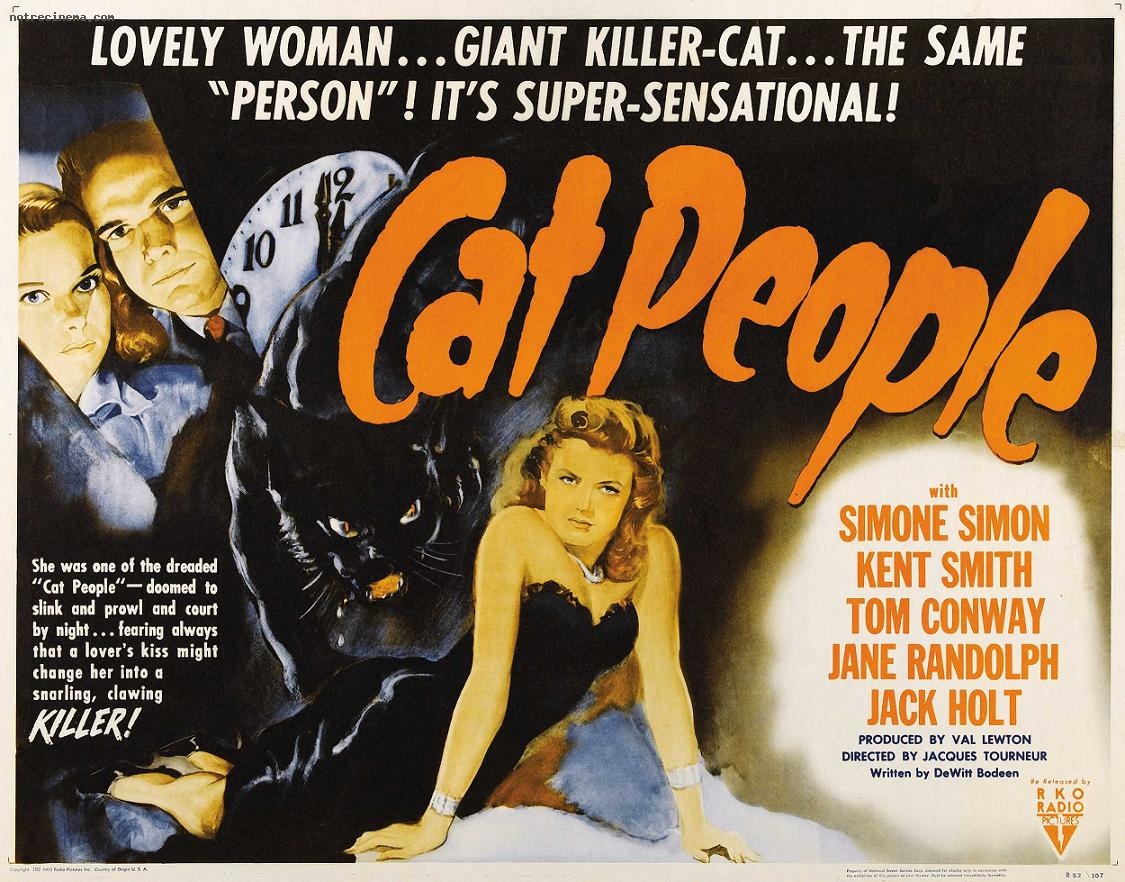
This is how the novel begins, with a film, or rather with Molina’s description of a film – Cat People if you are interested – and this introduces one of the most important aspects of the novel. Molina’s retelling of the films make up the majority of the novel, the effect of which is strange, I found myself absorbed by these subplots and a desire, just like Valentín, to know how the films end, while simultaneously desperate to know how the novel itself will begin to pan out.

cat-people-poster

The storytelling is captivating, I felt at times as though I could see the film panning out before me, Molina’s descriptions, particularly those of the women, bring the scenes to life before your eyes.

‘She has her legs crossed, her shoes are black, thick high heels, open toed, with dark-polished toenails sticking out. Her stockings glitter, that kind they turned inside out when the sheen went out of style, her legs look flushed and silky’

While the eloquent, effeminate Molina and the gruff, radical Valentín present themselves as almost polar opposites the character that emerge through their conversation share a key similarity. Valentín believes in suffering for the greater good; while Molina believes in enduring all else for the magic of love, but each man feels destined to be alone, Valentín for want of the cause, and Molina due to his passion for heterosexual men.

Slowly, as the novel progresses and the men spend night after night wrapped in each other words, they begin to surrender themselves to one another, with each committing himself to the cause of the other.

In The Kiss of the Spider Woman Puig rewards his readers with a truly unique reading experience. Puig’s unusual style and abstract form choice combine to create a novel which is both deeply moving and incredibly thought provoking. The unique position if the reader within the novel allows for the development of an almost intimate character-reader relationship. As such Molina’s films serve as an escape, not just for the prisoners, but also for the reader.

Who is the spider woman?

The main question I found myself asking while reading this book was – what is the relevance of the spider woman? She is referred to just once, briefly in the novel, when Valentín tells Molina ‘– You, you’re the spider woman, that traps men in her web.’ Still this doesn’t give much away as to who, or what the spider woman is. It requires a little research.

Pur_12_aracneIn Latin American history, the Teotihuacán Spider Woman, or Great Goddess, is thought to have been the goddess of the underworld, and, somewhat strangely, of earth, water and possibly creation itself. While in Greek mythology the other spider woman, Arachne, was a mortal woman who was incredibly skilled in the art of weaving and challenged the goddess of wisdom and crafts, Athena, to a – for want of a better phrase – spin off and was transformed into a spider as punishment for her arrogance.

So which of these spider women lend themselves to Molina? Having read the book I feel I could attribute either of these personas to his character, although I’m not sure myself which Puig was referring to, if indeed he was referring to either. Puig presents Molina as a glittering weaver of great things, as a true an artist adept at creating beautiful scenes to distract and allure Valentín, but it also emerges that he is a great manipulator capable of influencing those around him for his own cause.

“You are a little soul carrying about a corpse, as Epictetus used to say.” ― Marcus Aurelius

Good news obscure poetry fans – I have another #TBT treat for you!

I can’t take all the credit for this one, it was the combined effort of myself and several school friends – the result of one of many days spent the days lurking in the sixth form study room (we were far too unpopular to think of straying into the so called ‘common’ room). I had been set the task of writing a sonnet for an English literature task, and implored upon my school friends to help me.


Ode to a rotting corpse emily_of_corpse_bride_by_starreyley94-d3krr5b

Shall I compare thee to a rotting corpse?
Thou art more gruesome and more horrid yet,
The one for whom the maggots use their sporks
To eat up all the rotting flesh they get.
Sometimes I want to tear your eyeballs out
And often I succeed in doing this,
And all the time I wish that you had gout
By summer you will smell like rotting fish.
But that will not redeem your horrid life.
Nor make your presence any less morbid.
Nor will you ever learn to play the fife,
While rancid lips remain so, so sordid.
As long as there is flesh still on your bones,
I hope to always hear your corpsey moans.


I am beginning to get the impression that I was a strange child…

“The ignorance of the oppressed is strength for the oppressor.” — A. R. Bernard

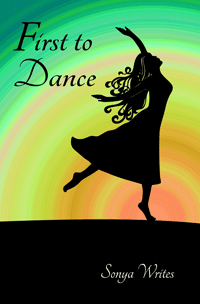
First to Dance  — Sonya Writes 

First-to-Dance-Cover-200pg

Sonya Writes lives in North Carolina with her two daughters. A quick look at her website reveals she has a love of all things literary, Writes is an author, book reviewer, and non-fiction fanatic – so no stranger to the world of words. Writes’ novels delve into the obscure, exploring the results of slight changes to traditional plots and include a series of ‘fairy tales retold’. ‘In most cases, the plots to my books were started with a simple question,’ she says, reeling off the questions that led her to publish her first few novels. ‘I’ll continue to ask many more as my writing career goes on.’ As well as an impressive collection of novels, Writes also has a series of books designed for children. Her first full novel, First to Dance, was published in 2014.


Zozeis is a dismal planet, with a society so oppressive it seems to bleach the bleak streets that streak its surface. On such a place there is no room for individuality. Children are moulded into their positions, plucked from school and assigned to their lifelong roles. To see the children in their classrooms you may think them all the same, as they sit absorbing knowledge, with no opportunities to learn through exploration. On Zozeis the written word is fact, and ‘they’ decide which facts are learned. Any kind of creativity is shunned, not banned as such, but certainly not considered as acceptable.

An insatiable appetite to learn draws 19-year-old Ayita behind the panels of her dusty garage, into a long hidden library whose books tell of a planet where creativity is nurtured, beauty is immortalised through paint and stunning ‘lies’ coat the pages of books – Earth. Ayita dares to dream that such a place exists. Exploring her own rebellion, she paints the walls of her bedroom with flowers, and dances alone in the dark. When she is discovered Ayita has no choice but to flee her home, in the hope of finding earth, and freedom not just for herself, but for all the people of Zozeis.

The opening lines of a book can be the most important; it is your chance to capture a reader’s attention – while many people are encouraged now to look beyond a book’s cover, they may not look past the first few lines if what is inside fails to captivate. Luckily Writes did not disappoint:

‘Don’t try to teach Aaron about Earth, Etana. I forbid it.’
‘I didn’t know that I married a dictator.’
‘If you teach him about Earth, you’ll lose him, not because I am a dictator but because that is what the people have decided.’

These few lines precede the opening chapter, and introduce a small, yet important part of the history of Zozeis –my interest was immediately piqued. The chapter that follows introduces Ayita, mid argument with a school friend. It emerges that Ayita has discovered a book that talks about Earth – her friend is not impressed.

‘It’s a book of lies,’ Aira said. ‘Destroy is. None of what it says is true.’

Having only read the first page of First to Dance, there are already so many questions buzzing around in the reader’s head. What is this planet? How did these people get here? And who is Etana? What happened to Earth? The only possible way to find the answer to these questions is to read on.

Feliz_1984Zozeis is a George Orwell-esque society; imagine 1984 crossed with the world portrayed in Ricky Gervais’ The Invention of Lying. Earth, the place it seems the people of Zozeis originated, is like a huge conspiracy, covered up and left out of text books. Zozeis is everything, and within Zozeis everything is regimented – jobs, love, and schooling are all predetermined and rigid:

‘After dropping out, students were assigned a job, and when they were old enough, a spouse and home according to their job district. Five or six years ago, dropping out for Ayita would have meant working in the fields or delivering the weekly grocery boxes to each household. Now it would mean a hands-on internship leading to a more high-profile and envied position in a wealth district, such as where she lived now. If she made it through the next three years in class she could eventually receive a top position in government or be on the committee that decided which facts were taught to people and when.’

Should a person toe the line of what is considered normality, they risk being sent to the dreaded ‘secondary school’. The secondary school is a domineering building, shrouded in mystery, where citizens are sent to learn the ‘truth’ so that they might come back into society – though some who enter are never seen again.

It takes some time for the whole story of Zozeis and its people to come into the light, and Writes opts to introduce this information in a slightly different way. Part way through the book there is a section in which the narrator assumes the voice of one of the founding members of Zozeis, Etana, and it is through this section that we learn the history of Zozeis. Writes’ decision to introduce the information in this way may not be to everyone’s taste – it could seem slightly jarring to have the tense switch like this. I personally thought it worked quite well, although perhaps it could be more carefully slotted in, allowing for time to pass between the present and the past so as to make the section a little less intimidating. I will leave it to other readers to judge for themselves.

Through this section of the book we learn that Zozeis, and many other planets, began as a series of experiments conducted by an eccentric billionaire Dr Timothy Azias. It sounds horrific doesn’t it? Imagine Dr Timothy as a futuristic combination of John Cleese’s character in the film Rat Race and Jeffrey Combs’ in Would you Rather? And yet somehow, at times, I felt something close to compassion for Dr Timothy, despite the fact that he essentially kidnapped thousands of people to satisfy his own morbid curiosity. I can imagine this reaction to be somewhat similar to what Etana herself would have felt. I’m not sure how Writes intended for the reader to feel towards Dr Timothy, his character is left very much open ended and I have a feeling there is much more to learn about him.

I’d love to talk some more about the other planets that come into play in First to Dance, but I am, as always, wary of spoilers and do not want to give too much away. What I will say is Ayita does visit other planets in the book, and that the question on Writes’ mind that led her to write First to Dance was ‘What if everyone shared the same personality type?’ and leave it at that.

There was one aspect of First to Dance that I found really quite troubling, and that was the lack of animals on any of the planets. I found this especially problematic given that there seemed to be an abundance of plant life. For me, this part of the book didn’t really work. I can’t quite comprehend how such places could exist without creatures of some sort to sustain the ecosystem. Of course, given that it is a work of fiction, Writes has poetic licence over such matters, but I think if this is to be the approach of the book then some sort of explanation is needed.

On the whole, I found First to Dance to be a thoroughly entertaining read. Writes’ questioning nature has created a great backstory that gives way to an equally brilliant storyline. I do think that there are a few structural things that could do with being improved, and that the text would benefit from being seen by a professional editor, but I don’t feel that these issues are great enough to warrant any kind of despair on behalf of the author. Overall I really enjoyed the book, and would be very interested to see whether Writes will decide to continue the series.

Many thanks to Sonya Writes for supplying a free copy of First to Dance in exchange for an honest review.

“The moment you doubt whether you can fly, you cease for ever to be able to do it.” ― J.M. Barrie

Flowers, shadows and the age of magic

Nigerian author Ben Okri reflects on how moving from the UK to Africa as a child introduced him to new experiences that were to be a big influence on his future writing

Ben Okri

Writing should be a lifelong experience, says Ben Okri, the Nigerian poet and author. Since publishing his first novel, Flowers and Shadows, at the tender age of 21, Okri has risen to international acclaim. His best known work, The Famished Road, was awarded the 1991 Booker Prize.

As a newcomer to Okri’s work, you would be forgiven for seeing it as somewhat obscure. His ideas, he says, are born “out of the strangeness of reality”. To put this into context, he refers to a time when he first noticed the peculiarity of everything around him, when travelling back to Nigeria from the UK as a young boy. “Everything was strange,” he says, “the trees, and the streets, everything was unusual, and therefore brimming over with ideas.”

In order to reflect this perceived strangeness of reality, Okri expresses himself in a very different way to what he calls the “old Western novel”, referring to books written by the likes of Jane Austen. This older style of writing, he says, follows a sequential pattern, born from a sequential way of thinking taught within Western institutions. Okri’s writing attempts to convey a new way of thinking, to show that writing does not need to follow a strict criteria and can instead be perceived in any number of unique ways  – it can be sequential, he says, or “circular and dancing”.

Okri was participating in the Cambridge Festival of Ideas – a week-long University of Cambridge public event celebrating the arts, humanities and social sciences. He reflected on his colourful writing career, sharing a stage with Tim Cribb, an English fellow at the university. Crowds of people turned up to listen to Okri speak. He was invited to begin reading from one of his poems, with the audience duly advised that there was a problem with the sound system, and so we would have to listen carefully. As Okri rose to begin his recital, the audio equipment suddenly crackled into life and the auditorium exploded into applause.

Okri, however, seemed reluctant to speak into the microphone. “I think I will abandon this,” he said, gesturing towards the device. “I do not like to raise my voice. The gentler I speak the clearer I think.

“It is wonderful to be here,” he added, lamenting on what a lovely day it was for such a splendid turnout. “You must love ideas more than sunlight,” he commented, smiling. “That’s unwise.”

Although he was born in west-central Nigeria to an Urhobo family, Okri spent the majority of his early life in London, only returning to Nigeria in 1968 when the country was in the midst of civil war. These experiences dramatically shaped his writing. While Okri has won several esteemed prizes for his work, including the 1987 Commonwealth Writer’s Prize, his ability to write emerged only after completing a long and arduous journey.

“As a child,” Okri reflects, “I would read Plato and the classics, and once, my father told me ‘we have our own Platos’. This confused me, and so I asked ‘Where?’.”

His father’s response to this, Okri shows the audience, was to simply gesture all around him. After many years of not fully understanding what his father meant, Okri says that the realisation suddenly dawned on him. His father’s gesture, he now understood, meant: “It is here, you’re just not seeing it.” This realisation, he says, led to more than seven years of self-discovery through writing, a period Okri refers to as his “critical crisis”. Throughout this time he attempted to break down the barriers of language to establish a way of conveying his new look at reality. “Try and get a dimensional reality into sequential prose,” he challenges, “it cannot deal with it – it does not work!”

“The difficulty in writing,” Okri says, “is finding the language to express these ideas without the need for explanation.” Writing, Okri believes, should serve as the special explanation of ideas, where a literal explanation is not needed. The solution to the problem lies within the discovery of language.

Ideas can only exist outside of the mind with the right language; “Otherwise they exist only in their own reality,” he adds.

And more than anything, you must write something which hasn’t been written before. “What are you going to write if it has already been done so beautifully before? How can you do what Dostoyevsky has already done? The whole point in writing is to not repeat – you invest your life in a journey, and if you repeat each day you are effectively writing yourself out of existence.”

In this way, Okri focuses his own writing on the micro moments that have gone unnoticed in more traditional methods of writing. “Everyone focuses on the big moments,” he says, “but reality is in the micro moment, grind it down and you see the seedbeds of the greater moments.”

While uncovering such a method of writing for oneself may seem slightly terrifying to the fledgling writer, reaching a point where you have something unique is the ultimate challenge. “Writing when you do not know where you are going is frustrating and painful,” he says, “but the process, and the finished work, is more fruitful, more rewarding and more beautiful.”


‘Some things only become clear much later’

The Age of Magic ― Ben Okri

The Age of Magic

Ben Okri’s first novel in seven years, The Age of Magic, follows the journey of a film production team travelling from Paris to Basel while filming a documentary. As the voyage unfolds, the team find themselves followed by shadows, plagued by ghosts, troubled by their pasts and enlightened by the world around them.

“What does Arcadia mean to you?” is the subject of the documentary and, increasingly, the question on each of the crew’s minds. The characters are troubled – burdened with their own physical and emotional baggage, in the form of invisible ghommids, trolls, niebelungens, gnomes, harpies, sprites and an elusive quylph. When they are together, the crew speaks increasingly of a disconcerting presence among them – the ever-present, domineering figure of Malasso, the name given by the crew to a haunting, shadowy spectre which stalks the group.

When they arrive at a hotel in a small Swiss town, in the eye of the domineering Rigi Mountain, they are at once gripped by the serene beauty around them. Over the course of the stay, they each find themselves drawn towards the mystery of the crystal clear lake on the edge of the hotel grounds and the secrets of the mountain town.

The novel takes the reader on a journey unlike any other, presenting characters with a different way of seeing the world and offering the reader a very different way of reading. As the crew are transformed by their journey, so too is the reader.

The Age of Magic unfolds to form a truly dreamlike story, with characters wandering like ghosts in a world that seems to form and fall away before their very eyes.

Both the article and review published here were first published in Global: the international briefing. Many thanks to Head of Zeus for supplying a free review copy of The Age of Magic.