“Think of all the beauty still left around you and be happy.” ― Anne Frank

Truly stunning.

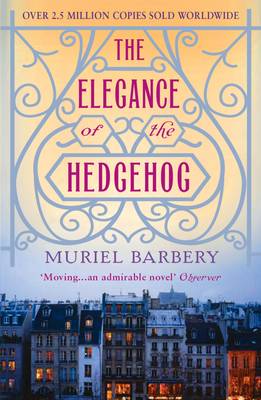
The Elegance of the Hedgehog ― Muriel Barbery

Image

I don’t feel as though I can stress enough just how beautiful this book is. Barbery’s style is so perfect and so utterly captivating I found myself completely hypnotised, both by the story itself, and the sheer elegance with which it is written. I enjoyed this so much I insisted that my partner watch the film adaptation ‘La Herison’ with me. As to the film, while not bad in itself, it is nothing compared to the book.

Renée Michel is a concierge, and self confessed member of the lower class, despite being fantastically intelligent, she knows her place, and sticks to it, stating that to be “poor, ugly and, moreover, intelligent condemns one, in our society, to a dark and disillusioned life, a condition one ought to accept at an early age”. Renée lives a secret life, reading Russian literature in the privacy of her lodge while donning the air of a simpleton when speaking with the inhabitants of number 7, Rue de Grenelle where she works.

Upstairs in one of the 4,000-square-foot luxury apartments Paloma Josse is planning to commit suicide. She is an incredibly intelligent 11 year old girl, so disillusioned by the world in which she lives that is does not see the point in carrying on. She begins to write a journal of profound thoughts, and observations on the movement of the world, in a vague attempt to find a reason worth living.

When an elderly inhabitant of the apartment complex passes away the whole place comes alive with excitement, at the idea of a new face setting foot inside the walls. Karuko Ozu moves into the late Pierre Arthens apartment and forms an unlikely friendship, with Paloma Josse, with whom he shares his suspicions that their faithful concierge Madame Michel is not all she appears to be. The unlikely friendship leads to the unison of three souls, almost inseparably fused together. This could possibly be everything Madame Michel needed, and just the thing Paloma was looking for as a reason to live.

I cannot go into further detail for ruining the plot, and I very much hope that anyone who reads this will make the effort to read the book.

Barbery’s writing had just the effect that a good book should. When I reached the last pages I felt emotional, fulfilled, and somehow devastated that I was closing the book for the last time.

“We went down into the silent garden. Dawn is the time when nothing breathes, the hour of silence. Everything is transfixed, only the light moves.” ― Leonora Carrington

Short and obscure

After Dark ― Haruki Murakami

Image

Set in the witching hours between midnight and sunrise, Murakami explores encounters throughout Tokyo during this silent time. At the centre of the story lies Mari Asai, a young college student sat quietly reading and smoking in a 24 hour Denny’s, her sister Eri Asai a fashion model has been mysteriously sleeping for two months. Mari is troubled by the distance between herself and her sister, physically and emotionally, and is choosing to stay away from home. Mari is drawn out of her night time sanctuary and into the lives of the people who frequent Tokyo at night, Takahashi a jazz trombonist who takes an interest in Mari, insisting that they’ve met before, Kaoru the rugged female manager of a japanese “love hotel”, and a Chinese prostitute savagely beaten by a night-shift businessman.

Murakumi follows Mari and her counterparts, drifting through the city like ghosts. Mari learns about the lives of all whom she encounters, Takahashi, Kaoru, the love hotel staff, and the prostitute.

Marukumi also traces the evening of the mysterious businessman who attacked the Chinese prostitute – Shirakawa. Working late in the office of his company ‘veritech’,  Sharakawa seems plagued by what he has done, what he ‘had to do’, and the thought of returning home to his family. On occasions he comes dangerously close to the furious ‘owners’ of the prostitute, literally within an inch of his life.

On several occasions the reader enters the room of the sleeping Eri Asai, who is sleeping ‘so very’ deeply, in the room ‘we’ adopt the view of what seems like a security camera, and are given strict rules to adhere to, ‘we can only watch’, although it is not apparent where exactly these rules come from. Slowly it becomes apparent that the TV in the room is on, and a man in a silicone mask inside the screen is watching Eri, Eri is transported in her sleeping state, awakening inside the TV. On the floor she finds a pencil with the word ‘veritech’ inscribed on the side, we are made to believe that Eri’s sleeping state is somehow, mysteriously linked to the businessman. By the end of the novel Eri has left the TV and is inside her room, sleeping once again.

The story is obscure, and extraordinary, on two occasions character stand and look in the mirror, only to leave their reflections behind when they walk away.

I can’t pretend to have fully understood what Marukumi was trying to express when he wrote this book, I imagine Marukumi to be the type of author who is never fully understood by anyone. His style of writing seems very abstract. I am tempted to have a look at more of his work in the hope of understanding it better.

The writing style is difficult to get on board with at first [partly, I assume, due to having been translated from Japanese], but once I got past the first chapter or so I found I had happily adjusted. The detail more than makes up for any difficulties with style. The reader often takes the position of some kind of security camera, and everything is taken in, Eri’s eyelashes as she sleeps, the glass of beer in the love hotel, Shirakawa’s pencil, the reader sees them all. For me the description seemed to go beyond the level you would normally see with your eyes. The best way I can find to describe it is like audio descriptions for the visually impaired on a DVD.

Overall while I don’t proclaim to have discovered Marukumi’s message behind this book, I definitely think it is worth a read, and I will seriously consider looking further into his work.

“A picture is a secret about a secret, the more it tells you the less you know.” ― Diane Arbus

A fast, fun read

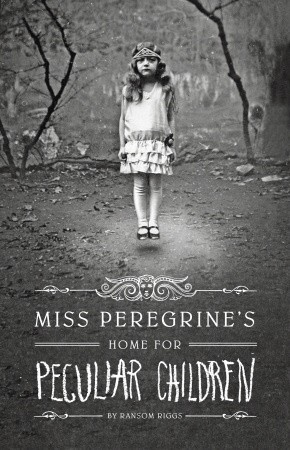
Miss Peregrine’s home for Peculiar Children ― Ransom Riggs

Image

This book really isn’t the most innovative or inspiring piece I’ve ever read. However I absolutely love the idea behind the way it is written. The author Ransom Riggs began collecting photographs a few year ago, frequenting flea markets, and cheap second hand store where such items could be picked up for next to nothing. The more this hobby developed the more he wondered about the stories behind these intriguing photos, with no way of tracing these people and finding out he decided to create the story himself.

The story itself is quite good fun.  The main character Jacob is a teenage boy, struggling to comprehend his life following the untimely death of his grandfather, who died in Jacobs arms having been mauled by a mysterious creature. Jacob is plagued by nightmares, haunted by his grandfather seemingly nonsensical dying words and finds himself falling into a deep depression. In an attempt to come to terms with what has happened to him Jacob travels to the only place he feels may uncover the mystery behind his grandfathers death, and puzzling last words. What follows takes the reader to an abandoned children’s home on a remote Welsh island, which on closer inspection turns out to be not so empty after all.Image

I don’t feel it necessary to go into any greater detail with this book as there is nothing, other than the photographs, that makes it really stand out for me. It was a rather fun way to spend a rainy afternoon, and I didn’t feel the need to give up reading part way through, but I don’t think I will be going out of my way to read other things by Riggs.

That said I think writing a story around interesting photographs is an absolutely genius concept, and I commend Riggs for coming up with the idea. I just don’t necessarily think he was the right man to write the story.

Overall it’s not a bad book, nor is it particularly good.

“Europe is overpopulated, the world will soon be in the same condition, and if the self-reproduction of man is not rationalized… we shall have war.” ― Henri Bergson

Terrifyingly brilliant (Soylent green is PEOPLE!)

Make Room! Make Room! ― Harry Harrison

Image

I bought this book while I was at university for a class I was taking on utopias and dystopias, but I was somewhat ambitious with the amount I expected to read, and invariably this one was left untouched, until now.

Written in 1966, and set in 1999 Make Room Make Room is a dystopian science fiction novel, set in New York City, which follows the lives of several characters, exploring the potential repercussions that unchecked population growth could have on humanity. Set in a future where New York has a population of 35 Million, the earth itself has a population of 7 million, and humanity is more or less on the brink of collapse. The city is overcome by overcrowding, resource shortages, crumbling infrastructure, disease, crime and poverty. The welfare state is no longer able to support the growing population, fresh food is a distant memory, water is rationed, social housing has been extended to include sewers and in times of crisis only the young are given medical care. Despite all this, the population of New York city is divided over the issue of birth control.

Harrison wrote ‘Make Room Make Room’ as a social commentary, with the underlying theme of the novel being the importance of sustainable development and population control. The bleak world Harrison portrays, is that of future generations left to deal with the wasteland left behind once all the natural resources are used up, and the earth is no longer able to sustain itself. The book opens with a dedication to Harrison’s two children Todd and Moira – ‘For your sakes, children, I hope this proves to be a work of fiction’. With the Earth’s current population having just reached 7 billion the book has proved to be a work of fiction – so far. ‘Make Room Make Room’ is a terrifying reminder of what could be waiting for our children real efforts are not made to move towards sustainable growth, and population control.

The Book really is truly excellent. Harrison is able to paint a bleak, desperate and depressing view of New York City, but without going off into long tiresome descriptions. Through the eyes of the characters that Harrison creates the reader is able to view the city, and get a real feel for atmosphere of this dismal future, which may not be too far away. The reader is transported into a place where the streets are lined with filth, the poor huddle together in stairwells and burnt out cars, and riots caused by food and water shortages are quickly becoming the norm.

Through his choice of characters Harrison was able to portray the problems faced by the wretched citizens of New York through several different perspectives, while ultimately keeping the underlying issues same: Billy Chung, the poverty stricken boy who is so desperate to escape he will do anything; Shirl, a girl whose only hope of escaping reality is her body; Andy, a police officer who works his fingers to the bone for literally nothing; and Sol, the pensioner who remembers the time before, but can do nothing to change the course of history. All the characters are helpless, helpless to undo the damage caused by those who came before.

‘Make Room Make Room’ really is an excellent, thought provoking book. I have explored a few dystopian novels and this is the first one which really hit home for me. Despite having written this book almost 50 years ago, the issues Harrison explores are incredibly topical, and while the world Harrison painted did not come to light at the turn of the century, there is every possibility that it could still be waiting just out of sight.

“God is a circle whose center is everywhere and circumference nowhere.” ― Voltaire

The power of words

The Chronicles of Narnia ― C. S. Lewis

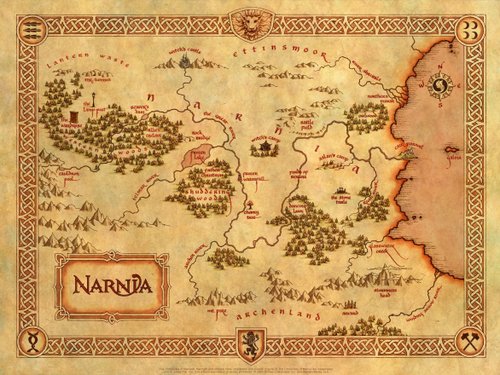
book-inmyownview-map-narnia-the-chronicles-of-narnia-Favim.com-204175

Firstly let me say how irritated I just was when I typed ‘The Chronicles of Narnia’ into Google image search, and was overcome with stills from the films. I had to add ‘book’ before I got anything of use.

I’m going to make this a short review, as this is a review of seven books in one I feel it necessary to keep it to the minimum or I could go on for an age.

I would recommend these books very highly to anyone who hasn’t read them, and would not want to spoil any part of them. Go out, buy the books, read them, read them to your children, buy them as gifts. I feel I would have loved these books even more had I read them as a child. I would recommend the Chronicles of Narnia for children far above the Harry Potter books, Philip Pullman’s dark materials or Lemony Snicket’s Series of Unfortunate Events. Not that the other series’ do not have their merits, but I would go so far as to say I would not let any of my children grow up without giving them the opportunity to experience these stories.

C S Lewis writes the stories in a way that everyone can understand, communicating at times with children on their level. I have read it written that C. S. Lewis had an incredibly strong respect for children, and felt the need to speak with them as if they were his equals and not beneath him. This is evident throughout the books, with C S Lewis coming up with little analogies to explain things which only a child will fully appreciate.

I know many people will know the basics of the Chronicles of Narnia, but I still don’t wish to ruin anything for those of you who are in the dark. Put very simply, the books follow the adventures of the Digory Kirke, Polly Plummer and the Pevensie family in the mysterious land of Narnia, and their encounters with the king of Narnia -Aslan.

I am sure there are people out there who will not enjoy the Chronicles of Narnia, partly due to their obvious theological content. It is well known that the books draw heavily in the bible, from the Creation Story through to the Book of Revelations. I have never been what I would call religious, I have yet to decide exactly what I believe in, no doubt one day I will decide but it will be my choice alone. However I believe that these books teach fantastic morals, and can be enjoyed on several levels.

The books are a great read as stories alone. The adventures are incredibly enticing, and kept me enthralled for hours at a time, to the point where I did not want to put the books down, reading one after another in quick succession. C S Lewis’ presents religion in such as way as to appeal to those who are not open to the ideas of Christianity, by giving them something which is meant first and foremost to be entertaining, presenting religious stories as works of fiction.

I feel as though the stories are meant to inspire children to love Aslan in the way that Christ should be loved. Not to force children into believing, but to help them understand how others feel. I felt myself falling completely in love with Aslan, for reasons I can not fully explain. Something in the way he is described -beautiful and yet terrible at the same time, the voice he is given and the words that he speaks very much appealed to me, as I’m sure they have to many people. There is one quote I will share with you from The Last Battle, when Aslan is explaining the difference between himself and the terrifying god Tash, which for me perfectly encapsulates the idea of religion, and when de-constructed is a fantastic moral to teach children:

“The Lion growled so that the earth shook (but his wrath was not against me) and said, It is false. Not because he and I are one, but because we are opposites, I take to me the services which thou hast done to him. For I and he are of such different kinds that no service which is vile can be done to me, and none which is not vile can be done to him. Therefore if any man swear by Tash and keep his oath for the oath’s sake, it is by me that he has truly sworn, though he know it not, and it is I who reward him. And if any man do a cruelty in my name, then, though he says the name Aslan, it is Tash whom he serves and by Tash his deed is accepted. Dost thou understand, Child?”

Ultimately Aslan is not speaking of serving one god or another, but of a way of living. It is a guideline, a moral, to be good and kind and feel the benefit of your actions, or to suffer as a result cruel choices.

Overall I thoroughly enjoyed these books for what they were – stories. It was interesting for me to look at the theological aspect as well, but ultimately it was the stories that I enjoyed, and it is the stories that I recommend. Having finished the books I plan to lend them on to my younger siblings, who are of the perfect age to fully appreciate the stories.

“It is quite possible–overwhelmingly probable, one might guess–that we will always learn more about human life and personality from novels than from scientific psychology” – Noam Chomsky

The making of a very thoughtful evening

The Little Prince ― Antoine De Saint-Exupéry

Image

First published in 1943 this sweet little novella is the most famous work of Antoine De Saint-Exupéry, and has been translated more time than any other book in the French language.

This is another book I found nestled cosily amongst our bookcases one evening. It’s a tiny little thing so I decided to spend the evening getting to know the Little Prince hidden within it’s pages a bit better.

The Little Prince seems at first to be written for children, but there is a very obvious philosophical message behind the story. I feel that on this level the story has appeal to both children and adults, anyone sat reading this book with a child on their knee is sure to enjoy it just as much as the little one.

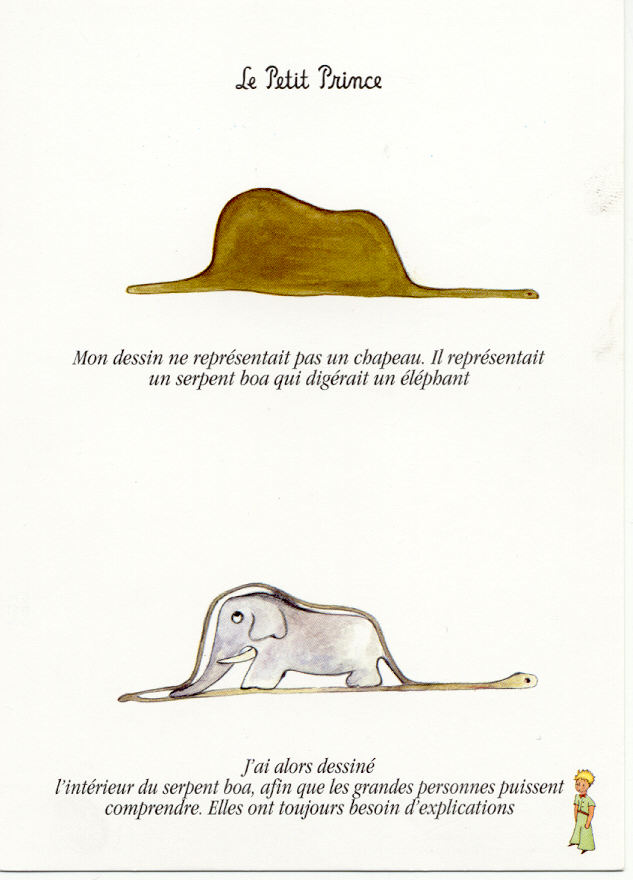
Saint-Exupéry tells the story of a very thoughtful chap, who as a child learned only to draw boa constrictors from the inside and outside, and was terribly upset to find no one else fully appreciates his artwork.

Image

As an adult the voice of the story becomes stranded in the desert, and makes an unlikely friend. Someone who finally understands his drawings of so long ago – ‘the Little Prince’.

This charming little story traces the tale the Little Prince has to tell, of his travels across the universe, before finding his way to earth, and to our humble narrator.

The Little Prince visits many planets on his travels, mainly inhabited by a single person. Each character is more ‘odd’ than the last in the eyes of the Little Prince. A king – Obsessed with giving orders, A businessman – obsessed with money, A drunk – obsessed with drink and his own misery. The Little Prince continues on his travels, never fully understanding the people he has met along the way.

Behind Saint-Exupéry’s dear little story, there is an allegory of the human condition. The inhabitants of these planets are so preoccupied with the things that seem so strange to this innocent little mind. Not one of the people the Little Prince encounters is able to make a valid argument for the importance of his work. While the Little Prince cares only for doing what makes him happy, about asking questions, and caring for his possessions back on his own planet, including the love of his life -a beautiful rose.

Overall I found The Little Prince to be quite a satisfying read. It’s a short book, and can easily be enjoyed all in one go; in fact I found that once I started to read it I didn’t want to stop until it was finished. The book appeals to me on a many levels, I think it is a lovely little story for children ― I also think a fair few adults will enjoy the story for what it is ― but I also really enjoyed the allegorical side of the tale.

“Every man at the bottom of his heart believes that he is a born detective.” – John Buchan

I’m fairly sure I said I will ‘try’ and upload one review a day. This one’s only 11 days late!

The Thirty-Nine Steps ― John Buchan

buchan-thirty-nine-steps-bookcover

John Buchan published this little novel in 1915. The newest edition has been published as part of Penguin’s Great Books for Boys collection, and it really is a great book for boys. On a side note, I actually came across this hidden on my partner’s book shelf, a lovingly inscribed present from his grandfather.

I have heard elsewhere that everyone has an inner adventurer that will love books such as this. While this may be true for some, I think it is misleading to say everyone loves an adventure. If you do however, this is the book for you.

The Thirty-Nine Steps is set four weeks before the commencement of World War I. The story is that of Richard Hannay and his unlikely entanglement in a German plot to steal secrets from the British military. The story begins with Hannay lamenting on how boring life has become, and wondering if leaving the country would award him a more exciting life. This all changes when Hannay meets for the first time his upstairs neighbour.

The neighbour, Scudder, confesses to Hannay that he is in grave danger and in desperate need of a place to hide. Scudder is a US spy with knowledge of an assassination attempt, due to take place on June 15th, which if successful will ravage Europe. Hannay believes Scudder and decided to help him out. However, when the very next day Hannay arrives home to find scudder himself has been murdered, he realises just how much trouble he is landed himself in. With both the police and the killers after him, Hannay decides to go on the run until the assassination is due to take place, with the hope of stopping murder before it’s too late.

Hannay is chased through England to the harsh Scottish wilderness, pursued by a mysterious aeroplane, as well as the London police. The novel follows Hannay through exciting chase scenes and incredibly narrow escapes, all while Hannay tries crack the code in Scudder’s diary – the key discovering where and when the assassination will occur. Hannay discovers the kindness of strangers who prove invaluable to his journey. An adventure loving reader will be kept engrossed by the mystery of “the thirty-nine steps”, Hannay must discover the meaning of this riddle in a race against time.

While this book isn’t necessarily the sort of thing I would normally choose to read, I did actually quite enjoy it. Although I do feel it’s more of a boy’s book – I think it would make a fantastic gift for a young boy who loves to read.  I won’t spoil the ending; nothing ruins an adventure like a spoiler.

One of the things I particularly enjoyed about this book was the attention to detail Buchan used when describing scenes and people. I love the way Hannay can go from looking like a fine upstanding gentleman, to a dishevelled traveller, to a weathered road worker, and back again while all the time his image is kept meticulously clear in your mind.

I cannot stress enough that this is definitely a book for adventure lovers, and I feel it may also be appropriate for those with an interest in World War I.  Having been set around the time of the war itself it may be interesting to examine the novel in relation to history. Buchan is said to perfectly capture the feel of the time period.

“Even bad books are books and therefore sacred” – Günter Grass

My journey into the really obscure

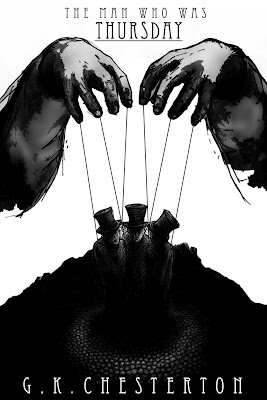
The Man Who Was Thursday ― G K Chesterton

Image

One of the best reviews I have read of this book was very short:

‘Boy, this was really good until it wasn’t at all anymore’

That almost sums it up for me I’m afraid. Needless to say I was horribly disappointed by this book. I did not begin reading with any sort of expectations, I had never heard of G K Chesterton before, and was just taken in by the unusual title more than anything. I found this little book on the shelf of a charity shop and decided to give it a go.

I really enjoyed the book at first. I like the style in which it is written, it remind me almost a bit of P.G Wodehouse. It’s a pleasure to read, and full of wonderful, intricate little descriptions. One is simultaneously drawn into the depth of the story, and laughing out loud at the ridiculousness of it.

I feel it necessary to give you a brief overview.

It begins with two poets arguing in a park in London as to whether poetry is more akin to law or anarchy. One Poet, Gregory, claim to be an anarchist, the other, Syme, does not believe Gregory can possibly be so. Later that night Gregory takes Syme to his secret anarchist meeting place, after swearing him to secrecy.

The anarchist lair exists underground, below a public house, and has wall lines with firearms. Gregory confides in Syme that the anarchist council is run by seven men, each taking their name from a day of the week. Gregory feels he is about to take the place of the recently deceased Thursday. At this point, right before the Gregory’s fellow anarchists enter the room, Syme drops a bombshell and tell Gregory that he is in fact an undercover policeman. That was it, Chesterton had my complete attention.

When the other anarchists enter the room, they hold a vote, and as predicted Gregory is selected as the candidate to replace Thursday, and asked to say a few words. Gregory, worried by Syme’s presence, changes his tune and tries to trick Syme into believing that anarchists are not dangerous at all. Upon which time Syme adopts the disguise of a true anarchist, and finds himself -quite hilariously- elected the new Thursday.

What follows is a terrifying journey for Syme, who soon finds himself surrounded by the other six leaders of the anarchist council. Including the terrifying Sunday:

‘They might have called Sunday the super-man. If any such creature be conceivable, he looked, indeed, somewhat like it, with his earth-shaking abstraction, as of a stone statue walking’

Without going into too great detail, in the proceeding chapters Syme discovers little by little that the other leaders -all except Sunday- are all in fact members of the same secret police service as himself. Having all been recruited by the same mysterious man in a dark room. Despite all being terrified of Sunday, the group decide to confront him, and find out exactly who he is, and what his plans are.

The meeting takes place on a balcony, and when confronted Sunday merely says: ‘There’s one thing I’ll tell you though about who I am. I am the man in the dark room, who made you all policemen’ before leaping from the balcony and escaping into London. The ensuing chase is absolutely fantastic, with Sunday absconding first via handsome cab, then on a stolen elephant and finally in a hot air balloon.

The six friends continue their pursuit in vain, exhausted, bedraggled and covered in their own blood, and begin discussing their views on Sunday. It now comes to light that each man’s thoughts, though almost completely different to the next, have one thing in common, they all view Sunday as the universe.

At this point in the story I realised it wasn’t going to be the ridiculous ending I had hoped for – although I’m not entirely sure what exactly I was hoping for.

The group are eventually picked up by an employee of Sunday’s, who packs them each into their own private carriages and takes them off to Sunday’s house (it gets stranger). Once at the house they are each given a bed chamber, and a change of clothes for the fancy dress party (but of course!). Each man has a costume that corresponds to their day of the week  in the creation story, with Thursday suitably decorated in the sun, the moon and the stars. There were seven thrones present at the fancy dress party -which was further attended by an assortment of forest type creatures, all dancing round a giant bonfire- each would-be anarchist has his own throne, with Sunday sitting in the middle throne, dressed as if made out of light itself.

I’m everyone can work out where this is going. Sunday, is God. Of course! Of course Sunday is God! Why on earth wouldn’t Sunday be God? It completely ruins what was otherwise quite an interesting, quirky little book, that’s why. It also turns out that Gregory (remember him?), represents evil. To top everything off, the book ends with the fancy dress party fading out of sight, and Syme finding himself walking along a country lane with Gregory at his side.

I find it quite difficult to describe to you my disappointment, in everything, and especially in the ‘he woke up and it was all a dream’ esque final paragraph.

Upon doing a bit of research of Chesteron after finishing this it turns out he liked to write about Christian theology, in ALL his novels. So needless to say I won’t be picking up one of his books if I pass it in a charity shop again. I don’t think I can claim to have fully understood exactly what Chesterton was getting at when he wrote this, that God is a terrifying joker perhaps?

As I said at the beginning, I think this book is best summed up by ‘Boy, this was really good until it wasn’t at all anymore’. I won’t say I didn’t enjoy it at all, but any enjoyment I felt was completely ruined by the ending.

Overall I think the book would have been a hell of a lot better is Chesterton wasn’t obviously so terribly keen on being Christian.
Is this a hearty welcome, or a Hardy welcome?

Blogging seems to be all the rage these days, so I’ve decided to jump on board the band wagon. After all, who doesn’t enjoy talking about themselves? I’m not so vain as to think many people will be particularly interested in my chattering away about nothing though – I do think blogs are more interesting when they are about something, rather than everything. My ‘something’ will be the books I read. I like to read, but I am by no means a connoisseur of fine literature. I will blog about the books I feel like reading, rather than reading books purely for the sake of blogging about them, so I’m terribly sorry if my reviews are grossly behind the time and irrelevant. Furthermore I refuse to rate anything out of ten, the idea that all my thoughts and emotions relating to a book can be summed up in such a small scale is, frankly, ridiculous.

So on to the first book of many.

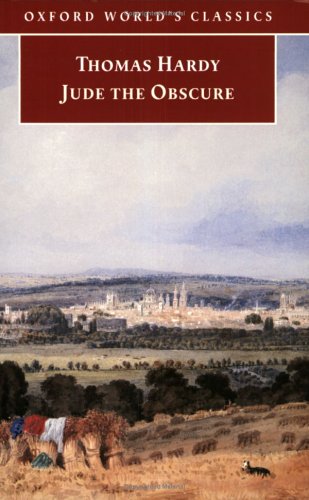
Jude the Obscure – Thomas Hardy

Jude The ObscureI will admit that I have never really given Hardy the time of day before now ― due to a very bad experience of far too many hours spent listening to the audio book of ‘Return of the Native’ read by Alan Rickman, thanks to the incompetence of my sixth form English literature teacher. A friend of mine recently read Jude and told me it was “the most depressing book ever” naturally I was intrigued so thought I would give Hardy a second chance – I’m glad I did, although I can’t really say I enjoyed reading it.

I have never come across a character in my reading quite as unlucky as Jude Fawley, and that is to put it lightly. Poor Jude has from a young age, dreamt of travelling to the nearby town of Christminster and pursuing the life on an academic, but Hardy places so many road blocks along the way that Jude’s journey seems doomed to fail. Hardy goes far beyond making Jude’s character merely unfortunate, gifting to him a life filled with little other than misery and pain.  The chronicle of Jude’s life seems to me so depressing that it becomes almost completely farcical. While I am fully aware that Jude’s life is one to be pitied, I find myself more inclined to have a laugh at his expense, as his life gets ever more ridiculous.

For those of you who haven’t had the pleasure of reading this book I will elaborate.  Jude has a very humble background, and was raised for the most part by his elderly Aunt, a bitter, cynical old lady, who tried in vain to convince Jude that the Fawley family are not meant for marriage.  Despite this Jude is quickly trapped by local girl Arabella, who tricks him into marriage, which seemingly makes Jude’s dreams of becoming a scholar a distant memory. However, when the marriage inevitably falls apart and Arabella leaves the country it seems almost possible that Jude may have a second chance at happiness. I was too easily fooled by this first part of the book, Hardy continually lays these traps, luring the reader into thinking that things could be ok for Jude after all.

Eventually Jude does find himself in Christminster and once again has high hopes of somehow securing a place in the colleges; however he is inevitably rejected by all the institutions, and somehow find the time to fall hopelessly in love with his cousin Susan Brideshead in the process, whom of course he cannot marry being already wed to another. In true Jude style, Arabella asks for a divorce, just in time for Sue to get married. When Sue finally decides she wants to be with Jude and asks to be released from her marriage it seems just a bit too good to be true.

Of course it really would be asking too much for Jude to have any sort of luck, and so he soon finds out he has a son from his first marriage. Refusing to let this dampen their spirits the couple decide to raise the child – known as ‘Little Father Time’- as their own. This inevitably leads to their being shunned by society for living together out of wedlock. Jude and Sue decide to leave the area completely, in order to avoid the gossip.

When Jude and Sue return to Christminster a few years later, after pretending to tie the knot, and having a further two children of their own they find things little improved and are continually turned away from lodgings. Noticing the tension in the air Little Father Time speaks with Sue and quickly gathers that his parents are suffering because they have children, he then throws a tantrum and promises to never forgive Sue upon finding out that there is another child on the way. The next morning Jude and Sue find all three children hanging dead in their bedroom, Little Father Time having killed both his younger siblings and then himself – leaving behind the note ‘because we were too menny’. The devastation of losing her children leads Sue to lose the baby she is carrying. Sue then leaves Jude, returning to her first husband, as she feels that the death of her children was a punishment for her having done wrong in her first marriage.

Alone and miserable Jude is somehow once again tricked into marrying Arabella. By this stages Jude’s health is declining rapidly, he soon becomes bed ridden and is of little interest to Arabella. When Jude inevitably dies, he is on his own, pleading for a glass of water. Once discovered by Arabella the death is temporarily covered up, so as to not inconvenience Arabella’s social plans. Jude’s funeral is a dismal event, of which Sue does not attend.

My thoughts upon finishing this book are mixed. I am satisfied that what started out as an incredibly depressing story did not somehow end up having a fantastical and unbelievable happy ending. However as I have said before the extent to which Hardy attempts to make the story one of woe does seem to go a bit too far. The idea that any one person could be quite as unlucky as Jude Fawley does make me laugh (Hardy ha ha), it seems so detached from reality.  I also found myself really disliking most of the characters, which I feel in some ways made the book more enjoyable. Sue is the most annoying creature I have ever experienced. Sue’s character has moments of such fantastic clarity and insight, expressing her thoughts so brilliantly, but for every one of these there are at least a dozen irritating sessions in which she is seen to cry, continually change her point of view and attitude, and ultimately behave like a complete swine to her husband Mr Phillotson –who is in turn annoyingly accepting and far too nice for his own good. Jude’s character is not only unlucky, but also so intolerably needy, and so incredibly weak willed (what sort of a man gets tricked into a marriage, twice?!). Despite being quite an unpleasant character, it seems to me that the only one of group with an ounce of strength in her is Arabella, she is manipulative and cruel, but ultimately she gets what she wants, and is the only person who ends up being anything close to happy.