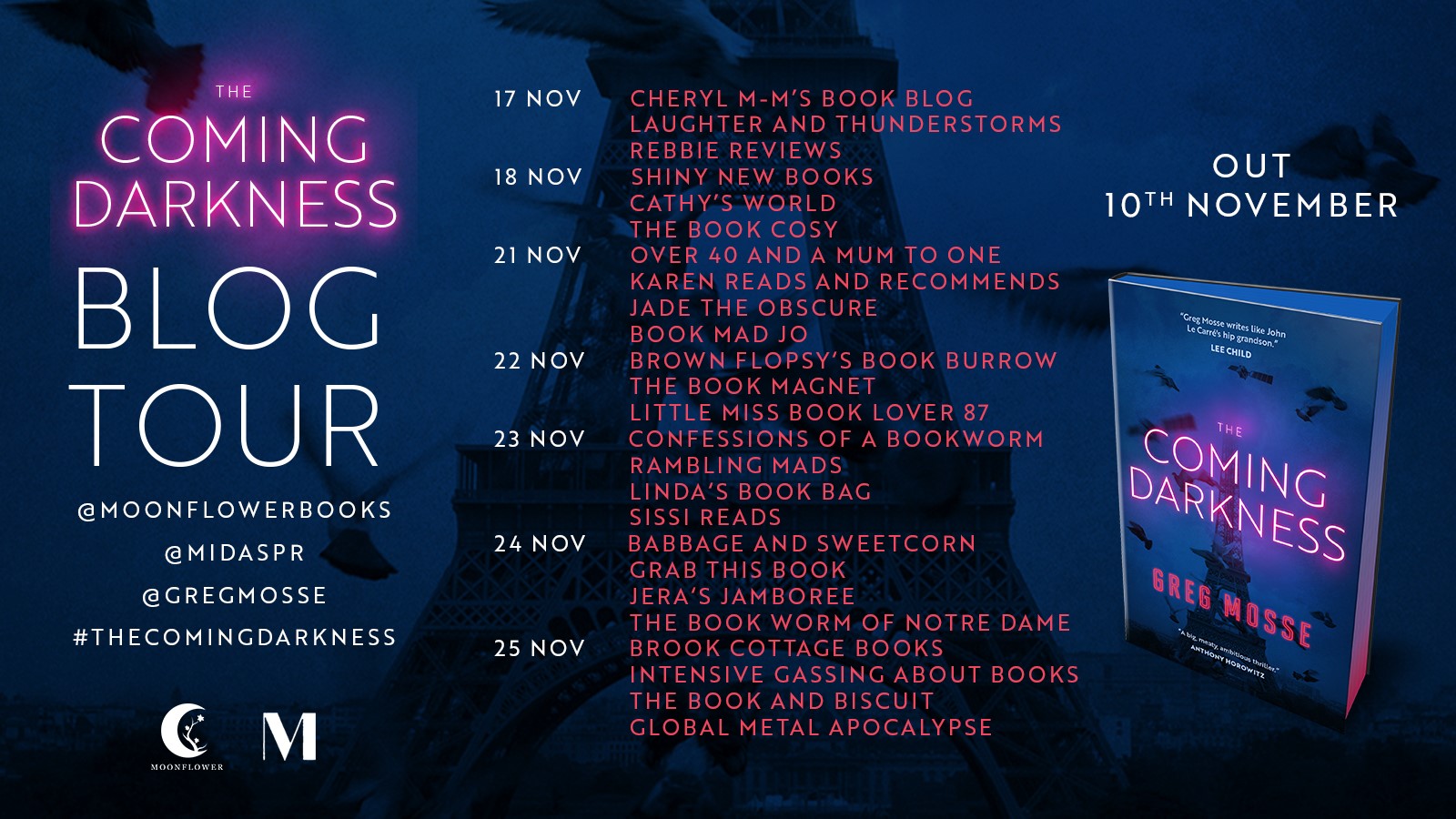
Midas PR Blog Tour: The Coming Darkness – Greg Mosse

“These so-called bleak times are necessary to go through in order to get to a much, much better place.”

— David Lynch

Welcome to my stop on The Coming Darkness blog tour. A big thank you to Sofia at Midas PR for the invitation to take part, and to Moonflower Publishing for the gifted copy of the book.

A little sidenote on the author…

Greg Mosse is an actor, director, and writer with a long career in the theatre producing plays and musicals. He is also husband to the bestselling author Kate Mosse. So, he had quite a lot to live up to when in 2020, he decided to take advantage of the unending stream of COVID lockdowns (for which I have nothing more to show than one short story) to fulfil a long-held ambition of producing his first novel – The Coming Darkness.

NB. I will confess to having never read any of Kate Mosse’s work – not even Labyrinth. It’s one for the ‘to read’ list.

Onto the book….

I’ve had a love of dystopian fiction, ever since taking a glorious module on ‘utopias and dystopia’ as part of my undergrad politics degree. And, while it’s unlikely anything modern will ever surpass Make Room! Make Room! or 1984 (though Naomi Alderman’s The Power was damn good), this sounded scarily relevant to what is going on in the world today, so I was very excited to give it a go. I was not disappointed.

Mosse’s The Coming Darkness is set just a few years into our own future, and all too familiar themes of infection control, quarantine, climate change, and extreme geopolitical unrest that make it feel more of a prediction of things to come than a work of fiction. A prophecy of the bleak future that awaits us as we carry on along a path of almost certain destruction.

Set in Paris in 2037, in a time of poverty, exclusion, and disease, with the earth tipping dangerously close to complete environmental collapse (uncanny isn’t it?), The Coming Darkness follows the tale of Alexandre Lamarque, a disillusioned French special agent on the hunt for eco terrorists.

Alex notices signs of a new terror group – one that is widespread and reaches the highest levels – but experience has taught him there is no one he can trust. In search of the truth, Alex follows a trail of clues through an ominous spiral of events – from a theft from Norwegian genetics lab and a sequence of brutal child murders, to a chaotic coup in Northern Africa.

Finally, the stories come together, and the full picture is revealed in the coming darkness. Looming like a spectre on the horizon, the darkness foretells a plot of global level destruction the likes of which the human race has never seen before. It’s up to Alex to try and stop it before it’s too late.

I will be honest and say that I struggled a little with the book at first. The author has quite a distinct style – fast paced, with short chapters rapidly switching between merging storylines, and there is an awful lot of scene setting in the preliminary sections, with a seemingly unending list of characters, and a huge amount of technical information. As such it was a bit difficult to try and tie everything together. That said, I persevered – and would thoroughly recommend other readers do the same, because you will be rewarded.

The Coming Darkness was a great read. The book would probably benefit from a cast list of bios to allow readers to look up characters mentioned in previous chapters (I certainly would have appreciated this), but this is really my only gripe. The plot was gripping, and well executed, and I certainly found it difficult to put down as I got further into the story.

On the whole, I would thoroughly recommend this book for anyone interested in discovering new thrillers, or looking for an exciting read to get them the darker months.

To find out more or to purchase a copy of the book please visit Moonflower Publishing online.

I was sent a free copy of The Coming Darkness in exchange for an honest review.
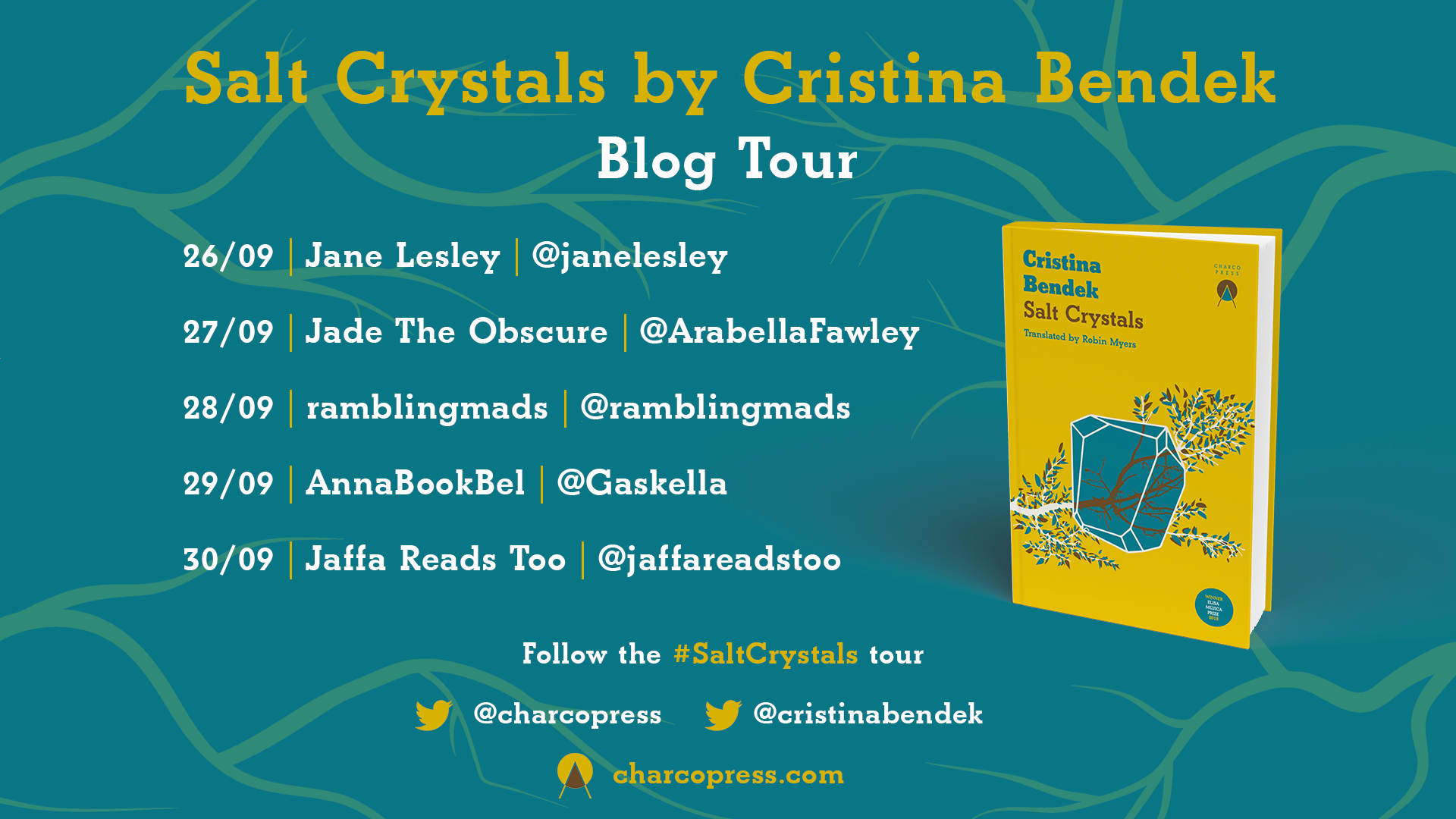
Charco Press Blog Tour: Salt Crystals – Cristina Bendek

“I think you travel to search and you come back home to find yourself there.”

― Chimamanda Ngozi Adichie

Another Spanish translation to add to the list – though so very different from the last.

The island of San Andrés, a little seahorse floating in the Caribbean Sea, is a troubled paradise. Officially part of Colombia, but much closer to the shores of Nicaragua, San Andrés is home to a rich mix of cultures – the native ‘Raizals’, themselves of European and African Descent, mix with Arab traders and Spanish-speaking tourists from the mainland.

The population of the eight-mile strip of land, a modest 20,000 in 1973, has ballooned in the last few decades, bringing drought and unrest. In the high season visitors from the mainland come in droves, and jumbo jets roar overhead as natives blockade the streets protesting a lack of water, but nothing changes for the better.

That’s how we were built: out of historical circumstance, a mysterious process that landed us all in this cooking pot, in this blockade, including the cachaco and the other mixed folks who chat and share the need and the spell of San Andres, who question and refuse.

Salt Crystals is the story of Victoria Baruq, an island native who, having spent many years living abroad in Mexico City, returns home following the breakdown of a relationship. She returns to the whitewashed house of her childhood, now empty, save for the pencil marks that she gouged into the banister as a child, and seeks to find her place in the world.

For Victoria, travelling back to San Andrés is a journey self-discovery. An insulin-dependent diabetic, she recites her upper and lower blood glucose levels like a mantra, seeking sugar hits in cemeteries, mango trees, and bakeries. Life on San Andrés is less certain, more unpredictable, and challenging – her supply of glucose monitors a constant reminder of her vulnerability.

Her appearance, inability to speak Creole, and time spent away from the island mean that most of the locals she meets assume she is from the mainland. She seeks to find out more about her originals, at the local library, ‘thinking rundowns’, and places undiscovered and perhaps unsafe. On a search for answers about her heritage she discovers some dark and uncomfortable truths.

‘Those places are dangerous.’ I was always told. But the whole island is my mother, I tell myself: I came out of the ocean and rose up here on the sand that’s existed for millions of years, through the blood of all my dead.

Salt Crystals is a complex book: think genealogical study meets political commentary in a poetic fever dream. A tale of discovery and understanding of one’s place in the world, shaped, but not dictated, by those that came before.

We belong to the Earth, and that’s what we need to honour: this rain that been everywhere for millions of years, the air we breathe, the ocean that’s the womb of absolutely everything. It’s true. I’ll never know the whole truth about my ancestors, the mind can’t connect the dots; that’s an impulse of the heart.

Translated from the original Spanish by Charco Press, and translator, Robin Myers, Salt Crystals (Los cristales de la sal) was first published in Colombia in 2019. To find out more or to purchase a copy of the book (in English or Spanish) please visit Charco Press online.

I was sent a free copy of Salt Crystals in exchange for an honest review.

Charco Press Blog Tour: The Forgery – Ave Barrera

“We all live in a house on fire, no fire department to call; no way out, just the upstairs window to look out of while the fire burns the house down with us trapped, locked in it.”

– Tennessee Williams

As a fan of translated fiction, and decade-long learner of Spanish, I’m not sure why it took me so long to pick up a Spanish translation – but I’m very happy to have rectified this, and even happier that my first dip into Mexican fiction was Ave Barrera’s The Forgery.

I’ve been burned by translated works in the past – and know that not all languages lend themselves well to an English translation – but I can’t deny that I was well and truly ready to fall in love with this book and I’m so relived to say that it did not disappoint.

I was drawn to The Forgery on a very personal level. Mexico as a country is very close to my heart – my husband’s family are from Mexico, and we recently honeymooned in Guadalajara, I’m also a huge fan of Mexican art (Frida Kahlo in particular) so The Forgery ticked all my boxes.

José Federico Burgos is a suffering artist turned copyist, and soon to be forger– any dreams he once had of making it big have failed, he is down on his luck and struggling to make rent, his beat-up truck and a half-pack of crackers the only possessions to his name. That is until he meets Horacio Romero.

Horacio is an antiques dealer, collector, and hoarder of fine things. At the very heart of Horacio’s collection is La Morisca, a splendid sixteenth-century panel, around which the very bones of his family home have been constructed. Horacio can offer José the money he needs to make all his problems disappear if he can create an exact forgery of La Morisca – perfect enough to fool ‘the heirs’.

At first wary of falling once more into the murky waters of forgeries, José is powerless to resist Horacio’s offer – or is it something else? – after first setting eyes on the magnificent altarpiece.

“Young man, do not look too long at that painting, or you will sink into despair”

The Forgery jumps between timelines: Ella Fitzgerald LPs and almond-scented memories in the dilapidated artist’s studio and confused fever dreams of painted flames in the high-ceilinged hallways of the city hospital give way to José’s entrapment and resulting surrealist nightmare.

I’ve no doubt that the Forgery is just as compelling in its native Spanish as in the translation by Ellen Jones and Robin Myers. It is authentic, unspoiled, and evidently very well researched, paying homage to many great Mexican artists and revealing the bloody secrets behind historical artistic techniques. The book comes alive – from the dusty, sun-stained streets, cafés, and cantinas of Guadalajara to La Tona’s tiled kitchen, the deserted pool, and the twisting jacaranda tree by Isabel’s French doors. I feel as though I could walk through the grounds of Horacio’s house – though you’ll understand my reluctance to enter the chapel. 

This curious novella will send you through a bizarre and dreamlike labyrinth where you encounter all manner of weird and wonderful characters – including a charming vagabond with toothache aptly named ‘Socket’ – and leave you desperately attempting to reach your own conclusions on the real story behind La Morisca within 170 short pages.

If you are a fan of the surreal, and up for asking a few questions that you may not find an answer to, then I would thoroughly recommend you add The Forgery to your ‘to read’ list.

Translated from the original Spanish by Charco Press, and accomplished translators, Ellen Jones and Robin Myers, The Forgery was originally published in Mexico to critical acclaim in 2016. To find out more or to purchase a copy of the book (in English or Spanish) please visit Charco Press online.

I was sent a free copy of The Forgery in exchange for an honest review.

GIVEAWAY ‘Bookmarked: How The Great Works Of Western Literature F*cked Up My Life’ by Mark Scarbrough

New York Times bestselling cookbook author Mark Scarbrough lays bare on his complicated, near-obsessive relationship with books in his new memoir: Bookmarked: How The Great Works Of Western Literature F*cked Up My Life.

Intrigued? Check out the except below for a taste of what’s in store.


Excerpt from BOOKMARKED: HOW THE GREAT WORKS OF WESTERN LITERATURE F*CKED UP MY LIFE

Copyright 2021 by Mark Scarbrough. Propertius Press All rights reserved.


Caution: A Preface

Stop me if you’ve heard this one before: “I found myself in Middlemarch!” Or “Shakespeare saved my life!”

I call bullshit. Shakespeare never saved anyone. Least of all, me. Although I sure wanted him to. Ached for him to, somewhere in the marrow middle of my bones. And not only him but all the other literary lions, like William Blake, Charlotte Brontë, and Henry James, now dead and mounted on the wall of Western culture.

I got sucked in by their promises, the best things. A once upon a time that leads logically to the end. Characters who remain true to themselves, despite what the plot throws at them. And desires that can be—ta-da!—fulfilled. Or at least understood.

And something more tangible, too. Down in my soul’s basement, where the lights are dim and my hopes are laid away in boxes, I dreamed up a mad quest through the great books to find a home. To hear the crackle in a fireplace. To feel the weight of the covers at night. To breathe in and out all that’s human and loved.

Maybe I should have lowered my sights. Maybe only the main character gets home. Problem is, I’ve always felt like a minor one: the sidekick in a baggy sweater, the wiseacre two desks down. The guy who steps into a story, pushes it along in some vague way, and gets a one-liner as his reward: Years later, I heard he died in a car crash.

Or maybe I asked so much from the great books because of my upbringing. When I was ten, my parents left the Southern Baptist church. “It is too liberal,” they said, seemingly in unison, a plainsong truth-telling that led us to the upland pastures of American fundamentalism. Letters were sent. Ministers were challenged. Friends were lost.

Don’t get me wrong. I didn’t latch onto the great books because they were forbidden. I never once read under the sheets with a flashlight. Oh, sure, I had to skip the sex scenes and turn a blind eye to the notion that a liberal could be the good guy. Authors! What can you do?

But nothing could befoul us. We were the true believers. We interpreted the Vietnam War, Nixon, and everything else as a story, a plot, rushing toward the apocalypse. The world sinned, it burned up, and we got out alive. Time was a straight line.

Once I started reading, I discovered that novels, stories, plays, and even poems were alternate timelines, descending and ascending like a grid. They even got to the same places we believed in: just deserts or happily ever after. For a long time, I wanted to homestead on that scaffolding, even though it kept coming apart and slamming to the ground. I just wasn’t myself without a book in my hand.

Then I wasn’t myself with one. Over time, books stopped being words outside my skin and became shadowy bits inside my brain, alternate versions of me, telling their own stories. I morphed into a bizarre body of shredded volumes, stalking the far country of my imagination. That’s how I saw a long-dead poet manifest in front of me one night. How I got a job fishing monks out of gay bars. And ultimately why I tossed the person I loved over the cliff of insanity in a hail Mary! attempt to save my own brain from dissolving like a cheap paperback in a deluge.

All of which is to say, be careful what you read. It can fuck you up, too.

But don’t worry. There’s a truth beyond the great works of Western literature. Life may seem linear, forceps to tombstone. Instead, the cosmos is round and elastic, spiraled and helixed. Atoms, galaxies, your DNA—they spin and come back around. I got out from under literature’s curse. You can, too.

So this story is a comedy, like Dante’s, if not so divine. But there’s no good news without the bad, which is part and parcel of it. In books, in life, even in the old poet’s journey across the universe, the way up starts with the way down.


Want to read more? Then I have good news for you – I have a free copy of Bookmarked to give away to one lucky reader! Simply comment on this post by midnight (GMT) or Sunday 16th January to be in with a chance of winning.

Happy commenting!