The road is rough
The Humanitarian – N Caraway
This month I have the pleasure to present to you a book I’ve been involved in re-releasing as well as reviewing –The Humanitarian. If you like the review then please head on over Amazon where the new edition is available to purchase on kindle and as a paperback.
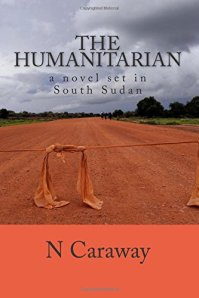
N Caraway was born in 1957 and grew up in a picturesque village in rural Cambridgeshire. In 2002 Caraway and moved to Nairobi, Kenya, and began working for the United Nations in South Sudan, experiencing the country during the final years of the Sudanese civil war. This experience sets the background for his first novel, The Humanitarian, which was published in 2012. There is little further information available about Caraway’s working life up to this point, but the flavour of the text gives a clear impression that this has been written by someone who has dedicated his life to working in places like those he describes and has, like so many others (Paul Theroux springs to mind), come to question the validity of what he and others like him are doing.
Through an ageing diary found abandoned in a B&B bedroom Caraway introduces the reader to Richards, an ageing United Nations official, beginning his final mission to a remote region in South Sudan. Richards is a troubled man who, as he draws closer to a life outside the bureaucracy of development, finds himself beginning to doubt his significance in the world of which he is a part. Feelings of detachment give way to memories of times long past, and almost forgotten. As his isolation deepens, so too does his despair in humanity, and his past threatens to crumple the carefully constructed cocoon of security within which he has encased himself. As the mission draws on, and Richards slips further and further into an abyss of isolation and self loathing, the chance of redemption arises in the form of an unlikely friendship with a young priest. Will this meeting be the aid Richards needs to rediscover his faith in humanity, or is it already too late?
I found this piece to be a very insightful read. Caraway was able to sketch a remarkably vivid representation of the camp, the area, and the struggles through the eyes of the disillusioned Richards. Perhaps it sounds clichéd, but at times I felt as though I was there, in the rank, stifling heat of Richards’ tent, as he lay awake with only his thoughts for company. The story sheds real, first person insight on the harsh and unforgiving environment of a war-torn landscape. Through Richards’ short diary, Caraway provides an insight into the inner workings of the UN, and the disillusionment felt by some of the aid workers at the core of the institution. As well as this, the book serves as an interesting analysis of the ideological implications involved in carrying out aid in remote areas which are not fully understood by the organisations involved.
Caraway’s medium serves as a live stream into Richards’ consciousness, as though Richards’ is projecting his mind onto the pages of his ‘yellow exercise book’. Caraway’s style is very distinct and unique, using evocative language and long, somewhat rambling yet eloquent sentences which provide an insight into the inner workings of Richards’ despair riddled mind:
‘The date is a hard, concrete element in the swaying flux that has swallowed me up and made me disappear. I can hold onto it, like a shipwrecked sailor holding onto a lifeline, or like Theseus in the labyrinth holding onto the thread that will guide him out, a thread that started in Nairobi and led through Loki and then out here into the darkness beyond.’
Years spent working for institutions providing aid for struggling communities has left Richard disillusioned, he has become apathetic, someone who no longer believes in the work of development agencies. Caraway has told a story I’m sure many people involved in development research and humanitarian aid can relate to. He describes the moral doubt in the work of which he is part, the self-questioning and more than anything else the overwhelming feeling of impotence in the face of suffering – the relentless provision of spontaneous food drops, and crude privies in the hope that the effects of these short term solutions will carry through to the long term.
‘I let my eyes travel round the circle of blank faces. Who were these people, how far had they come, how long had they waited for us to show up, and what did they really think this strange meeting was all about? These people were the real mystery, doubly isolated by language, strangers even to the Sudanese. I doubted they would benefit from any relief supplies, in any case. The distributions took place down below at the airstrip and they never went down there.’
Linked to Richards’ disillusionment are the haunting thoughts of his past, which invade his sleeping, and waking hours. Through Richards’ eyes Caraway using incredibly evocative language, allowing the reader a very personal insight into Richards’ despair over past events. You get the impression that perhaps, as The Humanitarian is based, somewhat on real experiences, that these may be thoughts which the author actually experienced himself. As a reader you become absorbed by Richards’ self-pity and self-loathing:
‘How did you approach him, this person, strong or naïve, whatever he was, who, unlike you, did not wake up every morning with a curse in the very taste of the saliva in his mouth, who did not wish God, if he existed at all, might rip the entrails out of your belly, rip your flesh apart in any way he chose, do whatever he wanted so long as it would stop the dreams from coming, stop the memories, just switch off the images that tormented you, with no promise of eternity, just the peace of an endless dark sleep, just the switch going off and a deep slow sigh escaping from your breast into the air.’
Richards’ saving grace – if I can even call it that, as the book is left very much open ended – comes in the form of a kind stranger. In Father Severino, Richards’ finds a kindred spirit of sorts, a person to whom, for some reason, he feels as though he can pour his heart out. In turn Father Severino seems to understand where the roots of Richards’ feelings of despair lie. For Richards, father Severino represents someone outside of everything. Not a part of his team, or the villagers requiring aid. He is a mutual third party, a kind stranger, who is able to listen, and to understand, when Richards’ most needs it:
‘There was an excitement inside me that kept out the dark and anticipated the arrival of Father Severino in his landcruiser. It was not just the trip, but something more, something about the man himself and the thought that we would meet and talk and the sure knowledge that our talk would take us far beyond the desultory exchanges that were all I ever managed with my colleagues or with Simon.’
Overall I found The Humanitarian to be a very thoughtful provoking piece, which offers the reader an insight into the Sudanese conflict, and the repercussions surrounding this, as well as the inner working of the organisations responsible for providing aid to these places. The Humanitarian is an incredibly powerful read, which will leave the reader asking questions, and with a desire to uncover more.
 I had a play around with Bing translator and one of my favourite poems – Rudyard Kipling’s The Way through the Woods . I didn’t run it through hundreds of times like Sutherland did, nor did I take words out in between translations and manipulate it in that way. I ran it through about 10 times, and then tidied the text up. If I have more time I might try following Sutherland’s process a little more carefully, but I’m still quite happy with the result I got from this one.
 Jade the Obscure